

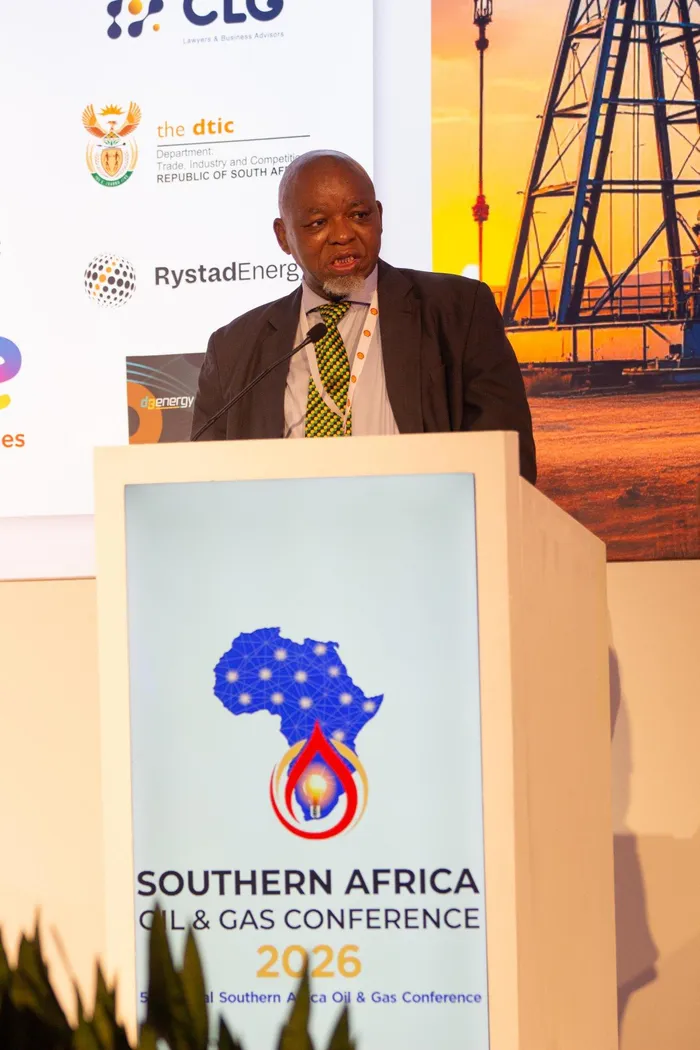
Mineral and Petroleum Resources Minister Gwede Mantashe speaking at the Southern Africa Oil and Gas Conference in Cape Town on Monday.
Image: Supplied
Mineral and Petroleum Resources Minister Gwede Mantashe has warned that significant fuel price increases may be unavoidable in the coming months due to global geopolitical tensions, but assured South Africans that government is working with industry to ensure uninterrupted fuel availability.
This comes as data from the Central Energy Fund's latest fuel price analysis indicate that motorists will in April feel a heavy hit at the pumps, with petrol showing a possible increase of about R4 a litre and diesel up to R6.75 a litre.
Experts also warn that the country’s dependence on imported crude, combined with dwindling local refining capacity, leaves it exposed to price spikes, supply disruptions, and even potential fuel rationing, despite official assurances that shortages are not imminent.
The government is yet to signal whether it will introduce any relief measures to cushion the blow. Brent crude futures rose to around $106 per barrel on Monday, the highest level since July 2022, following US strikes on military sites on Kharg Island as the Middle East conflict entered its third week.
Speaking at the Southern Africa Oil and Gas Conference in Cape Town on Monday, Mantashe said volatility in global oil markets — driven largely by geopolitical conflict in the Middle East — is placing pressure on countries that rely heavily on imported refined petroleum products.
Since the start of the conflict in the Middle East at the end of February, international fuel supply chains have experienced disruptions while price under-recoveries have continued to fluctuate, increasing the likelihood of fuel price adjustments in many importing countries.
Mantashe said these heightened geopolitical tensions continue to create uncertainty and volatility in the global oil markets.
“While questions remain about potential fuel supply disruptions, the reality is thatsubstantial fuel price increases are increasingly unavoidable,” Mantashe said.
“Countries that rely heavily on imports of refined petroleum products remain particularly vulnerable to global market shocks.”
South Africa imports a significant portion of its refined fuel requirements, making the domestic fuel price highly sensitive to global oil prices and supply disruptions.
Despite the looming price pressures, Mantashe stressed that government is actively engaging with fuel suppliers and industry stakeholders to secure adequate supply and prevent shortages in the domestic market.
He said the Department of Mineral and Petroleum Resources is currently working closely with industry players to explore multiple supply sources to ensure fuel continues to flow into the country without disruption.
“These engagements are aimed at ensuring uninterrupted fuel availability in the domestic market, without immediately utilising the country’s strategic reserves,” he said.
The minister added that the government is trying to maintain supply stability without having to immediately draw from South Africa’s strategic fuel reserves.
Energy security has become an increasingly important policy focus as the country grapples with limited local refining capacity and heavy reliance on imports.
Mantashe said the long-term solution to these vulnerabilities lies in expanding domestic petroleum exploration and production, which could help reduce South Africa’s dependence on imported fuel.
“This can only be achieved through the rigorous exploration and responsible exploitation of our own petroleum resources.”
BUSINESS REPORT