

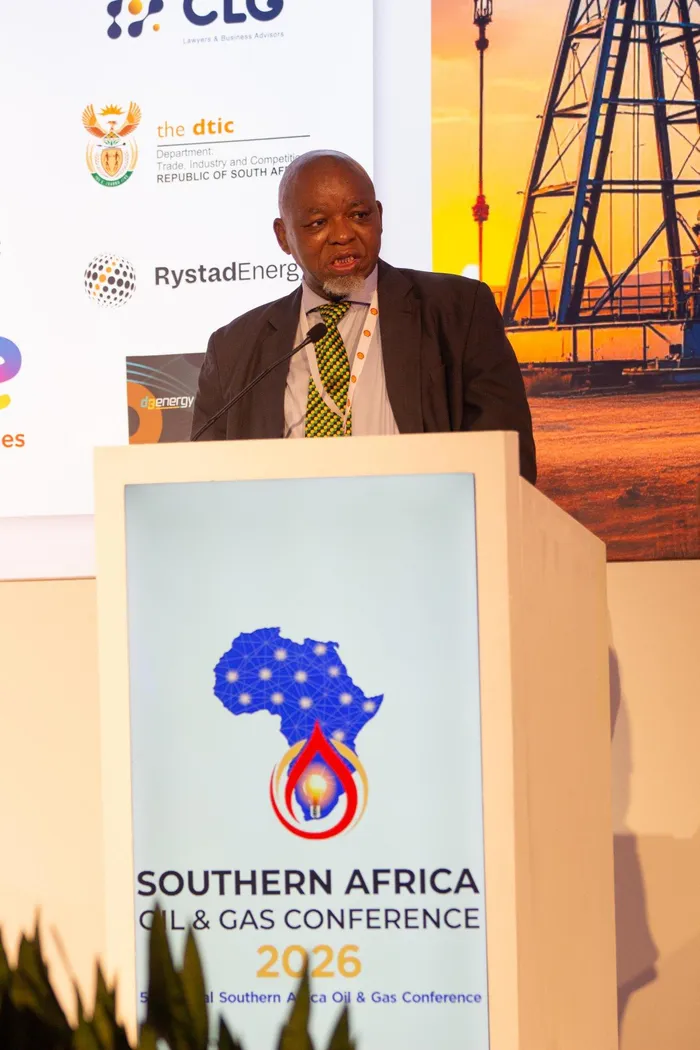
Mineral and Petroleum Resources Minister Gwede Mantashe speaking at the Southern Africa Oil and Gas Conference in Cape Town on Monday.
Image: Supplied
Mineral and Petroleum Resources Minister Gwede Mantashe has called for South Africa to accelerate domestic oil and gas production, arguing that developing the country’s own petroleum resources is the most sustainable long-term solution to energy security and rising fuel costs.
This comes as data from the Central Energy Fund's latest fuel price analysis indicate that motorists will in April feel a heavy hit at the pumps, with petrol showing a possible increase of about R4 a litre and diesel up to R6.75 a litre.
Speaking at the Southern Africa Oil and Gas Conference in Cape Town on Monday, Mantashe said global geopolitical tensions and disruptions to international supply chains have highlighted South Africa’s vulnerability as a country that relies heavily on imported refined petroleum products.
Mantashe warned that the ongoing conflict in the Middle East and volatility in global energy markets have placed pressure on fuel supply and pricing, exposing the risks faced by countries with limited domestic production capacity.
“To maintain product availability in our country, the department remains in constant engagement with industry players to explore all possible supply sources,” Mantashe said.
While these short-term measures are aimed at ensuring uninterrupted fuel supply, he stressed that the long-term solution lies in expanding domestic exploration and production.
“The sustainable long-term solution to our challenges lies in domestic production. This can only be achieved through the rigorous exploration and responsible exploitation of our own petroleum resources,” he said.
Mantashe highlighted South Africa's considerable untapped oil and gas potential, particularly in offshore basins such as the Outeniqua Basin and the Orange Basin, which has gained global attention following major oil discoveries in neighbouring Namibia.
Geological evidence suggests that these deposits could extend into South African waters, presenting an opportunity for the country to expand its energy resources and reduce reliance on imported fuels.
However, the development of the sector has been slowed by regulatory delays and legal challenges, including opposition from environmental lobby groups.
Mantashe said ongoing litigation and environmental objections have prevented the country from fully exploring and exploiting its petroleum resources.
“One of the biggest challenges facing the development of our petroleum sector remains the persistent opposition from environmental lobby groups who continue to block every oil and gas development initiative in our country,” he said.
The minister emphasised that the responsible development of oil and gas resources must balance environmental sustainability with economic growth and social development. South Africa’s Constitution, he noted, requires that natural resources be used in a way that supports both environmental protection and economic progress.
To unlock the sector’s potential, government is implementing several legislative and policy reforms aimed at creating a more enabling environment for exploration and production.
Government is therefore moving ahead with reforms such as the implementation of the Upstream Petroleum Resources Development Act aimed at unlocking petroleum potential.
In addition, Mantashe said the government is modernising the Petroleum Products Act and advancing the establishment of the South African National Petroleum Company to strengthen State participation in the sector.
Mantashe said expanding domestic refining capacity would also be crucial to improving energy security. Currently, the country relies mainly on facilities such as the Natref refinery, the Astron Energy refinery and the Sasol coal-to-liquids plant in Secunda to meet part of its fuel demand.
“South Africa must not stand on the sidelines while the global energy landscape evolves,” Mantashe said. “We must act decisively and responsibly to unlock the full potential of our petroleum sector.”
Meanwhile, Mantashe warned that significant fuel price increases may be unavoidable in the coming months due to global geopolitical tensions, but assured South Africans that government is working with industry to ensure uninterrupted fuel availability.
South Africa imports a significant portion of its refined fuel requirements, making the domestic fuel price highly sensitive to global oil prices and supply disruptions.
Mantashe said these heightened geopolitical tensions continue to create uncertainty and volatility in the global oil markets.
“While questions remain about potential fuel supply disruptions, the reality is that substantial fuel price increases are increasingly unavoidable,” Mantashe said.
“Countries that rely heavily on imports of refined petroleum products remain particularly vulnerable to global market shocks.”
BUSINESS REPORT