

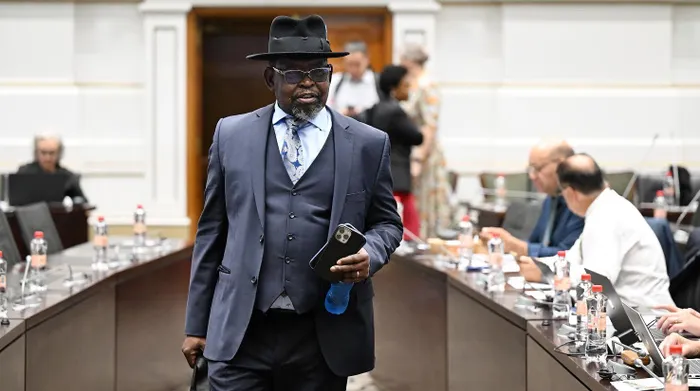
In a letter dated 13 March 2026 to committee chairperson Lynette van der Merwe, Finance Minister Enoch Godongwana said Treasury would not participate in the session, citing constitutional and procedural boundaries around accountability.
Image: Independent Media
South Africa’s efforts to improve menstrual health access came under scrutiny on Tuesday after the National Treasury declined to attend a crucial parliamentary briefing on the implementation of the Sanitary Dignity Programme (SDP).
The SDP has been a focal point of oversight in recent years, amid concerns about uneven implementation across provinces, delays in distribution, and instances of unspent funds being returned to the fiscus. The programme aims to provide free sanitary products to vulnerable learners, addressing period poverty and improving school attendance among girls.
The virtual meeting of the Portfolio Committee on Women, Youth and Persons with Disabilities is receiving updates from multiple departments, including the Department of Women, Youth and Persons with Disabilities, Department of Social Development, Department of Basic Education and National Treasury.
Tuesday’s briefing is expected to shed light on provincial expenditure trends over the 2024/25, 2025/26 and 2026/27 financial years, as well as ongoing coordination challenges between national and provincial governments.
Last year, Treasury told Parliament that provincial treasuries had returned more than R160 million in SDP funds to the fiscus over the past three years due to procurement delays, capacity issues and distribution mechanisms.
However, in a letter dated 13 March 2026 to committee chairperson Lynette van der Merwe, Finance Minister Enoch Godongwana said Treasury would not participate in the session, citing constitutional and procedural boundaries around accountability.
Godongwana argued that responsibility for reporting on programme implementation and spending lies with the relevant line departments and their executive authorities.
He emphasised that departments administering the SDP — particularly women, education and social development — are best positioned to provide a “comprehensive update” on progress, expenditure and performance challenges.
“In this regard, the Department of Women, Youth and Persons with Disabilities, working closely with the Premiers’ Offices and provincial departments of Social Development and Education, is best placed to provide the Committee with a comprehensive update on the implementation of the SDP and any associated spending or performance challenges,” Godongwana said.
The minister also underscored that accounting officers within departments are legally mandated to ensure funds are used efficiently and in compliance with the Public Finance Management Act.
As such, questions around underspending, provincial allocations and service delivery outcomes should be directed to those departments rather than Treasury.
Treasury’s role, he added, is primarily focused on fiscal policy, budget allocation and overall public finance management, with accountability exercised through Parliament’s appropriations and finance committees rather than sector-specific portfolio committees.
“As Minister of Finance, I report to Parliament primarily through the Standing and Select Committees on Appropriations and Finance on matters relating to budget allocations, fiscal policy and the overall management of public finances,” Godongwana said.
“This delineation of responsibilities is consistent with parliamentary oversight protocols, and I have previously communicated this understanding to both the Speaker of the National Assembly and the Chairperson of the National Council of Provinces.”
Despite declining the invitation, Godongwana reaffirmed his commitment to supporting parliamentary oversight and maintaining transparency in public finances. He said clearly defined institutional roles were essential to preserving accountability across government.
“I remain committed to supporting Parliament’s essential oversight work and to strengthening transparency and accountability in public financial management. Clearly defined roles and responsibilities are critical to the integrity of the system as a whole,” he said.
“Given the above, and taking into account National Treasury’s scheduled commitments across several parliamentary committees responsible for budget oversight, I regret to advise that National Treasury will be unable to attend the meeting on 17 March 2026.”
With Treasury absent, the spotlight is likely to fall more heavily on frontline departments to account for delivery gaps and ensure that the programme meets its social and developmental objectives.
BUSINESS REPORT