

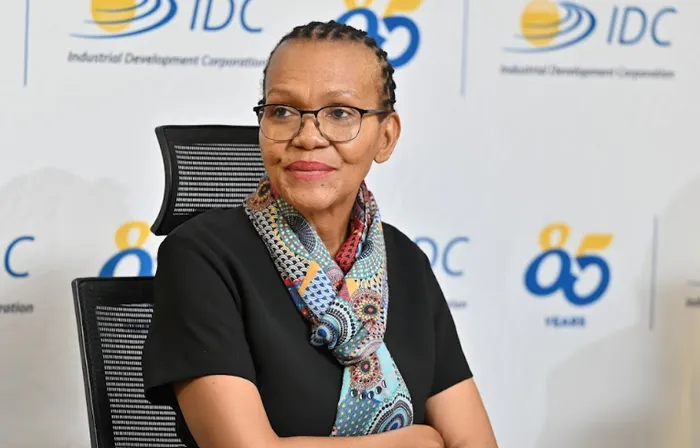
Mmakgoshi Lekhethe is the CEO of the Industrial Development Corporation. Nafcoc last month presented to Parliament allegations that the State financier was discriminating against black-owned enterprises and deviating from its transformation mandate.
Image: Supplied
The Industrial Development Corporation (IDC) has reaffirmed its commitment to transformation, inclusive industrialisation and support for black entrepreneurs, as scrutiny intensifies over its funding decisions and internal processes.
This comes after the National African Federated Chamber of Commerce and Industry (Nafcoc) last month presented to Parliament allegations that the State financier was discriminating against black-owned enterprises and deviating from its transformation mandate.
Nafcoc claimed that some businesses were aggressively pursued for funding, only to later face harsh enforcement measures when they encountered financial distress.
In a statement on Wednesday, the IDC acknowledged growing public debate and stakeholder concerns regarding its due diligence, evaluation systems and broader role in advancing economic inclusion.
“As South Africa’s leading State-owned development finance institution, the IDC recognises the importance of these conversations,” the corporation said, adding that it remains committed to engaging constructively and strengthening how it delivers on its mandate.
The corporation said this commitment is embedded in its Corporate Plan for 2025/26 to 2027/28, which prioritises inclusive growth, transformation and support for underserved entrepreneurs.
Central to the IDC’s defence is its funding track record. Over the past two financial years, the institution said approximately 88% of its funding allocations—both in volume and value—were directed toward black-owned businesses and black industrialists.
In the 2024/25 financial year alone, transformation-focused funding approvals reached R26.6 billion. This included significant support for women- and youth-owned enterprises and contributed to the creation and preservation of more than 15,000 jobs.
The IDC said these figures demonstrated its continued contribution to broad-based economic participation and inclusive growth, particularly in sectors aligned with localisation, beneficiation and industrial expansion.
However, the corporation also clarified how its funding processes work, emphasising that it operates as a development finance institution rather than a traditional lender.
“The IDC’s role extends beyond receiving and processing applications,” it said. “We actively support businesses through a structured, growth-oriented process.”
This process typically begins with an initial screening and evaluation, followed by pre-investment support to strengthen business proposals where necessary. Applications are then subjected to rigorous due diligence, assessing commercial viability, developmental impact and long-term sustainability.
The IDC stressed that extended engagement with applicants should not be interpreted as a guarantee of funding approval. Instead, it said this reflects the institution’s developmental approach and responsibility to ensure that investments are both viable and impactful.
Where applications are unsuccessful, the IDC said it provides feedback to applicants to explain the reasons behind the decision.
Amid calls for greater accountability, the corporation outlined steps it is taking to improve transparency and oversight. These include the development of an independent compliance and review mechanism, expected to be launched by June 2026.
The new system will assess objections and complaints related to funding decisions, providing a structured and impartial process for addressing stakeholder concerns. The IDC said the initiative is aimed at strengthening trust and reinforcing its commitment to fair and responsible decision-making.
The announcement comes at a time when development finance institutions are under increasing pressure to demonstrate both financial sustainability and developmental impact, particularly in a challenging economic environment marked by slow growth and rising unemployment.
While critics have questioned whether the IDC’s practices fully align with its transformation mandate, the institution maintained that its funding outcomes and strategic priorities reflect a clear commitment to inclusive industrialisation.
Looking ahead, the IDC said it will continue to engage with stakeholders, refine its processes and focus on delivering measurable impact through job creation and economic participation.
“The Corporation remains committed to its role as a developmental finance institution, partnering with entrepreneurs, supporting industrial growth, and contributing meaningfully to South Africa’s transformation agenda,” it said.
Meanwhile, Parliament has agreed to establish a formal inquiry into the affairs of the IDC as portfolio committee chairperson Mzwandile Masina said MPs were deeply concerned by the allegations and the case studies presented.
“It appears that the IDC has not effectively embedded issues of transformation in its business processes and may need to reform how it provides financial and non-financial support, especially to black businesses,” Masina said.
“We are persuaded and broadly agree that there is a need to initiate an inquiry regarding the IDC business practices in relation to economic transformation, as there may be a wider problem within the IDC.”
BUSINESS REPORT