

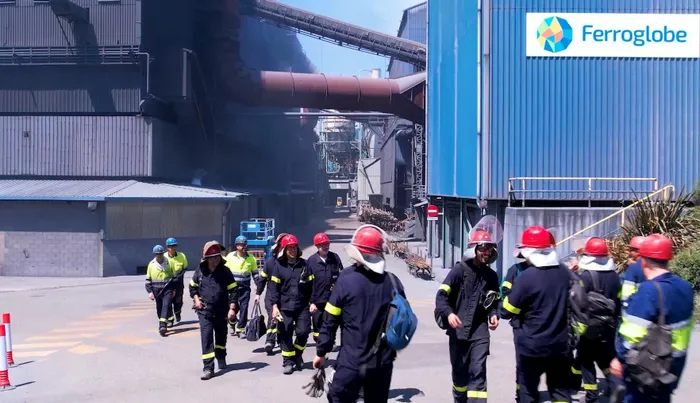
The potential shutdown would have devastating consequences for employment and local economies. While Ferroglobe South Africa directly employs 275 permanent staff, it also relies on 288 long-term contractors and supports nearly 4,000 indirect jobs.
Image: Supplied
Ferroglobe South Africa has issued a stark warning that it may be forced to shut down all its local operations within days, citing unsustainable electricity price increases that have rendered its business model unviable.
In a statement released on Monday, the company said it would have “no option” but to halt production across its facilities unless reduced electricity tariffs are approved before 1 April 2026.
The looming deadline coincides with a further Eskom tariff hike of nearly 9%, which the company said will deepen already severe financial losses.
The announcement adds to growing concerns about the impact of rising energy costs on South Africa’s industrial base, particularly energy-intensive sectors such as mining, metals and manufacturing, which are increasingly struggling to remain globally competitive.
Last month, Eskom granted the Glencore-Merafe Chrome Venture and Samancor Chrome a 62 cents per kilowatt-hour tariff as a relief measure to secure about 11,000 jobs and reopen 69 smelters by the end of the year.
However, leading producer of manganese ferroalloys Transalloys also warned that its future hangs in the balance and it may be forced to retrench up to 600 workers due to higher electricity tariffs in the smelting sector.
Ferroglobe has operated in South Africa since 1997 and has built a significant industrial footprint over nearly three decades. Its assets include the Polokwane silicon metal smelter and the eMalahleni ferrosilicon smelter, the latter marking its 100th year of operation in 2026 and long regarded as central to the economic development of the surrounding region.
However, the company said the economics of operating in South Africa have deteriorated sharply. Electricity prices have surged by approximately 900% since 2007 and now account for more than half of total production costs.
This has pushed production costs above selling prices, leaving the company at a significant disadvantage compared to international competitors, some of whom benefit from electricity prices up to 75% lower.
The situation has been compounded by the emergence of competing facilities in neighbouring countries, where more competitive energy pricing has attracted industrial investment away from South Africa.
Ferroglobe warned that without urgent intervention, it may be forced to relocate production to its international operations, where conditions are more favourable.
The potential shutdown would have devastating consequences for employment and local economies. While the company directly employs 275 permanent staff, it also relies on 288 long-term contractors and supports nearly 4,000 indirect jobs.
Beyond this, its charcoal division sustains an estimated 60,000 indirect livelihoods across community-based operations, many of which are linked to environmental rehabilitation efforts such as the clearing of invasive plant species.
The company has already taken steps to scale back operations in recent years. In 2024, it placed its Polokwane smelter under care and maintenance shortly after restarting it, triggering a Section 189 process that affected more than 300 workers and contractors. Production at its Witbank facility has also been reduced by 30%.
Marco Levi, Levi, CEO of Ferroglobe, described the situation as critical, warning of the broader social and economic fallout if operations cease.
“This is an extremely difficult moment for Ferroglobe South Africa and for the thousands of families and communities that depend on our operations,” Levi said.
“We have invested consistently in this country for nearly three decades and remain committed to South Africa’s industrial future. However, no business can survive energy costs that have risen at this scale.”
He added that the company remains open to engagement with government and other stakeholders to find a sustainable solution.
“We stand ready to work with all stakeholders to find a viable long-term solution that preserves jobs, supports communities and allows this strategic sector to continue contributing to the South African economy,” he said.
Ferroglobe stressed that a shutdown is not its preferred outcome, noting that it has absorbed losses for several years in an effort to maintain operations and protect jobs. However, it said the current electricity pricing structure has made continued operations untenable.
If no agreement is reached, the company warned that it would extend the Section 189 process to all remaining employees, with potential dismissals expected to take effect from June 2026.
BUSINESS REPORT