

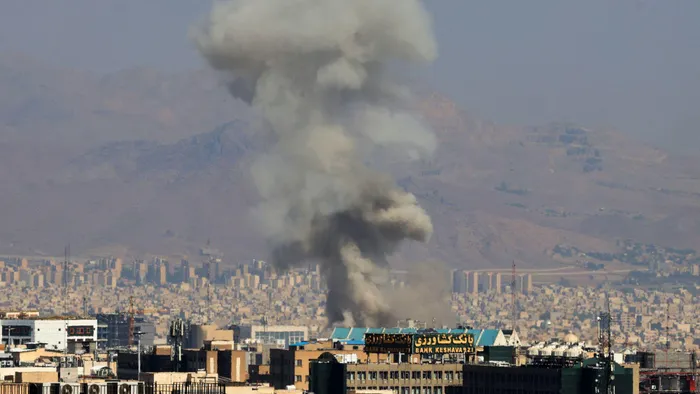
Energy-intensive sectors such as airlines, chemicals and manufacturing are particularly vulnerable, as rising fuel costs squeeze margins and reduce demand.
Image: Atta Kenare / AFP
A prolonged conflict in the Middle East, centred on Iran, could tip the global economy into a rare and synchronised recession, while already triggering fuel supply concerns in South Africa.
According to new modelling by Oxford Economics released on Friday, the world economy faces a sharp slowdown if disruptions to energy flows persist, particularly through the Strait of Hormuz, a critical artery for global oil trade.
“Under our prolonged war scenario, global inflation would rise to 7.7%, close to the 2022 peak,” said Ben May, director of global macro research at Oxford Economics.
“The magnitude of this price spike triggers large non-linearities that magnify the economic impact, resulting in a rare contraction in global activity in mid-2026.”
The scenario assumes oil prices surge above $150 per barrel for several months, with Brent crude peaking near $190. This would not only fuel inflation but also disrupt supply chains, weaken financial markets and reduce global demand.
As a result, global GDP growth is projected to slow to just 1.4% in 2026, well below recent averages, before only modestly recovering to 2.1% in 2027. Major economies, including the United States and Europe, are expected to fall into recession, while China’s growth could drop to 3.4%.
The shock is being transmitted primarily through energy markets.
Moody’s analysis on Friday showed that prolonged disruption in the Middle East would keep oil and gas prices elevated, strain supply chains, and tighten financial conditions globally.
Energy-intensive sectors such as airlines, chemicals and manufacturing are particularly vulnerable, as rising fuel costs squeeze margins and reduce demand. At the same time, higher transport and logistics costs are feeding into food prices, compounding inflationary pressures worldwide.
For South Africa, the global turmoil is already having tangible effects.
Western Cape Premier Alan Winde on Sunday warned of emerging fuel supply disruptions, raising concerns about hoarding and market manipulation.
“Withholding supply places the economy and livelihoods, especially in the province’s agriculture sector, at great risk,” he said.
Diesel shortages are of particular concern, given their central role in agriculture, logistics and industry. The sector accounts for more than half of South Africa’s exports, making it highly sensitive to fuel disruptions.
While the Fuel Industry Association of South Africa has indicated that national supply remains sufficient, localised shortages suggest bottlenecks in distribution or opportunistic behaviour by suppliers.
Authorities, including the Competition Commission, have warned that price gouging is illegal and subject to prosecution.
The government is expected to announce a massive fuel price adjustment for April, with petrol expected to surge by nearly R6 per litre and diesel by close to R10 per litre as a result of soaring Brent crude oil price and a weaker rand.
Brent crude rose past $112 per barrel on Sunday, resting their highest level since June 2022 as fresh disruptions in the Strait of Hormuz overshadowed diplomatic gestures.
However, the National Treasury and the Department of Mineral and Petroleum Resources are yet to announce any fuel price relief measures as the increases will cripple households, destroy small businesses, and send food and transport costs through the roof.
Globally, the risks are escalating beyond fuel prices alone. The Oxford Economics scenario highlights how shortages of refined products like diesel and jet fuel could paralyse transport systems, disrupt trade and reduce economic activity. Shipping costs have already surged, and further increases could make it uneconomical to move low-value goods.
“Diesel shortages could be even more disruptive, since diesel is the main fuel for commercial transport and parts of industry,” May noted. “Shortages and price rises would have a much broader effect on business activity, supply chains, and inflation.”
Financial markets are also expected to come under pressure. Equity markets typically react negatively to oil shocks, and the S&P 500 is projected to enter bear market territory under this scenario, further dampening consumer spending.
Central banks face a difficult balancing act. While inflation is surging, weakening economic activity may limit their ability to raise interest rates aggressively. Diverging policy responses, particularly between the US Federal Reserve and European central banks, could add further volatility to global markets.
The South Africa’s central bank last week opted for caution, keeping interest rates unchanged as escalating tensions in the Middle East inject fresh uncertainty into the inflation and growth outlook.
BUSINESS REPORT