

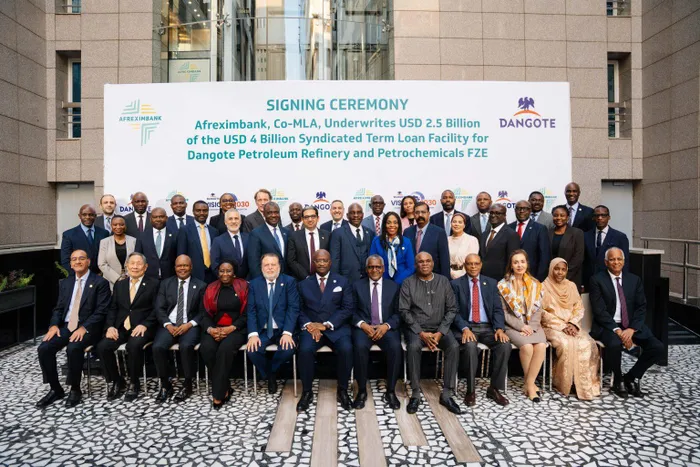
Dr. George Elombi, President and Chairman of the Board of Directors, Afreximbank, and Aliko Dangote, President/CEO, Dangote Industries Limited, joined by Afreximbank Board members and the Bank’s executive leadership during the signing ceremony in Cairo, Egypt.
Image: Supplied
The African Export-Import Bank (Afreximbank) has reinforced its role as a key financier of Africa’s industrialisation drive by underwriting $2.5 billion of a $4bn syndicated term loan for the Dangote Petroleum Refinery and Petrochemicals, in one of the continent’s largest energy financing deals.
With Afreximbank’s backing, the project is now better positioned to deliver on its promise of transforming Africa’s energy landscape—while setting a precedent for future mega-deals driven by African capital and ambition.
The five-year facility, arranged alongside Access Bank as co-mandated lead arranger, will be used to consolidate existing debt, optimise the refinery’s capital structure, and support its long-term growth ambitions. The deal also signals strong investor confidence in Africa’s largest refinery, which has a production capacity of 650,000 barrels per day.
Located in Nigeria, the Dangote refinery is widely regarded as a transformative project for the continent’s energy sector. By significantly expanding local refining capacity, it aims to reduce Africa’s dependence on imported petroleum products while strengthening energy security and supporting intra-African trade.
Afreximbank’s $2.5 billion contribution represents the largest share of the syndication, underscoring the bank’s strategic focus on backing large-scale, high-impact industrial projects. The institution has been a long-standing supporter of the refinery, having previously provided a $1 billion working capital facility following the start of refining operations in February 2024.
The bank also played a key advisory role in the “Naira-for-Crude” initiative, which enables the refinery to purchase crude oil and sell refined products in local currency. The initiative is seen as a critical step in reducing reliance on foreign exchange and stabilising domestic energy markets.
Dr George Elombi, president and chairman of Afreximbank, described the financing as part of a broader commitment to supporting African-led development.
“We take immense pride in being the single largest provider of financing to the Dangote Group. We do so primarily because Dangote is African,” Elombi said. “When we invest in ourselves, we do more than create jobs and wealth or expand government revenues; we build a secure and resilient future for our continent.”
He noted that Afreximbank has invested approximately $15bn in the Dangote Group since 2015, highlighting the scale of its long-term partnership with one of Africa’s largest industrial conglomerates.
Elombi emphasised that supporting African enterprises is central to achieving economic self-sufficiency.
“Afreximbank and its Board of Directors stand ready to support the realisation of Dangote Group’s aspirations because when we build our institutions and provide the requisite support to grow, we will no longer have to look elsewhere for benevolence or salvation in difficult times.”
The financing has been welcomed by Aliko Dangote, president and CEO of Dangote Industries, who described it as a critical step in strengthening the refinery’s financial position.
“This financing marks an important step in strengthening the financial foundation of Dangote Petroleum Refinery and Petrochemicals and positions the business for the next phase of its growth,” Dangote said.
“We appreciate Afreximbank’s continued support and confidence in our vision to build world-class industrial capacity that serves Nigeria, Africa and global markets.”
The transaction attracted strong participation from a consortium of African and international financial institutions, reflecting growing confidence in both the refinery and the broader African industrialisation agenda.
Beyond its immediate financial impact, the deal is expected to have far-reaching economic implications. By boosting local refining capacity, the Dangote refinery could significantly reduce fuel import bills across the continent, improve trade balances, and stabilise fuel supply chains.
It also aligns with broader efforts to promote intra-African trade under frameworks such as the African Continental Free Trade Area (AfCFTA), by enabling the movement of refined petroleum products within the continent.
Industry analysts say the scale and structure of the financing demonstrate increasing maturity in Africa’s capital markets, with regional institutions playing a leading role in mobilising funding for large infrastructure and industrial projects.
As Africa seeks to accelerate industrial growth and reduce external dependencies, the Dangote refinery stands as a flagship example of what can be achieved through coordinated investment and long-term vision.
BUSINESS REPORT