

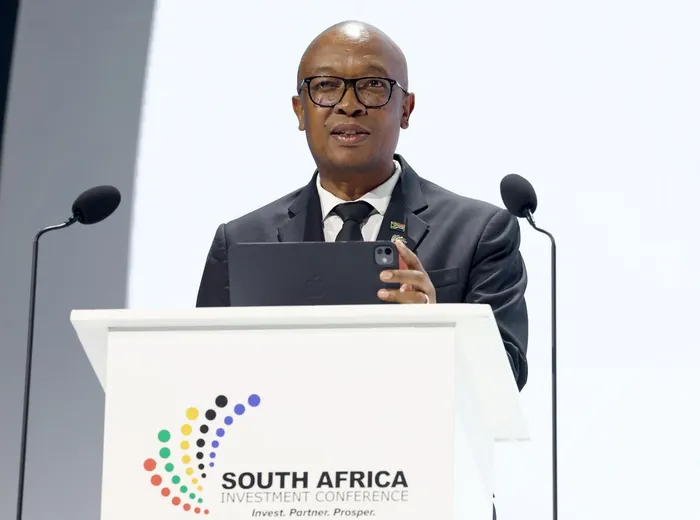
Minister of Trade, Industry and Competition, Parks Tau, delivering the welcome address at the 6th South African Investment Conference on Tuesday.
Image: Supplied
South Africa is entering a new phase of economic recovery and expansion, with Trade, Industry and Competition Minister Parks Tau declaring that the country has “turned the corner” on both trade and investment.
Delivering the welcome address at the 6th South African Investment Conference on Tuesday, Tau struck an optimistic tone, positioning the country as a resilient and competitive destination for global investors despite a volatile international environment.
“Our message today is clear: South Africa is open, South Africa is ready, and South Africa is an investment destination of choice,” Tau said.
The minister acknowledged that global trade conditions have become increasingly uncertain, with rising protectionism and disruptions affecting open economies like South Africa. However, he emphasised that the country has responded with agility rather than retreat.
“We have learned that complexity is not a reason for paralysis, but rather it is a prompt for action. When the status quo was upended in April 2025, many predicted a reckoning. The prognosis was steep,” Tau said.
“Tens of thousands of jobs in citrus, wine,and vehicle manufacturing in South Africa were said to be atrisk. Economists estimated the tariff shock could shave off measurable points of growth. It was, in the parlance of the moment, a crisis.”
Central to this response is the so-called “Butterfly Strategy,” which has seen South Africa redirect its trade efforts toward high-growth markets across Africa, Asia, the Middle East and Latin America. Through initiatives such as the Export Support Desk, affected exporters have been assisted in finding alternative markets.
A key breakthrough has been the signing of the China-Africa Economic Partnership Agreement (CAEPA), which will provide South African exports with duty-free access to a massive consumer market. Full zero-tariff treatment for goods entering China is expected to take effect from 1 May 2026.
Tau also highlighted strengthened ties with Europe through the Clean Trade and Investment Partnership, signed by Cyril Ramaphosa and European Commission President Ursula von der Leyen in 2025. The agreement has already unlocked an investment package of nearly R230 billion focused on energy transition, digital infrastructure and industrial development.
On the African continent, South Africa continues to play a leading role in advancing the African Continental Free Trade Area (AfCFTA), which Tau described as moving from “aspiration to implementation.” The country has intensified trade engagements across multiple African markets, yielding tangible gains for local manufacturers.
Beyond trade, Tau underscored the importance of translating investment pledges into real economic activity. Since the launch of the investment conference initiative in 2018, more than 300 projects have been initiated, with 161 either completed or under construction. Over R600 billion has already been channelled into the economy.
He cited major projects such as the Platreef Mine in Limpopo, which employs more than 2,000 workers, and BMW’s R4.2 billion investment in electrifying its Rosslyn plant in Tshwane as evidence of tangible progress.
“At this Sixth Conference, the pipeline continues in the same vein. Every announcement that will be made today has been vetted, signed by a company executive, and backed by board approval and confirmed funding,” Tau said.
Looking ahead, the government’s economic strategy will be anchored on three pillars: diversification, decarbonisation and digitalisation. These priorities are aimed at strengthening industrial capacity, supporting the energy transition and enhancing competitiveness in a digital global economy.
Tau acknowledged that challenges remain, particularly regulatory delays that can hinder investment. To address this, government has established a dedicated “Fusion Centre” to identify and resolve bottlenecks in real time, alongside plans for legislative reforms to fast-track approvals and streamline processes.
Despite these constraints, Tau insisted that South Africa’s fundamentals remain strong, backed by policy certainty, institutional capacity and a clear development agenda.
“We are not asking you to take a leap of faith. We are inviting you to follow the evidence. Come and invest with us. Come and partner with us. And together, let us prosper,” he said.
BUSINESS REPORT