

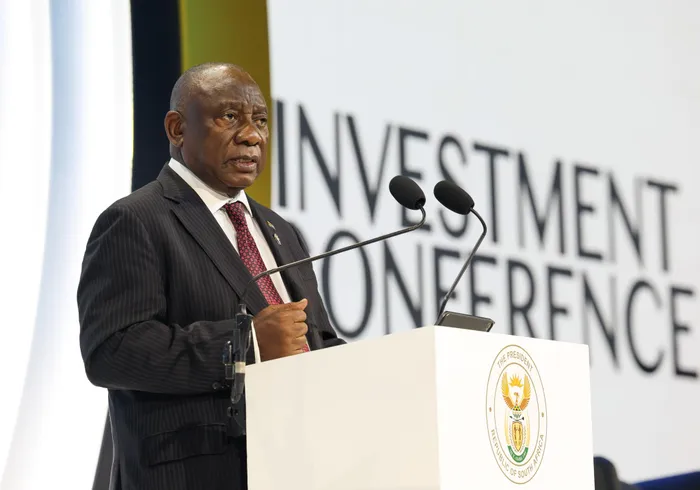
President Cyril Ramaphosa delivered the keynote address during the Sixth South Africa Investment Conference (SAIC) held in Johannesburg on Tueday.
Image: Supplied/GCIS
President Cyril Ramaphosa has placed sweeping reforms in South Africa’s electricity sector at the centre of the country’s investment drive, signalling a decisive shift towards large-scale renewable energy and a more competitive power market.
Speaking at the 2026 South African Investment Conference on Tuesday, Ramaphosa said the transformation of the energy sector has been one of the most significant achievements of government’s broader economic reform agenda, unlocking billions of rand in new investment and restoring confidence among investors.
“The electricity sector has undergone the most significant transformation since the advent of democracy,” Ramaphosa said, outlining structural changes aimed at stabilising supply and attracting private capital.
The central pillar to these reforms has been the restructuring of Eskom and the establishment of a National Transmission Company as an independent grid operator. This shift has introduced a rules-based framework for grid access, an essential requirement for private sector participation in power generation.
Ramaphosa said these changes, combined with the Energy Action Plan introduced in 2022, have helped bring an end to load shedding and restored reliability to the national grid, long seen as a major constraint on economic growth.
The reforms have already unlocked a substantial pipeline of investment in renewable energy. According to Ramaphosa, more than 220GW of renewable energy projects are currently in development, with 36GW already progressing through grid connection processes.
Over the next five years, South Africa is set to roll out massive new solar, wind and battery storage capacity, positioning the country at the forefront of the global energy transition. This expansion is expected to significantly reduce energy costs while supporting industrial growth and environmental sustainability.
“Over the next five years, we will add massive new solar, wind and battery storage capacity to transition our economy towards cheap, green energy sources at scale,” Ramaphosa said.
“We are now moving rapidly to establish a competitive wholesale electricity market and to complete the unbundling of Eskom, through the establishment of a fully independent transmission operator.”
In a further step to attract capital, South Africa is enabling private investment in transmission infrastructure for the first time through Independent Transmission Projects. This is expected to accelerate the expansion of the grid, which is critical to integrating new renewable energy capacity.
“We are moving to enable private investment in expanding our transmission network through Independent Transmission Projects for the first time,” Ramaphosa said.
“Transitioning to a low-carbon, climate-resilient economy and society remains a priority, and is in line with our international climate commitments as well our ambitious Nationally Determined Contribution (NDC) to combat climate change.”
Ramaphosa emphasised that these reforms are not only about energy security but also about economic opportunity. The transition to a low-carbon economy is expected to drive the emergence of new industries, including green hydrogen, electric vehicle manufacturing and battery storage.
“Decarbonisation will create new industries, new jobs, and new opportunities,” he said, noting that South Africa’s abundant mineral resources, particularly platinum group metals, manganese and chrome, position the country as a key player in the global clean energy supply chain.
Ramaphosa also pointed to confirmed renewable energy investments of R29 billion as evidence of growing investor confidence in the sector.
These developments form part of a broader structural reform programme led by Operation Vulindlela, a joint initiative between the Presidency and National Treasury aimed at reducing the cost and risk of doing business in South Africa.
By removing regulatory bottlenecks, streamlining approvals and opening key sectors to competition, government aims to create a more conducive environment for investment-led growth.
Ramaphosa stressed that reliable and affordable energy is foundational to economic expansion, enabling industries such as manufacturing, mining and agriculture to operate more efficiently and compete globally.
He said the energy sector reforms will play a pivotal role in attracting both domestic and foreign investment.
With a new investment target of R2 trillion over the next five years, Ramaphosa said South Africa is building the infrastructure and policy certainty needed to support long-term growth.
“We are creating the conditions for investment-led growth that is broad-based, inclusive and durable,” he said.
BUSINESS REPORT