

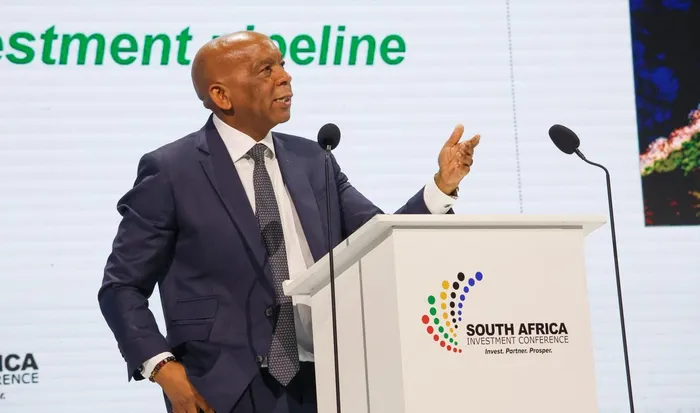
Minister of Electricity and Energy Kgosientsho Ramokgopa, speaking at the 6th South Africa Investment Conference, Ramokgopa, laid out what he described as a data-driven case for why investors seeking strong returns should look to South Africa’s energy sector.
Image: Supplied/GCIS
South Africa has positioned itself as one of the world’s most attractive destinations for renewable energy investment, with Minister of Electricity and Energy Kgosientsho Ramokgopa telling investors that the country offers a rare combination of natural resource abundance, political stability, and growing demand.
Speaking at the 6th South Africa Investment Conference, Ramokgopa laid out what he described as a data-driven case for why investors seeking strong returns should look to South Africa’s energy sector.
“I do imagine that when you make investment, it is not driven by affinity for one country over the other, but is a subject of anticipated returns,” Ramokgopa said.
At the heart of his argument is South Africa’s exceptional renewable energy potential.
Ramokgopa pointed to global research identifying just five regions worldwide with the highest solar yield, placing the Northern Cape-Namibia corridor alongside Chile, the Australian outback, the Sahara Desert, and parts of the Gulf.
“These are areas with the highest global horizontal irradiation,” he explained, referring to the amount of solar energy received per unit area. South Africa, he said, can reach levels of up to 2,700 kilowatt hours per square metre, placing it firmly among the global leaders.
Wind energy offers a similarly compelling case. Coastal regions, particularly in the Eastern Cape, Western Cape, and parts of the Northern Cape, can achieve wind speeds of up to 10 metres per second, further strengthening the country’s renewable energy mix.
“So essentially, your returns are guaranteed to invest in South Africa,” Ramokgopa said.
But natural resources alone are not enough to secure investor confidence. The minister emphasised the importance of governance and institutional strength, arguing that South Africa compares favourably when these factors are mapped against resource availability.
“You map geopolitical stability on one axis and natural resource availability on the other,” he said. “What you really want is a country that performs strongly on both.”
According to Ramokgopa, South Africa ranks among the top performers globally when accounting for democratic institutions, legal frameworks, financial sector stability, and freedoms such as movement and speech, factors he said are critical in investment decision-making.
He also highlighted the country’s strong and growing electricity demand, noting that South Africa accounts for roughly 20% of the continent’s total electricity consumption. With about 92% of households having access to electricity and per capita consumption at approximately 4.2 megawatts annually, he argued that investors can be confident that energy generated will find a ready market.
“You don’t want to invest your money and find that the electrons are stranded,” he said. “There must be sufficient domestic demand—and in South Africa, that demand is insatiable.”
Ramokgopa stressed that South Africa is not a newcomer to renewable energy. Over the past 18 years, the country has developed a mature energy ecosystem, including around 60 gigawatts of utility-scale renewable independent power producer capacity and approximately 70 gigawatts of embedded generation.
“This industry has matured on the supply side, the skills side, and the institutional side,” he said. “There is a degree of readiness and familiarity—we are unlikely to make mistakes.”
This comes as the government plans signal a massive scale-up. South Africa aims to procure 80GW of new generation capacity over the next five years and 105GW over 15 years. Transmission infrastructure is also set for a major expansion, with 14,000 kilometres of new lines planned at a cost of R440 billion.
To accelerate investment, the government is removing regulatory bottlenecks that have historically delayed projects.
Ramokgopa said “late-stage tender” processes are being introduced, meaning environmental approvals, land acquisition, and permitting are handled upfront by the state.
“All that you do is to invest your money, get the plan, and start building,” he said.
Additional reforms include government-led land procurement for battery storage projects, allowing investors to compete on price and technology rather than navigating complex land negotiations.
Beyond domestic demand, Ramokgopa pointed to regional opportunities, positioning South Africa as an energy hub for the continent. Growing demand from industries such as data centres—expected to rise from 400MW to 2,500MW, along with mineral beneficiation and regional electricity trade, will further support growth.
With a new investment target of R2 trillion over the next five years, Ramokgopa also reinforced the government’s pro-investment stance: “We are cutting the red tape and rolling out the red carpet.”
BUSINESS REPORT