

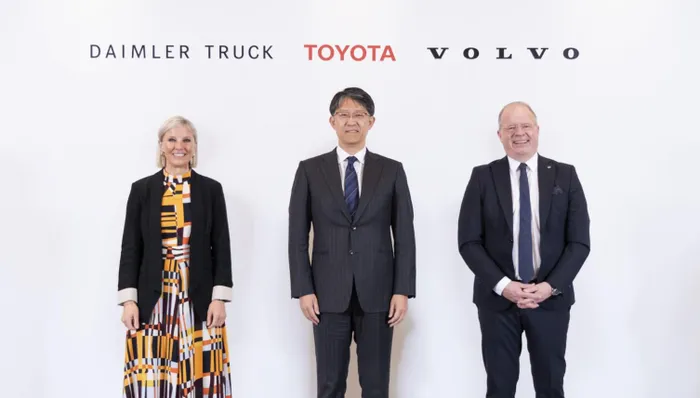
The three companies have signed a non-binding memorandum of understanding that would see Toyota become an equal shareholder in cellcentric, a fuel cell joint venture established by Volvo and Daimler Truck in 2021.
Image: Supplied
Global automotive giants are deepening their collaboration on clean transport, with Toyota Motor Corporation aiming to join forces with Volvo Group and Daimler Truck in a strategic push to accelerate hydrogen-powered mobility.
The three companies have signed a non-binding memorandum of understanding that would see Toyota become an equal shareholder in cellcentric, a fuel cell joint venture established by Volvo and Daimler Truck in 2021.
If finalised, the agreement would mark a significant step in the global race to decarbonise heavy-duty transport, positioning cellcentric as a leading developer and manufacturer of hydrogen fuel cell systems for trucks and other large-scale applications.
The partnership brings together complementary strengths. Volvo and Daimler Truck contribute extensive expertise in commercial vehicle manufacturing, while Toyota adds more than three decades of experience in fuel cell development, particularly in passenger vehicles.
Together, the companies aim to accelerate the development, production and commercialisation of fuel cell systems tailored for heavy-duty vehicles—an area widely seen as difficult to electrify using batteries alone.
Fuel cells generate electricity through a chemical reaction between hydrogen and oxygen, producing only water as a byproduct. As a result, they are considered a key technology in reducing carbon emissions in sectors such as long-haul trucking, where battery-electric solutions face limitations in range, weight and charging time.
Under the proposed structure, all three companies would hold equal shares in cellcentric, which will continue to operate as an independent entity. The joint venture will serve a broad customer base across on-road and off-road transport, as well as stationary energy applications.
Toyota’s planned investment is expected to enhance cellcentric’s capabilities, particularly in the development of fuel cell “unit cells”—the core components of the technology—as well as associated systems such as control architecture and production processes.
Industry leaders say the collaboration is essential to achieving the scale needed to make hydrogen technology commercially viable.
Volvo Group CEO Martin Lundstedt described the potential partnership as a critical step toward accelerating the transition to net-zero transport, emphasising the importance of collaboration across the industry.
“This is an important signal to customers, suppliers, and others in the ecosystem. Given the importance of accelerating the transformation into net-zero transportation, the need of great companies coming together and collaborating is more important than ever,” he said.
“Welcoming Toyota onboard will be a big leap towards realising decarbonisation of our industries.”
Daimler Truck CEO Karin Rådström echoed this view, noting that hydrogen fuel cells are expected to complement battery-electric systems in reducing emissions.
“We are proud that Toyota plans to join cellcentric as a shareholder. This will enable us to strengthen development and further scale hydrogen technology, which we believe must complement battery-electric drives in decarbonising transport,” Rådström said.
Toyota CEO Koji Sato said the partnership aligns with the company’s long-term vision of building a “hydrogen society,” highlighting the opportunity to combine expertise across sectors to deliver world-leading solutions for heavy commercial vehicles.
“Cellcentric which possess deep expertise in commercial fields together with Toyota's over 30 years of fuel-cell development in the passenger car sector, can combine their strengths to deliver one of the world-leading fuel cell systems for heavy commercial vehicles,” he said.
“Toyota will continue to contribute to realising a hydrogen society alongside like-minded partners.”
The companies also plan to work with industry partners and associations to support the development of hydrogen infrastructure—seen as one of the biggest barriers to widespread adoption. This includes expanding hydrogen production, distribution and refuelling networks.
Cellcentric, which already employs more than 560 specialists and holds around 700 patents, aims to become a global tier-one supplier of fuel cell systems. The addition of Toyota is expected to further strengthen its technological edge and market competitiveness.
Despite the strategic importance of the deal, the agreement remains non-binding, and discussions are ongoing. Any final transaction will require approval from the companies’ boards and relevant regulatory authorities.
Notably, the collaboration will be limited to fuel cell technology. Volvo, Daimler Truck and Toyota will continue to compete independently in all other areas of their businesses, maintaining competitive dynamics in the global automotive market.
The move comes amid increasing pressure on the transport sector to reduce emissions in line with global climate targets, including Europe’s Green Deal and Japan’s hydrogen strategy.
As governments and industries look for scalable solutions to decarbonise freight and logistics, partnerships like this signal a growing consensus: no single company can tackle the challenge alone.
If completed, the three-way alliance could play a pivotal role in shaping the future of zero-emission heavy transport, potentially accelerating the shift toward hydrogen as a mainstream energy source in the global economy.
BUSINESS REPORT