

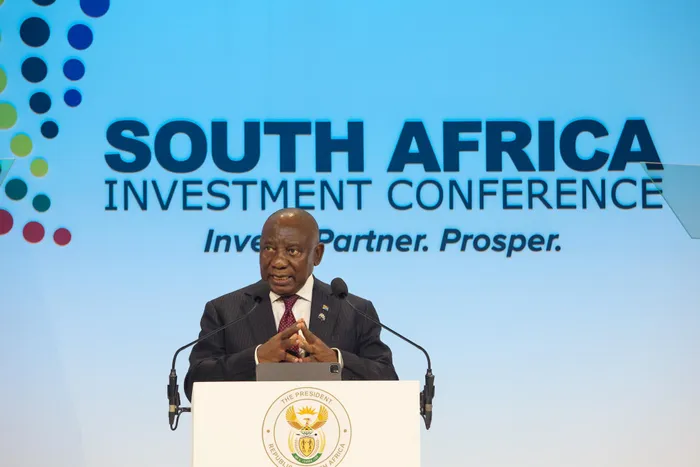
President Cyril Ramaphosa speaking during the Sixth South Africa Investment Conference (SAIC) held on Tuesday at the Sandton Convention Centre in Johannesburg.
Image: Supplied/GCIS
President Cyril Ramaphosa and Minister of Trade, Industry and Competition Parks Tau have called for urgent implementation of investment commitments made at the 2026 South Africa Investment Conference, as the country seeks to translate renewed confidence into economic growth and job creation.
Closing the 6th SA Investment Conference yesterday, Ramaphosa said South Africa is entering a “new phase of growth,” buoyed by the highest level of investment pledges secured since the inaugural conference.
“This conference has demonstrated that our economy is entering a new phase of growth,” Ramaphosa said. “There is a strong case for investment in South Africa today.”
Ramaphosa highlighted that the cumulative value of pledges, alongside the number of projects announced, marks a record for the annual gathering.
A significant portion of the commitments came from domestic investors, signalling growing confidence within the local business community, while foreign direct investment flows have also increased sharply.
“These investments span across all nine provinces, affirming their potential as engine rooms of growth,” Ramaphosa said.
Major announcements included a R10.4 billion investment by Toyota in KwaZulu-Natal to support the automotive sector’s energy transition, while Sasol committed R60bn to upgrade operations in Mpumalanga and the Free State.
In Gauteng and the Western Cape, Actom - a black owned electrotechnical manufacturing company - is investing R250 million in equipment to support grid expansion, including transformers, high voltage equipment and batteries for energy storage.
In the Eastern Cape and Western Cape, Teleperformance is investing R145m in global business services, an investment that will create 2,600 jobs.
In the Northern Cape as well as the Hillside smelter in KwaZulu-Natal, South32 is investing R3.9bn in rail infrastructure upgrades at their manganese mines.
Other projects range from mining and rail infrastructure to renewable energy and global business services, reflecting the diversity of opportunities in the economy.
Ramaphosa said these investments underscore South Africa’s strengths, including a sophisticated financial sector, deep capital markets, strong renewable energy resources and a stable constitutional democracy anchored in the rule of law.
“The rule of law underpins legal certainty, rights protection and accountable government, and is essential for social justice and economic development,” he said.
Despite the optimism, Ramaphosa acknowledged that South Africa still faces significant challenges in achieving its growth ambitions. Fixed investment remains at around 15% of GDP, and the country needs to double this level to unlock faster and more inclusive growth.
“There is a gap between improved sentiment on one hand, and greater capital deployment that translates to strong growth and jobs on the other,” he said, stressing the need to convert commitments into tangible projects.
Ramaphosa reiterated that the government’s structural reform agenda is “irreversible” and embedded within the state, supported by regulatory frameworks designed to provide certainty for investors.
A cornerstone of this progress has been collaboration between government and the private sector. Ramaphosa credited business for playing an “instrumental” role in economic recovery, from supporting the Economic Reconstruction and Recovery Plan to helping create over 200,000 youth work opportunities through the Youth Employment Service.
Efforts are also underway to improve the operating environment for businesses, including tackling crime and corruption and strengthening key institutions such as the National Prosecuting Authority and the Special Investigating Unit.
Meanwhile, Tau emphasised that the success of the conference will ultimately be judged by implementation rather than pledges.
“This conference has reaffirmed that investment is not an isolated transaction, but a partnership built on trust, policy certainty and mutual accountability,” Tau said.
He thanked investors, development finance institutions and industry leaders for their participation, noting that their contributions had advanced practical pathways for collaboration, innovation and growth.
“The true value of this conference will be measured not by the strength of our discussions alone, but by the effectiveness of our implementation,” Tau said.
Tau added that South Africa remains a strategic destination for long-term investment, with strong potential in sectors such as infrastructure, energy, critical minerals and industrial development.
He stressed that all stakeholders share a responsibility to ensure that commitments are translated into real economic outcomes.
“The responsibility we share is clear: to translate commitment into projects, to ensure timely execution, and to deliver tangible outcomes that advance growth, create employment and improve livelihoods,” he said.
As the conference concluded, Ramaphosa urged investors to see their involvement as more than financial participation.
“You are not merely investing in an economy,” he said. “You are investing in a nation determined to grow, transform, and succeed.”
BUSINESS REPORT