

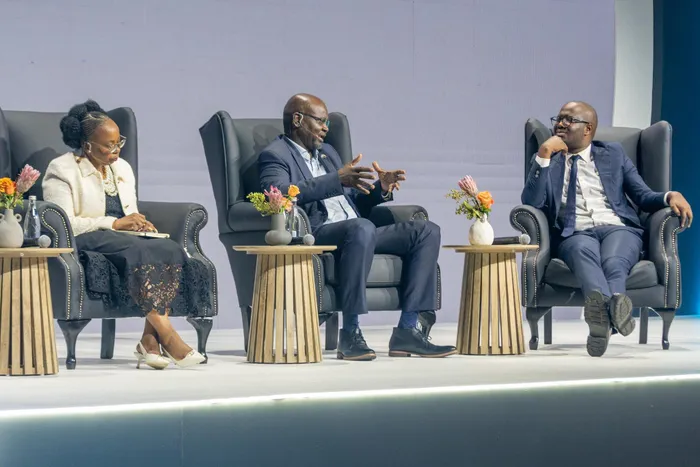
From left to right: Phindile Masangane, group executive at DBSA; Patrick Dlamini, Group CEO of the Public Investment Corporation; and Zuko Godlimpi, deputy minister of the Department of Trade, Industry and Competition, during a panel discussion at the 6th South Africa Investment Conference on Tuesday.
Image: Supplied
South Africa is intensifying discussions around the creation of a sovereign wealth fund.
Policymakers, economists and development finance leaders on Tuesday highlighted the fund's potential to unlock long-term investment, strengthen economic sovereignty, and accelerate infrastructure development across the country and the broader African region.
Speaking at a high-level investment dialogue during the 6th SA Investment Conference, participants emphasised that while South Africa has long debated the idea of a sovereign wealth fund, the time has come to move from concept to implementation—anchored by strong institutional design and clear policy direction.
A central theme emerging from the discussion was the need for a robust legislative and governance framework to ensure credibility and effectiveness.
Panellists argued that without enabling legislation and strong oversight, a sovereign wealth fund risks failing to attract the partnerships and capital required to succeed.
Patrick Dlamini, CEO of the Public Investment Corporation (PIC), the largest asset manager in Africa with about R3.8 trillion assets under management, said there must be enabling legislation that lends credibility to the institution, supported by optimal governance structures.
"I think it's an overdue issue for South Africa if you ask me," Dlamini said. "But I think I was also quite happy to see in the G20 legacy, social legacy project that this matter was looked into quite deeply.
Dlamini also pointed out to the country's mineral endowerment and how that can be leveraged to kickstart the fund.
"As a country that is endowed in so many minerals - the PGMs, the manganese, the chromium ore, really it says we could be generating massive royalties that could be used as a seed capital for the sovereign wealth fund," he said.
"We have a room there but what would be critical success factors for the sovereign wealth fund will be, I think, an enabling legislation by government to make sure that it is done in such a way that it lends credibility to the sovereign wealth fund as an institution."
Panellists also pointed to the role of existing institutions such as the PIC and the Development Bank of Southern Africa (DBSA), noting that a sovereign wealth fund would complement rather than replace them.
The fund could act as a long-term capital deployer, particularly in infrastructure and equity investments, while development finance institutions continue to prepare and de-risk projects.
Phindile Masangane, group executive at DBSA, in particular, highlighted the challenges they face in scaling infrastructure delivery. Masangane said while organisations like the DBSA have developed strong capabilities in structuring bankable projects, their balance sheets remain constrained.
“We take projects from concept to bankability, ensuring risk is properly allocated and returns are clear,” she explained. “But there are limits to how much we can fund. A sovereign wealth fund could help scale up these efforts significantly.”
By stepping in at later stages of project development, a sovereign wealth fund could crowd in private sector capital, especially from institutional investors such as pension funds that typically have lower risk appetites. This would help bridge the gap between project preparation and large-scale financing.
Another critical issue raised was the need to mobilise domestic capital rather than relying heavily on foreign investment. The speakers stressed that South Africa must “be captains of its own destiny” by leveraging local savings to fund infrastructure and industrial development.
A sovereign wealth fund could also play a strategic role beyond domestic development. Globally, such funds are often used as instruments of foreign policy, enabling countries to invest in cross-border infrastructure, secure supply chains, and strengthen geopolitical influence.
For South Africa, this could mean supporting regional projects that enhance economic integration, such as energy generation, transport corridors, and mineral beneficiation initiatives across the continent. Projects like large-scale hydropower developments and transnational logistics corridors were cited as examples of opportunities with far-reaching impact.
However, participants cautioned that the success of a sovereign wealth fund will depend not only on funding but also on the quality of projects available. Poorly structured or unviable projects would undermine investor confidence and limit the fund’s effectiveness.
To address this, there is a growing shift toward programme-based infrastructure development, where projects are bundled and prepared at scale to attract investment. This approach is already being implemented in sectors such as energy, rail, and logistics, and could provide a pipeline of opportunities for a future sovereign wealth fund.
The discussion also touched on the importance of aligning the fund with national development goals, including industrialisation and beneficiation of critical minerals. By directing investment toward value-added industries, the fund could help shift South Africa’s economy away from raw material exports toward higher-value production.
BUSINESS REPORT