

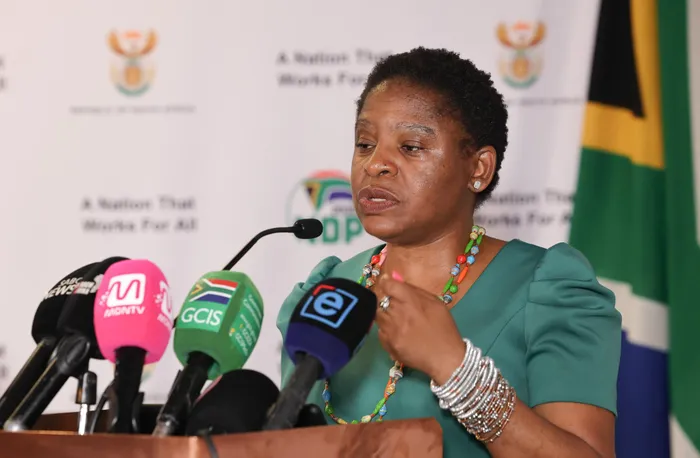
Minister in the Presidency, Khumbudzo Ntshavheni, last week briefed the media on the outcomes of the Cabinet meeting held on 25 March 2026.
Image: Supplied/GCIS
South Africa’s fuel landscape has come under renewed pressure, with government stepping in to stabilise supply and cushion consumers from rising costs linked to global geopolitical tensions.
In its latest Cabinet statement last week, South Africa confirmed that while the country’s fuel supply remains stable in the immediate term, external shocks—particularly the ongoing conflict in the Middle East—are beginning to ripple through the domestic economy.
The war has disrupted global energy markets, placing upward pressure on fuel prices and raising concerns about the broader cost of living.
Cabinet acknowledged that South Africa relies on the Middle East primarily for refined fuel products, making it vulnerable to supply chain disruptions.
Despite these risks, Minister in the Presidency Khumbudzo Ntshavheni reassured citizens that there is currently no shortage of fuel. Reports of dry petrol stations, Ntshavheni said, are largely the result of panic buying and logistical bottlenecks rather than an actual supply deficit.
“South Africans are discouraged from panic buying and fuel hoarding. We have got an adequate supply and we have got plans that will make sure South Africa remains fuel supply adequate,” she said.
South Africa consumes between 60 million and 70 million litres of petrol and diesel per day, demand which is currently being met through diversified import sources.
According to the Strategic Fuel Fund, South Africa has eight million barrels in reserve, which would translate to at least 1.3 billion litres of fuel.
This means that the country has at least 22 days of fuel capacity if the the country were to be forced to dip into the strategic reserves, far below the stipulated 60 days of capacity required in reserve by law.
To counter rising fuel costs, government has introduced a temporary reduction in the fuel levy. The general fuel levy reduction of R3 announced on Tuesday ensures that the fuel levy will fall from some R4.10 per litre to R1.10 per litre of petrol and reduce from R3.93 to R0.93 per litre of diesel – reducing further burden on consumers.
The move forms part of a broader package of responses coordinated by a newly established Ministerial Task Team tasked with managing the economic fallout of the global crisis.
The task team brings together multiple departments, including finance, energy, transport and trade, reflecting the wide-reaching implications of fuel price increases. Higher fuel costs not only affect motorists but also feed into food prices, logistics expenses and overall inflation, amplifying the strain on consumers.
“[The task team will] coordinate government’s response in a holistic manner to mitigate the impact on the cost of living, fuel and food security,” Ntshavheni said.
“As an immediate intervention, the task team recommended the reduction in the fuel levy in the immediate period to alleviate the impact on the fuel price increases that took effect on Wednesday,”
Government’s response underscores the central role fuel plays in economic stability. As transport and production costs rise, businesses often pass these increases onto consumers, creating a ripple effect across the economy. In this context, the fuel levy relief is seen as a short-term buffer rather than a long-term solution.
Beyond immediate interventions, the situation has reignited debate about South Africa’s long-term energy security. The country’s dependence on imported refined fuels exposes it to global volatility, highlighting the need for greater investment in domestic refining capacity and alternative energy sources.
Encouragingly, government noted that broader economic indicators remain stable, with steady GDP growth and strong tax revenue collection providing some fiscal room to respond to shocks. However, sustained increases in fuel prices could erode these gains if left unchecked.
The current crisis serves as a reminder of how interconnected global and local economies have become. Events thousands of kilometres away can quickly translate into higher costs at the pump, affecting everyday life for millions of South Africans.
The message from government is clear: fuel supply is secure, but vigilance and cooperation are essential. As global uncertainties persist, South Africa’s ability to navigate fuel challenges will depend not only on policy interventions but also on public behaviour and long-term structural reforms.
BUSINESS REPORT