

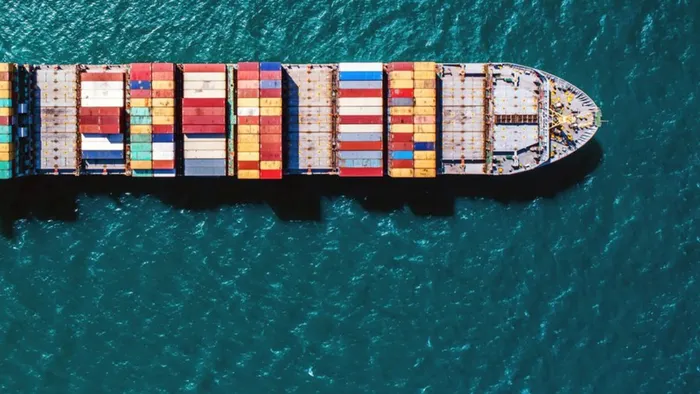
South African firms reported that foreign clients are increasingly hesitant to place orders amid heightened geopolitical uncertainty and volatile exchange rates.This weakening external demand is being compounded by severe disruptions to global shipping routes.
Image: Maersk / X
South Africa’s fragile economic recovery is facing renewed strain as the ongoing war in the Middle East disrupts global trade routes, weakens export demand, and drives up costs across domestic supply chains, according to the latest S&P Global Purchasing Managers’ Index (PMI).
While overall business conditions showed a modest improvement in March, the underlying data released on Tuesday reveals a worrying divergence: stronger output and hiring on one side, and collapsing export orders and mounting logistical pressures on the other.
The headline PMI rose slightly to 50.8 in March from 50.0 in February, signaling a marginal expansion in private sector activity after six months of stagnation.
However, this improvement masks the growing external pressures linked directly to the Middle East conflict.
At the heart of the problem is a sharp decline in export sales, the steepest drop in more than two years. South African firms reported that foreign clients are increasingly hesitant to place orders amid heightened geopolitical uncertainty and volatile exchange rates.
This weakening external demand is being compounded by severe disruptions to global shipping routes.
According to S&P, businesses cited delays in sea freight linked to instability around key oil transit corridors, including the Strait of Hormuz, a critical artery for global energy supplies. These disruptions have significantly lengthened supplier delivery times, which rose at the fastest pace in 16 months.
The ripple effects are being felt throughout domestic supply chains. Companies are struggling to secure inputs on time, leading to production bottlenecks and slower clearing of backlogs. Although firms have attempted to mitigate these risks by increasing inventory levels, this strategy comes at a cost.
Input prices surged in March at the fastest rate since August 2024, driven largely by escalating fuel prices and a stronger US dollar. Since many imported goods are priced in dollars, currency weakness has further inflated costs for South African businesses.
Fuel price increases, in particular, are proving to be a critical pressure point. Higher transport and logistics costs are not only squeezing company margins but also dampening demand from both businesses and consumers. The result is a feedback loop in which rising costs reduce purchasing power, further weakening economic activity.
To protect profitability, S&P said firms have responded by raising their selling prices to the greatest extent since the end of 2024. However, this risks suppressing demand even further, especially in a price-sensitive domestic market already grappling with economic uncertainty.
Despite these headwinds, some businesses are pressing ahead with expansion plans. Output growth accelerated to a six-month high, supported by new project starts and efforts to rebuild inventories. Companies also increased hiring at the fastest rate since May 2024, suggesting a degree of confidence in underlying demand conditions.
Yet this optimism appears increasingly fragile. Business sentiment about the future has deteriorated sharply, falling to its lowest level since July 2021. Much of this pessimism is tied directly to uncertainty over the duration and intensity of the Middle East conflict.
Economists warn that the longer the war persists, the deeper the impact on South Africa’s trade-dependent sectors. A prolonged disruption could further erode export volumes, intensify cost pressures, and ultimately filter through to slower domestic growth.
David Owen, S&P Global Market Intelligence economist, said the strengthening of the US dollar put pressure on import prices, whilst a sharp uplift in fuel prices constrained business and consumer demand.
“The steep drop in export orders, combined with greater delivery delays and input cost pressures, all of which linked to the war in the Middle East, points to a degree of trouble ahead for South African firms,” Owen said.
“Going forward, the duration of the war will be a key factor determining the extent of the impact on South African companies, including how much a drop in foreign demand and a mark-up in prices filters through to domestic activity.”
For now, South African businesses are navigating a precarious balancing act — expanding output and employment while contending with shrinking export markets and increasingly unreliable supply chains.
BUSINESS REPORT