

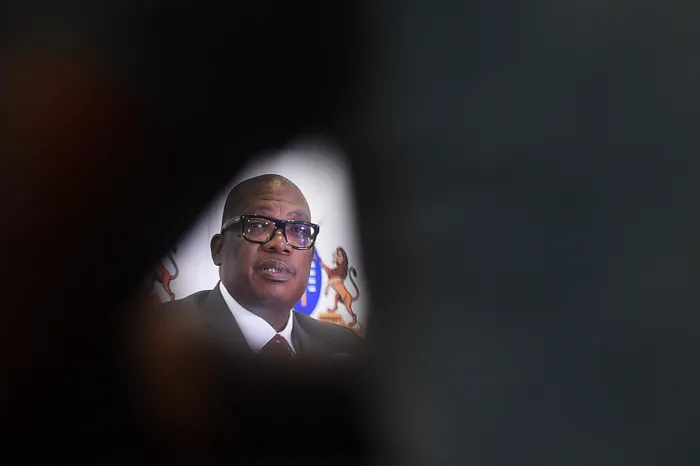
Gauteng Premier Panyaza Lesufi outlined an aggressive push to expand PPPs, positioning them as a key mechanism to unlock capital and fast-track development projects across the province.
Image: Itumeleng English / Independent Newspapers
Gauteng Premier Panyaza Lesufi has placed public-private partnerships (PPPs) and a renewed focus on core State functions at the centre of the province’s economic strategy, arguing that only a capable, well-coordinated government can unlock meaningful investment and growth.
Speaking at the Gauteng Investment Conference on Thursday, Lesufi said the province’s ambition to become a high-performing economy hinges on “doing the basics” while scaling collaboration with the private sector to accelerate infrastructure development and job creation.
“We just have to do the basics and level the playing field and ensure that everyone is comfortable to come to Gauteng and do what they need to do,” Lesufi said. “If you are the epicentre of crime, epicentre of lawlessness, epicentre of destruction of infrastructure, no one will come to invest in you.”
At the heart of his message were three non-negotiable priorities: skills development, infrastructure delivery, and building State capacity, all of which he described as essential foundations for sustainable economic growth.
“I want to start with the first one, which to me is very key and very fundamental. It’s skills development. If we can’t have the next generation to provide the skills that are needed by the private sector, that are needed by the public sector, forget,” he said.
Lesufi stressed that education and skills pipelines must align with the needs of both government and industry, warning that without this alignment, Gauteng risks falling behind in a rapidly evolving, innovation-driven economy.
The second priority, infrastructure, was equally critical. He highlighted persistent challenges faced by investors when accessing basic municipal services, arguing that these bottlenecks undermine the province’s attractiveness as an investment destination.
“If people want to build a factory, they must not struggle to get water. If people want to build a factory, they must not struggle to get electricity,” Lesufi said. “Infrastructure becomes another area that we just have to ensure that we get it right.”
He described the third pillar, State capacity, as the glue that holds the entire strategy together. Without a capable and responsive government, Lesufi warned, even the best policy frameworks and investment pledges would fail to translate into tangible outcomes.
“If you can’t have the capacity to respond to the needs, why invite people to your table?” he asked. “It is only when you have the capacity to respond to their needs, direct their needs, protect their needs, and show them the path, we will be in a position to ensure that makes sense.”
Alongside these priorities, Lesufi outlined an aggressive push to expand PPPs, positioning them as a key mechanism to unlock capital and fast-track development projects across the province.
“You will see, I think we’ll be the first province to run with public-private partnership,” he said. “It has worked.”
He pointed to a major infrastructure investment in the Gautrain made roughly two decades ago, which has since nearly doubled in value from R26 billion to R48bn, as proof that long-term partnerships between government and private investors can deliver substantial returns.
Building on this model, Lesufi said the provincial government now plans to scale up PPP-driven projects, including new transport infrastructure and regional connectivity initiatives.
“We want to expand that, and in expanding that, we intend to create almost 150,000 jobs. But we also want to bring new, innovative infrastructure realignment,” Lesufi said.
Among the proposed projects are high-speed rail links connecting Gauteng to provinces such as Limpopo and KwaZulu-Natal, as well as an overhaul of road and transport master plans aimed at unlocking economic opportunities.
Crucially, Lesufi highlighted recent reforms that make PPPs easier to implement, noting that projects valued below R2bn can now be approved at provincial level without lengthy national processes.
“Anything less than R2bn does not have to go through a red tape. As the province, we can take a decision immediately,” he said, adding that a wave of new PPP announcements is expected.
Beyond infrastructure, Lesufi emphasised that partnerships must be underpinned by strong coordination across all levels of government. He called for joint planning, aligned budgets, and improved intergovernmental relations to ensure that national, provincial, and municipal authorities work toward shared goals.
“It’s joint planning and joint budget… If we can’t plan together… then we’re not having a system of governance in our province,” he said..
“We want to create an environment where we are the preferred destination,” he said. “And if we grow Gauteng, we definitely grow South Africa.”
BUSINESS REPORT