

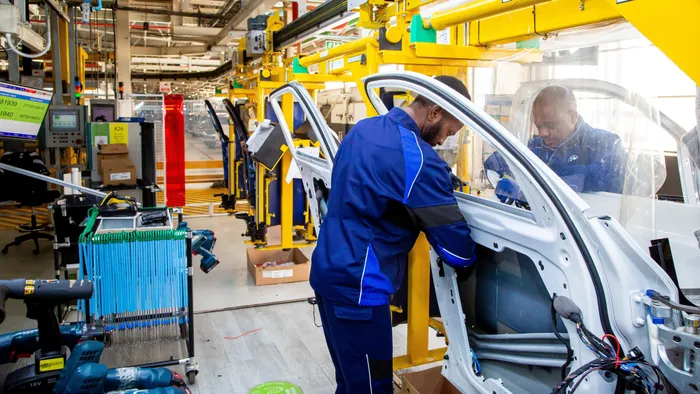
StatsSA said the downturn was broad-based, with seven of the 10 manufacturing divisions recording weaker performance.
Image: File
South Africa’s manufacturing sector remains under pressure, with output declining more sharply than expected in February, highlighting persistent structural challenges and weakening business conditions.
According to Statistics South Africa (StatsSA) on Thursday, manufacturing production fell by 2.8% year-on-year in February, marking the fourth consecutive month of contraction and the steepest decline since April 2025.
The drop was significantly worse than market expectations of a modest 0.3% decrease and follows a revised 0.1% decline in January.
StatsSA said the downturn was broad-based, with seven of the 10 manufacturing divisions recording weaker performance.
The largest negative contributors included food and beverages, which declined by 4.5% year-on-year, as well as wood and wood products, paper, publishing and printing, which dropped by a steep 9.7%.
The metals and machinery segment, including basic iron and steel and non-ferrous metals, also weighed heavily on the sector, contracting by 3.6%.
Nicolai Klaassen, director of industry statistics at StatsSA, said the weakness reflects widespread challenges across the manufacturing landscape. Despite the overall decline, Klaassen noted that a few sectors showed resilience.
“Three divisions were stronger year on year, including glass and non-metallic mineral products, electrical machinery, and petroleum, chemical products, rubber and plastic products,” Klaassen said.
On a month-on-month basis, the picture was equally concerning. Seasonally adjusted manufacturing output fell by 2.2% in February, reversing a revised 1.9% increase recorded in January.
Over a three-month period ending in February, production declined by 2% compared to the previous three months, underscoring the lack of sustained momentum in the sector.
Economists said the data aligns with other indicators pointing to subdued activity.
Investec economist Lara Hodes noted that the manufacturing figures are consistent with the movement of the Purchasing Managers’ Index (PMI), which remained in contractionary territory during February.
The PMI fell to 47.4 in February from 48.7 in January, remaining below the neutral 50 mark that separates expansion from contraction. The decline was largely driven by weaker business activity and subdued new sales orders, suggesting limited demand in the sector.
Adding to concerns, supplier delivery times remained elevated, an indication of slower logistics, which economists attribute more to supply chain disruptions than to strong demand conditions. Persistent logistical bottlenecks, including inefficiencies in freight rail and ports, continue to weigh on production and distribution.
Business confidence within the sector also remains fragile. Survey data for the first quarter of 2026 suggests that manufacturers are struggling to gain traction, with sentiment dampened further by global uncertainties.
Hodes said geopolitical tensions, particularly conflict in the Middle East, have added another layer of risk.
"The war in the Middle East is likely to have exacerbated this. Specifically, the results of March’s PMI survey show that the index measuring expected business conditions in six months’ time shed 22.9 points...the largest drop on record,” she said.
"The recently announced two-week ceasefire is a favourable development; however, uncertainty still remains somewhat elevated."
With weak demand, infrastructure constraints, and global headwinds continuing to weigh on activity, a meaningful recovery may remain elusive in the near term.
FNB senior economist Thanda Sithole said manufacturing output in the first two months of 2026 was also 1.5% lower than in the corresponding period of 2025, with six of the 10 manufacturing divisions recording contractions.
"The sector is likely to remain under pressure in the first half of 2026, amid elevated uncertainty related to Middle East tensions and persistent fuel-related input cost pressures," Sithole said.
"In addition, the Manufacturing PMI Expected Business Conditions Index dropped sharply to 46.0 in March from 68.8 in February, suggesting that manufacturers expect operating conditions to remain challenging in the near term."
BUSINESS REPORT