

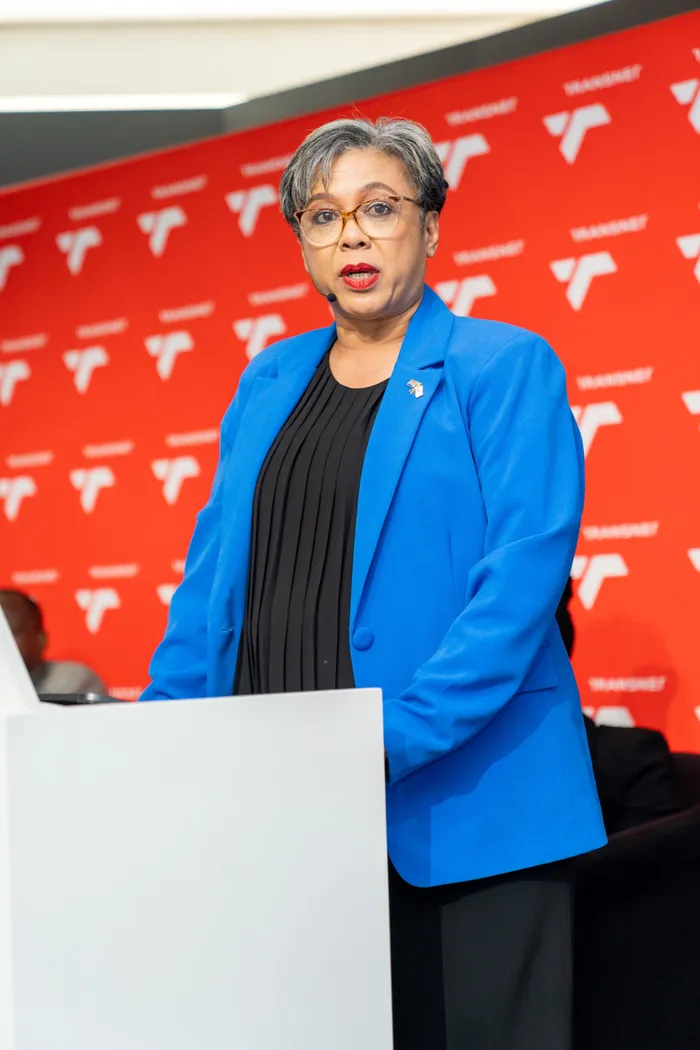
Transnet Group CEO, Michelle Phillips highlighted that rebuilding and expanding South Africa’s logistics network is essential not only for domestic growth but also for regional trade integration.
Image: Supplied
Transnet Group CEO Michelle Phillips has made a strong case for deeper private sector participation in South Africa’s infrastructure build-out, warning that critical logistics and energy supply projects cannot proceed without significant external funding and high-quality investment proposals.
Speaking during a panel discussion on infrastructure investment at the 2nd Gauteng Investment Conference yesterday, Phillips underscored the central role of connectivity, particularly rail and pipeline networks, in unlocking economic value across the country and the broader continent.
“You can mine all over, but if you can’t get that out of a country, if you can’t get it to the right places, you’re not going to be making any money,” she said. “Transnet does not make money if it does not move commodities.”
Phillips highlighted that rebuilding and expanding South Africa’s logistics network is essential not only for domestic growth but also for regional trade integration.
She pointed to the importance of strengthening links between provinces and improving export corridors to ensure commodities reach global markets efficiently.
Phillips said Transnet’s recovery plan, which was launched after a sustained decline in performance, is beginning to yield results. Freight volumes, which had dropped to 149 million tons from a peak of 226 million tons five years ago, are now recovering.
“The recovery plan has enabled us to arrest the five-year decline… we are now in the high 160s and moving towards 180 million tons,” she said.
Despite this progress, Phillips made it clear that Transnet’s ambitions far exceed its current financial capacity. The company does not receive automatic State funding and must compete for infrastructure financing while also seeking private investment.
“We do not get funding from the State… we have to apply for that funding,” she said, noting that Transnet secured support for three out of four applications through the National Treasury's Budget Facility for Infrastructure, unlocking about R12 billion for priority projects.
A major focus area is the Durban-to-Gauteng container corridor — a vital artery for moving goods between the country’s busiest port and its economic hub.
Phillips said Transnet plans to invest approximately R7bn into the corridor over the next five years, with additional billions earmarked for the central corridor linking multiple provinces and regional markets.
“In total for Gauteng, Transnet will be investing over the next five years about R34bn,” she said.
Among the most urgent projects is the development of a new fuel pipeline — known as Pipeline 6 — which will run from Heidelberg to OR Tambo International Airport. The project is critical to ensuring the continued supply of jet fuel to the country’s busiest airport.
“If we don’t build that… we will run out of capacity to feed OR Tambo,” Phillips warned. “We’ve got R1.3bn that we want to spend… by early 2029, we need that pipeline constructed and working.”
She added that existing fuel production capacity will not be sufficient to meet future demand, making the pipeline project a strategic priority for both the province and the national economy.
However, Phillips stressed that funding remains the biggest constraint, adding that private sector involvement is not optional, but essential.
“Do I have the money? No. This is why all of these people are here,” she said candidly. “Without private sector participation, none of these investments or none of this construction is going to be possible.”
Phillips also emphasised the need for robust feasibility studies, skilled execution, and credible business cases to ensure that investments deliver sustainable returns.
“A private partnership is the only way,” Phillips said.
Her remarks come as Gauteng continues to position itself as a leading investment destination. The inaugural Gauteng Investment Conference in 2025 secured R312.5bn in pledges, with 28% — or R73bn — already converted into active projects, supporting more than 114,000 jobs.
Gauteng Premier Panyaza Lesufi also placed public-private partnerships (PPPs) and a renewed focus on core State functions at the centre of the province’s economic strategy, arguing that only a capable, well-coordinated government can unlock meaningful investment and growth.
“You will see, I think we’ll be the first province to run with public-private partnership,” he said. “It has worked.”
He pointed to a major infrastructure investment in the Gautrain made roughly two decades ago, which has since nearly doubled in value from R26bn to R48bn, as proof that long-term partnerships between government and private investors can deliver substantial returns.
Building on this model, Lesufi said the provincial government now plans to scale up PPP-driven projects, including new transport infrastructure and regional connectivity initiatives.
“We want to expand that, and in expanding that, we intend to create almost 150,000 jobs. But we also want to bring new, innovative infrastructure realignment,” Lesufi said.
BUSINESS REPORT