

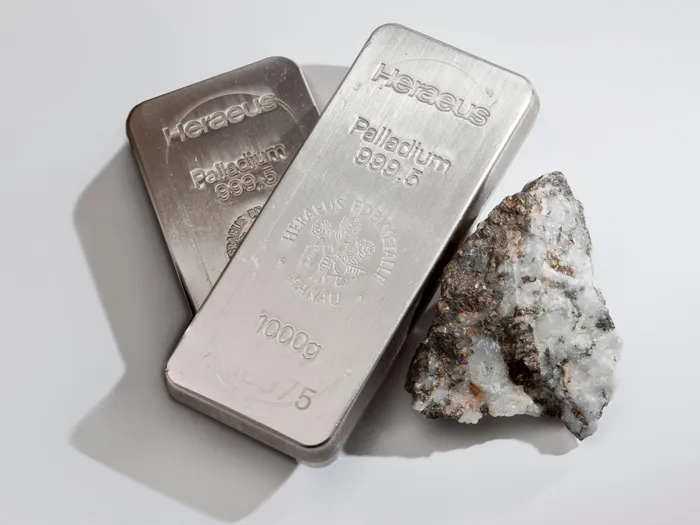
Palladium has a very high selectivity for hydrogen and thus can be used in a broad range of applications.
Image: Supplied
A new international partnership between Heraeus Precious Metals and Sibanye-Stillwater is set to reshape the economics of glass fibre manufacturing, with a strong focus on reducing costs while unlocking new demand for palladium.
The two companies on Thursday announced the joint research and development initiative, which will focus on creating a new generation of glass fibre bushings using platinum-palladium (PtPd) alloys enhanced by Heraeus’ proprietary dispersion hardening (DPH) technology.
The collaboration brings together Heraeus’ advanced materials engineering capabilities and Sibanye-Stillwater’s expertise in platinum group metals (PGMs), aiming to deliver more efficient and cost-effective industrial solutions.
It also builds on previous joint efforts between the two companies, including the development of a ruthenium-based catalyst for Proton Exchange Membrane (PEM) water electrolysis.
That breakthrough significantly reduced dependence on iridium, another costly and scarce metal, highlighting the partners’ focus on finding practical solutions to global resource challenges.
“By combining our expertise in advanced materials engineering with Sibanye-Stillwater’s strength in PGM supply, we aim to unlock new pathways for cost-efficient glass fibre production,” said Thomas Stenger, head of business line functional materials at Heraeus Precious Metals.
“Our DPH technology enables us totailor alloy properties in a way that balances performance and cost, making this approach particularly attractive for applications where economic efficiency is critical.”
Glass fibre bushings are a critical component in the production of glass fibres, which are widely used across industries such as construction, automotive manufacturing, wind energy and electronics.
Demand for these fibres has been rising steadily, driven by the global push toward lightweight materials, renewable energy infrastructure and advanced electronic systems.
Traditionally, bushings are made almost entirely from platinum due to its exceptional resistance to high temperatures and corrosion.
However, platinum’s high cost has long posed a challenge for manufacturers.
The new partnership seeks to address this by partially substituting platinum with palladium—another PGM that is typically less expensive—while maintaining the durability and performance required for industrial use.
The central challenge of the project lies in achieving the right balance in alloy composition. While increasing palladium content can significantly lower material costs, too much substitution risks weakening the bushing’s structural integrity and reducing its lifespan under extreme operating conditions.
To overcome this, Heraeus will deploy its DPH technology, an advanced oxide dispersion strengthening process that enhances the mechanical strength and thermal stability of metal alloys.
This approach allows engineers to fine-tune the material properties, ensuring that the new PtPd bushings can withstand the demanding conditions of glass fibre production without compromising on efficiency or longevity.
As industries worldwide continue to demand more efficient and sustainable materials, the Heraeus-Sibanye partnership could play a pivotal role in shaping the future of glass fibre production—while opening up new avenues for palladium in the global market.
The two-year project will cover alloy development, prototyping and validation with customers.
The ultimate goal is to produce market-ready solutions tailored specifically for applications such as E-glass fibres—alumino-borosilicate materials commonly used in reinforced plastics, printed circuit boards and wind turbine blades.
In these sectors, cost efficiency is a critical factor, making the development of lower-cost yet high-performance materials particularly valuable.
For Sibanye-Stillwater, the collaboration aligns with its broader strategic objective of diversifying demand for palladium.
“Developing new, sustainable and diversified demand streams for palladium is a key priority for Sibanye-Stillwater,” said Richard Stewart, CEO of Sibanye-Stillwater.
“Collaborations such as this with Heraeus Precious Metals enable us to support innovation in industrial applications while helping to sustain a balanced demand across the 6E platinum group metals basket in response to changing market dynamics.”
By enabling the substitution of platinum in certain applications, the project could stimulate additional demand for palladium, helping to stabilise the overall PGM market.
This is especially important as traditional demand drivers, such as automotive catalytic converters, face long-term shifts due to the global transition to electric vehicles.
Heraeus, meanwhile, will leverage its global footprint and technical expertise, with development work taking place in Hanau, Germany, and Shanghai, China. The company’s integrated capabilities—from trading and refining to advanced product development—position it as a key innovator in the precious metals sector.
BUSINESS REPORT