

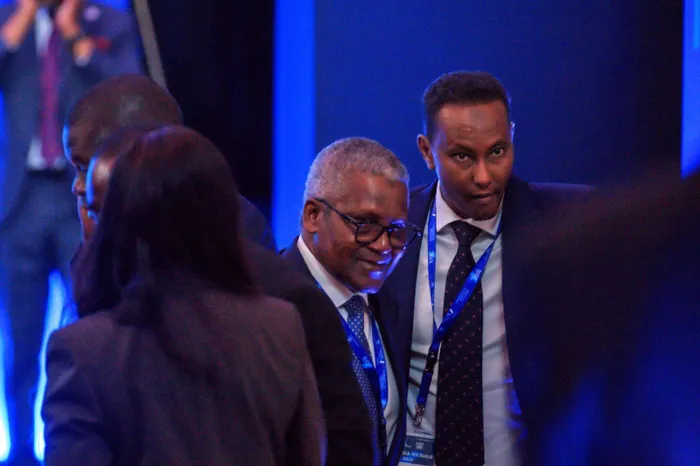
Billionaire industrialist Aliko Dangote at the "Africa We Build Summit" in Nairobi on Thursday set his sights on building another major oil refinery within the next four to five years, this time in East Africa.
Image: Supplied
Billionaire industrialist Aliko Dangote has set his sights on building another major oil refinery within the next four to five years in Tanga, Tanzania, doubling down on his call for Africa to take control of its industrial future through bold domestic investment.
The Dangote Group chairman said the continent can no longer rely on foreign investors to drive large-scale infrastructure projects, stressing that African capital and leadership must take the lead in transforming key sectors such as energy.
Speaking during a panel discussion with Kenya President William Ruto and Uganda President Yoweri Museveni at the "Africa We Build Summit" in Nairobi on Thursday, Dangote pointed to the success of his flagship refinery project in Nigeria as proof that large, complex industrial ventures are achievable on the continent.
“Even now, I can give commitment to the two presidents that are here. If they will support the refinery, we will build an identical one to that we have in Nigeria, 650,000 barrels per day," he said.
"My commitment here today is that if we agree with the three or four governments here about the refinery, we will lead and make sure that that refinery is built within the next four or five years."
The Dangote Petroleum Refinery and Petrochemicals FZE in Nigeria is expanding to double its capacity to 1.4 million barrels per day by 2028, aiming to solidify its position as the world's largest single-site refinery.
Dangote revealed that groundwork has already begun on the expansion project, with early construction activities such as piling underway, and adding that such a facility would significantly boost Africa’s refining capacity and reduce the continent’s dependence on imported fuel products.
“It’s going to deepen the market, and we are saying that all Africans should invest and we will be paying dividends in dollars,” he said. “There’s nothing that can stop it, and that’s why we are taking the bold move.”
Dangote’s remarks come as many African countries continue to grapple with fuel shortages, volatile import costs and limited domestic refining infrastructure. Despite being rich in crude oil resources, much of the continent still exports raw materials and imports refined products at a higher cost—a model Dangote sharply criticized.
“We are a continent of imports. We export raw materials, which means we export jobs, and when we import, we import poverty,” he said.
Central to his vision is a shift toward self-sufficiency, where African economies process their own resources and build industries that create jobs locally. Dangote argued that domestic investors must be willing to take the initial risk to unlock broader investment flows.
“A foreign investor will not come without the leadership of domestic investors,” he said. “They only come when things are looking rosy and good.”
Beyond refining, Dangote outlined a broader investment push by his group, revealing plans to invest $40 billion across multiple sectors by 2030. These include petrochemicals, fertilizers and manufacturing inputs that are currently in short supply across the continent.
He highlighted fertilizer production as a key example, noting that Africa’s dependence on imports has left it vulnerable to global shocks.
Dangote said his group is working toward making the continent self-sufficient in fertilizer by 2028, with plans to establish multiple blending plants and scale up urea production.
The industrialist also emphasized the importance of consistent government policy and regional integration in supporting large-scale investments. He called on African governments to create stable regulatory environments and facilitate the free movement of goods, services and people across borders.
“What we need, first of all, is consistency in government policies… and also the support of governments,” he said.
BUSINESS REPORT