

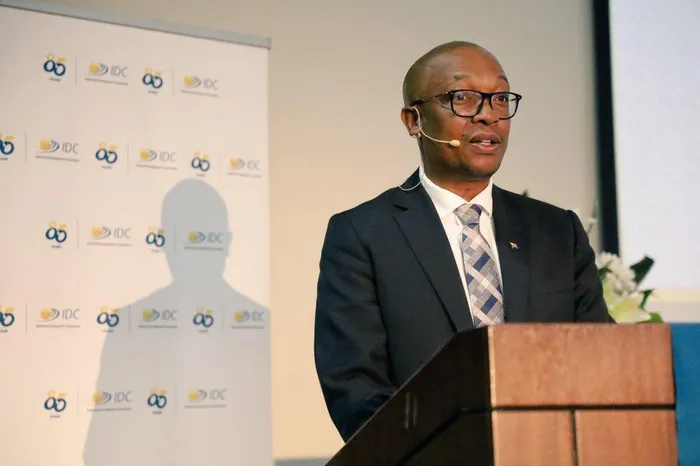
Minister of Trade, Industry and Competition, Parks Tau, speaking at an event in marking the Industrial Development Corporation’s 86th anniversary in Sandton on Thursday.
Image: Supplied
The Industrial Development Corporation (IDC) is set for a strategic overhaul as government moves to reposition the State-owned financier into a central driver of industrial growth, partnerships and investment mobilisation, Trade, Industry and Competition Minister Parks Tau said on Thursday.
Speaking at an event in marking the IDC’s 86th anniversary, Tau outlined a shift away from the corporation’s traditional role as a direct lender towards a broader platform that unlocks industrial ecosystems and crowd in capital across key sectors of the economy.
“The IDC’s role is evolving from being a traditional direct lender towards becoming a platform for industrial ecosystem development, mobilising capital, partners and capability to unlock high-impact sectors and rebuild South Africa’s industrial base,” Tau said.
The strategic pivot comes as South Africa grapples with slow economic growth, declining industrial capacity and weak investment in productive sectors, alongside infrastructure backlogs and entrenched market concentration.
Tau said the revamped IDC would align closely with government policy priorities, including infrastructure investment in energy, logistics, water and digital networks, as well as the revitalisation of Special Economic Zones and industrial parks.
Trade policy tools, regulatory reform and investment facilitation would also play a central role in enabling industrial expansion. Central to the new approach is a partnership-driven model aimed at leveraging both public and private capital.
Tau emphasised that collaboration would be critical to tackling the country’s “stubborn trifecta” of poverty, unemployment and inequality.
“To deliver on this, the IDC is working to mobilise partners so that we co-invest across value chains and extend reach through intermediaries,” he said, adding that the corporation is strengthening ties with international partners including countries in Europe, Asia and the Middle East, as well as across the African continent.
The IDC’s strategy will prioritise five key areas: co-investment with State-owned entities in network industries such as energy and freight rail; collaboration with development finance institutions; partnerships with academia to commercialise innovation; expanding access for small businesses; and working with private sector consortia to enable technology transfer.
Earlier this year, Parliament said it would establish a formal inquiry into the affairs of the IDC following allegations that it discriminated against black-owned enterprises and deviated from its transformation mandate.
The National African Federated Chamber of Commerce and Industry (Nafcoc) petitioned Parliament in October 2025, accusing the IDC of undermining black industrialists through aggressive recovery actions, premature legal enforcement and liquidation processes.
Tau also highlighted governance reforms, pointing to the appointment of a new board chaired by Gloria Serobe, alongside a new CEO, Mmakgoshi Lekhethe. The board, comprising experienced professionals across sectors, has already begun steering the institution towards its expanded mandate.
“The board has a responsibility to address the negative and real challenges experienced by black entrepreneurs,” Tau said. “Through the chairperson, I have tasked them with the responsibility to solve these challenges through an agreed-upon approach that has strict timelines and measurable milestones.”
Serobe, in her first formal public engagement as IDC chairperson, stressed the importance of governance, accountability and operational discipline in ensuring the institution delivers on its developmental mandate.
“The IDC remains a strategic institution for our country. Its mandate is developmental — to advance industrialisation, jobs and transformation — and it must be sustained through sound governance, risk discipline and financial stewardship,” she said.
She underscored that the board’s role goes beyond oversight, actively shaping strategy and holding management accountable for execution during a period of heightened scrutiny.
“This board is not ceremonial. We approve strategy and the Corporate Plan, test management’s assumptions, ensure alignment to government’s priorities, and hold the institution accountable for execution,” Serobe said.
Addressing concerns raised by stakeholders, Serobe said the board would prioritise improvements in responsiveness, transparency and client experience, including the establishment of an independent complaints review panel.
“Some concerns relate to responsiveness, process fairness, delays and breakdowns in communication — and those must improve,” she said. “The Board will engage them with urgency and care — and we ask to be judged on the seriousness of our process, the evidence that emerges, and the concrete improvements that follow.”
Looking ahead, the IDC’s renewed focus will include future-facing sectors such as critical minerals, green industries, digital infrastructure and advanced manufacturing, while continuing to support traditional industries vital to jobs and localisation.
Tau said the shift reflects changing global dynamics, with countries increasingly investing in strategic industries and securing supply chains.
“South Africa cannot stand still in this environment,” he said. “The IDC must continue to support traditional industrial strength where it matters but also move decisively into new growth frontiers.”
BUSINESS REPORT