

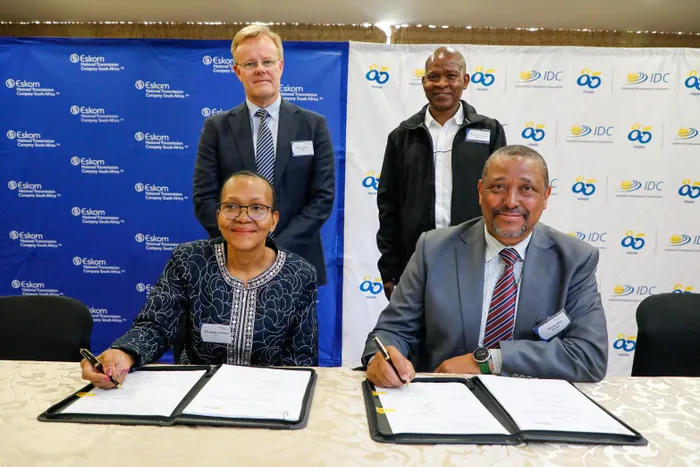
The IDC CEO, Mmakgoshi Lekhethe, and the NTCSA CEO, Monde Bala, during the signing ceremony of the MoU to collaborate on investing in SA’s transmission infrastructure to support localisation.
Image: Supplied
South Africa’s push to modernise and expand its electricity transmission network has received a significant boost.
This comes as the National Transmission Company South Africa (NTCSA) and the Industrial Development Corporation (IDC) on Monday signed a Memorandum of Understanding (MoU) aimed at accelerating infrastructure delivery while strengthening local industrial capacity.
The agreement establishes a framework for collaboration between the two entities, focusing on project development, execution and financing support for suppliers involved in expanding the country’s grid.
The partnership seeks to align infrastructure rollout with localisation and industrialisation goals, ensuring that South African manufacturers play a central role in the build programme.
The NTCSA is currently implementing its Transmission Development Plan (TDP) for 2025–2034, a large-scale initiative designed to address long-standing constraints in the national grid.
The plan includes the construction of approximately 14,500 kilometres of transmission lines, alongside new substations and the installation of around 210 transformers and related equipment.
This expansion is particularly urgent in provinces such as the Western Cape, Eastern Cape and KwaZulu-Natal, where grid capacity limitations have slowed the integration of new generation projects, including renewable energy.
Under the MoU, the IDC will consider providing funding — subject to its governance and due diligence processes — to NTCSA-approved suppliers and contractors. This could include working capital and capital investment support to enable companies to scale up production and meet the growing demand for transmission-related components.
A joint steering committee will oversee the implementation of the agreement, with a mandate to fast-track priority workstreams, monitor progress and resolve bottlenecks. Further details on funding mechanisms and eligibility criteria are expected to be released as the partnership is operationalised.
The IDC CEO Mmakgoshi Lekhethe commended the two institutions for signing the MoU, stating that securing South Africa’s energy security was critical to ensuring the country’s sustainable socio-economic and industrial development.
She also praised Eskom Holdings for recent operational improvements.
“We are proud of what you have done to stabilise energy security in the country. As the IDC, we stand ready to fund viable entities that will be selected to be part of this grid network expansion programme,” she said.
For the NTCSA, the partnership is as much about building industrial capability as it is about infrastructure delivery.
The NTCSA CEO Monde Bala emphasised the scale of opportunity created by the TDP, and the need to develop a robust local supply chain to support it.
“The TDP will create a substantial demand for manufactured inputs and components, placing a strong emphasis on ensuring the development of adequate local manufacturing capacity and capability to deliver,” Bala said.
He added that the agreement is designed to support suppliers identified through NTCSA procurement processes by linking them with both technical expertise and potential financial backing.
“This agreement is designed to support verified suppliers identified by the NTCSA through its procurement processes and equip them with the technical expertise and potential financial backing from the IDC to build sustainable capacity for delivering on the TDP projects,” Bala said.
“It will also strengthen supplier development, localisation and industrialisation (SDL&I). The focus will be on constrained commodities such as transformers, insulators, hardware, transmission steel, conductors, and broader grid infrastructure construction.”
The partnership reflects a broader policy push to deepen localisation in strategic sectors by giving domestic manufacturers clearer visibility of demand and access to financing.
By aligning procurement pipelines with funding support, the NTCSA and IDC aim to reduce reliance on imports while fostering industrial growth.
Set to run for 72 months, the collaboration is expected to play a key role in unlocking grid capacity, supporting South Africa’s energy transition and stimulating long-term economic development.
Meanwhile, the NTCSA last month revised the target date for introducing the Wholesale Electricity Market in South Africa (SAWEM), which is now planned for launch by the third quarter of 2026.
The market was initially targeted for implementation on 1 April 2026; however, following further assessment with the National Energy Regulator of South Africa (Nersa) and industry partners, additional work is required to ensure that all market, operational and regulatory requirements are fully in place.
The NTCSA is adopting a structured, phased approach to implementation to safeguard system stability and avoid any unintended disruptions. This approach is designed to ensure that all technical, regulatory and operational elements are fully coordinated before the market goes live.
BUSINESS REPORT