

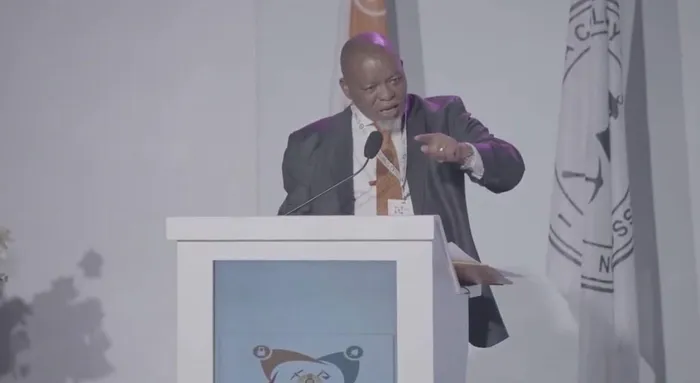
Mineral and Petroleum Resources Minister Gwede Mantashe speaking at the Coal Safe 2026 Conference on Thursday.
Image: YouTube screengrab
Mineral and Petroleum Resources Minister Gwede Mantashe has strongly defended the future of coal mining and coal-fired power generation, arguing that the industry will remain critical to the country’s economy and energy security for decades to come.
Addressing the Coal Safe 2026 Conference on Thursday, Mantashe said South Africa should continue investing in coal despite growing global pressure to move away from fossil fuels.
“Coal has a long life in South Africa. Mining is sustainable,” he said.
Mantashe said the government and industry needed to work together to change the image of mining by addressing what he described as the industry’s “five Ds” — dirty, difficult, diseased, dangerous and deadly.
“Mining is dirty. It is us who are going to make it clean,” he said. “Mining is difficult. If we invest in technology, it will not be difficult.”
Coal Safe 2026 conference aims to promote safety, sustainability, and leadership in South Africa’s coal mining industry. It acts as a premier forum for industry leaders, government and stakeholders to share best practices, improve safety standards, and pursue the goal of Zero Harm.
Mantashe said the industry had to improve safety and health standards to reduce occupational diseases and fatalities.
“Mining people must go to work and come back safe,” Mantashe said. “It’s two people, too many. We throw them down the shaft. We kill them. They are dead. We call it fatalities. It’s not fatalities. It’s two human beings dead down a shaft.”
Mantashe also reflected on his own history as a mineworker and union activist, saying his experience in the mining sector shaped his political journey.
“When I’m talking as a minister, never tell me that I’m talking from a comfort zone,” he said. “Go to Matla. They will tell you that I was not a minister there. I was a worker. Very disruptive. And very militant.”
He also highlighted changes in the industry since apartheid, particularly the increased participation of black workers and women in mining management and operations.
“Women were zero in the mining industry. By law, they were not allowed to work in the mining industry,” he said. “Today, more than 78,000 miners are female. That’s progress.”
Turning to energy policy, Mantashe criticised opposition to coal-fired power generation, particularly while countries such as China continued building coal plants.
“If we can’t build one power station in 2025, and China builds 50 coal power stations, and pollution has no boundaries, we’ll pay the price of climate change here,” he said.
“So I don’t understand this thing of not building coal power stations. I want them more. I want us to drill and drill and drill coal.”
The minister suggested that South Africa may need to extend the lifespan of existing coal-fired power stations because of electricity supply pressures.
“You may not be here by 2030. We’ll close so many power stations,” he told coal miners. “We may extend their life. I’m just whispering to you.”
Mantashe also praised Sasol for its coal-to-liquids and destoning projects, saying the country’s current petroleum challenges had highlighted the importance of domestic fuel production capacity.
“Now that there is a petroleum crisis, we appreciate the importance of that project,” he said.
The minister further revealed that he planned to engage with Iranian authorities regarding the Strait of Hormuz amid concerns over disruptions to global oil trade routes.
“You must remember, we’re friends to Iran. Closing off this trade is costing us dearly,” he said.
Mantashe also reaffirmed the government’s support for the mining sector, while warning that the industry still had significant work to do to improve safety and working conditions.
“Government must understand mining. It’s a very important sector. It’s going to be important for a long time,” he said. “So whatever you do, we’ll always have blood if the mining industry is not clean.”
BUSINESS REPORT