

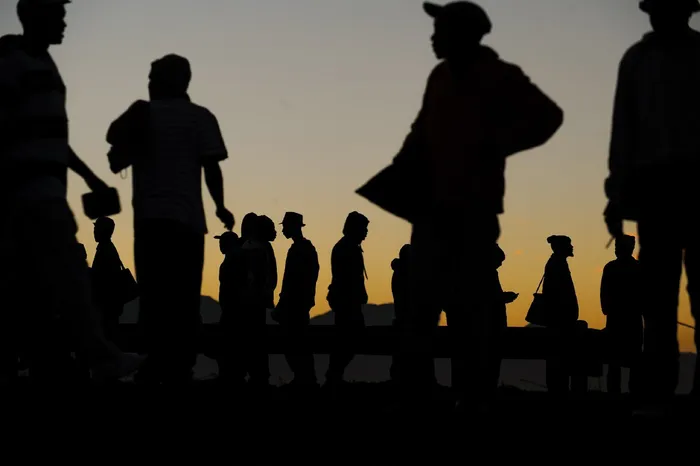
The number of employed South Africans fell to 16.8 million, while the number of unemployed people rose to 8.1 million. Youth unemployment climbed to an alarming 45.8%, with nearly 4.7 million young South Africans unable to find work.
Image: Henk Kruger/Independent Newspapers
South Africa’s unemployment crisis worsened sharply in the first quarter of 2026, exposing deep structural weaknesses in an economy that continues to struggle to generate enough growth, investment and business confidence to absorb millions of job seekers.
The latest Quarterly Labour Force Survey released by Statistics South Africa showed the official unemployment rate climbed to 32.7% in the first three months of the year from 31.4% in the previous quarter after the economy shed 345,000 jobs.
The number of employed South Africans fell to 16.8 million, while the number of unemployed people rose to 8.1 million. Youth unemployment climbed to an alarming 45.8%, with nearly 4.7 million young South Africans unable to find work.
Economists said the latest figures highlight not only the country’s weak economic growth trajectory, but also a labour market that is becoming increasingly exclusionary as more discouraged people abandon the search for work altogether.
KPMG lead economist Frank Blackmore said the sharp deterioration in employment reflects the intense pressure facing both households and businesses.
“This echoes the pressures that both consumers and businesses face: rising costs, high inflation, elevated interest rates, and, fundamentally, insufficient economic growth,” Blackmore said.
He noted that while South Africa’s working-age population continues to expand rapidly, the economy is failing to create jobs at a pace needed to absorb new entrants into the labour market.
“We need to increase that growth, and to do so, we need to attract international investment and invest more ourselves, which will require, you know, a lot of different initiatives based on the policy space and attracting investment space, for us to get the type of growth rates we need to dent this unemployment seriously,” Blackmore said.
Nearly half a million people joined the working-age population over the past year, yet the economy lost 33,000 jobs during the same period.
Statistician-General Risenga Maluleke said the reason for this was the large number of school leavers who matriculated the previous quarter and could not, for some reason or the other, further their education at tertiary institutions.
At the same time, the number of economically inactive South Africans increased significantly, suggesting many people have simply stopped looking for work.
The survey showed the number of people outside the labour force rose by 164,000 to 17.3 million during the quarter. This includes discouraged work seekers who no longer believe jobs are available.
North-West University Business School chief director, Prof. Joseph Sekhampu, said South Africa’s labour market is no longer defined only by unemployment, but increasingly by “withdrawal”.
“The issue is no longer only the scarcity of jobs, but the growing detachment of many South Africans from the expectation that sustained participation in the labour market will produce meaningful opportunity,” Sekhampu said.
He argued that the latest labour force data reveals a deeper structural crisis in which prolonged unemployment is gradually eroding confidence in the labour market itself.
“Withdrawal, in this context, reflects not a preference for inactivity, but a rational adaptation to persistently weak prospects of labour market entry,” he said.
The bleak employment picture comes as economic growth remains sluggish, with businesses battling weak consumer demand, high borrowing costs, electricity constraints, logistics bottlenecks and global geopolitical risks.
Job losses were broad-based across the economy. Community and social services suffered the biggest decline, shedding more than 206,000 jobs, while construction lost 110,000 jobs and transport employment declined by nearly 30,000.
Although manufacturing, mining and agriculture recorded modest gains, economists warned that these increases remain too small to materially change the overall employment outlook.
FNB and WesBank senior economist, Thanda Sithole, said unemployment could worsen further if global pressures intensify.
“Elevated levels of unemployment remain a critical challenge and could be exacerbated by the prevailing Middle East turmoil, which is likely to complicate consumption and production conditions as prices rise,” Sithole said.
Higher oil prices linked to geopolitical tensions are expected to place additional pressure on inflation, fuel costs and consumer spending, further weakening already fragile business conditions.
South Africa’s inability to create jobs consistently is also linked to low fixed investment and weak economic expansion.
The Congress of South African Trade Unions (Cosatu) said it will be tabling formal proposals on a stimulus package mobilising every possible public and private financial resource to Nedlac and Parliament.
“We cannot continue to normalise 1% economic growth and dangerously high levels of unemployment, poverty and inequality,” said Cosatu Parliamentary coordinator, Matthew Parks.
“The extent of this crisis requires a bold and aggressive stimulus package to kickstart the economy, rebuild public and municipal services, make capital affordable and accessible for SMMEs and industrial sectors, and extend relief for the unemployed by expanding public employment programmes.”
BUSINESS REPORT