

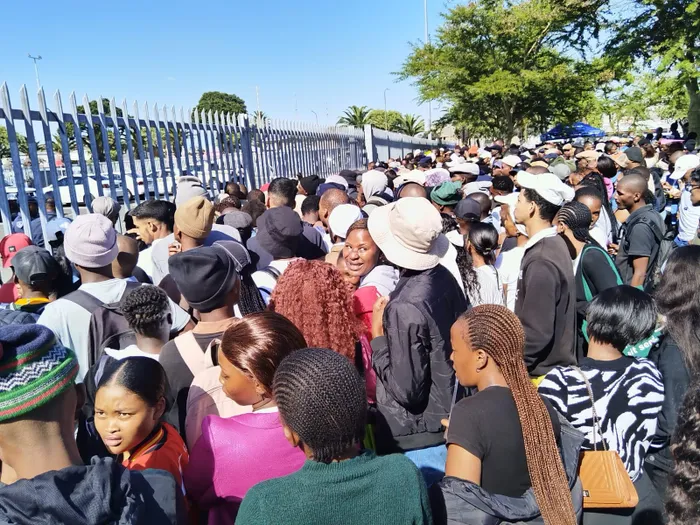
Frustrated young people gathered at the gates of Athlone Stadium, facing disappointment as the event reached capacity. The latest unemployment statistics painted a sobering picture of the state of the labour market in South Africa as the official unemployment rate to 32.7% in the first quarter of 2026, up from31,4% in the previous quarter.
Image: Phiri Cawe
The Portfolio Committee on Employment and Labour has called for urgent governance reforms, stronger accountability and accelerated labour market interventions as it adopted its Draft Report on Budget Vote 31 for the 2026/27 financial year.
The committee on Thursday finalised the report following engagements with the Department of Employment and Labour and its entities on their five-year strategic plans and annual performance targets.
Committee chairperson Boyce Maneli said the oversight process took place against a backdrop of persistent unemployment, weak economic growth and mounting pressure on public institutions to improve service delivery.
“The committee recognises the important role that the department and its entities must play in advancing inclusive growth, labour market stability, workplace justice, and social protection,” Maneli said.
The latest unemployment statistics painted a sobering picture of the state of the labour market in South Africa as the official unemployment rate to 32.7% in the first quarter of 2026, up from31,4% in the previous quarter.
StatsSA data indicates that unemployment among young people aged 15-24 remains alarmingly high, exceeding 60%, while millions of young South Africans remain outside employment, education and training.
The committee welcomed the department’s focus on labour market regulation, governance improvements and modernisation of services in line with the Medium-Term Development Plan.
However, lawmakers expressed concern that the department’s R4.578 billion budget allocation remains heavily skewed toward operational expenditure and transfers, leaving limited room for infrastructure development, systems modernisation and digital transformation.
The committee also reviewed the performance and strategic plans of key labour entities including the Unemployment Insurance Fund (UIF), Compensation Fund, Commission for Conciliation, Mediation and Arbitration (CCMA), National Economic Development and Labour Council (Nedlac), Productivity South Africa and Supported Employment Enterprises (SEE).
Committee members acknowledged the critical role played by these institutions but raised concerns over recurring governance failures, audit findings, ICT-related weaknesses and operational inefficiencies.
Particular attention was given to the implementation of Audit Action Plans following findings by the Auditor-General (AG). The committee stressed the need for stronger internal controls, consequence management and improved accountability systems across the labour portfolio.
The committee heard that the UIF had addressed 85% of AG findings, while the Compensation Fund reported that 62% of identified audit action measures had been fully implemented.
Despite this progress, committee members voiced concern over ongoing ICT governance weaknesses, recurring irregular expenditure, procurement non-compliance and historical financial misstatements.
“The committee noted that ICT-related weaknesses remain a major source of audit instability across the portfolio and require urgent structural intervention,” Parliament said in a statement.
The committee also called for improvements in UIF and Compensation Fund claims processing systems, increased labour inspectorate capacity and expanded labour activation programmes targeting vulnerable and rural communities.
Members further urged the department to ensure transparency and urgency in the planned placement of 200,000 unemployed graduates through labour activation initiatives.
The committee said opportunities should be widely advertised and implemented within clear timelines to maximise their impact on unemployment.
Attention was also placed on investment governance within the UIF and Compensation Fund, particularly investments managed through the Public Investment Corporation (PIC).
The committee called for joint briefings between the department, UIF, CF and PIC on investment performance, governance safeguards and risk mitigation measures linked to underperforming investments.
The committee also welcomed efforts by the UIF to recover funds linked to irregularities in the COVID-19 Temporary Employer/Employee Relief Scheme through collaboration with law enforcement agencies and the Special Investigating Unit.
The report adopted by the committee will now be tabled before the National Assembly for debate next week.
BUSINESS REPORT