

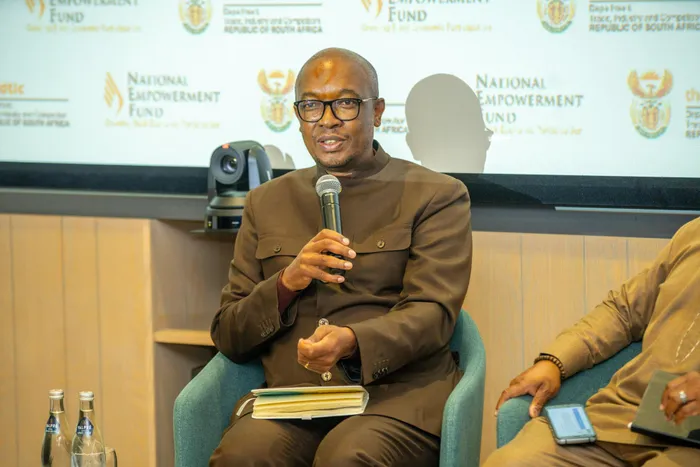
Minister of Trade, Industry and Comeptition, Parks Tau addressing the media on the Transformation Fund. The writer argues that alignment between key institutions, the National Treasury, the Sarb, the dtic, the FSCA and the Competition Commission mandatory.
Image: Supplied
By Dr Nthabiseng Moleko
Escaping South Africa’s low-growth trap will require a sustained effort to increase productive capabilities that drive structural transformation of the economy and promote labour-absorptive growth. Manufacturing contributes about 14% of GDP, yet black participation in industrial ownership and control remains low due to historic exclusion.
With strong spillovers, widening participation is central to inclusive growth. Expanding manufacturing is critical, as it not only drives growth but accelerates it through strong spillover and multiplier effects. Why are we arguing for widespread inclusion?
Exclusion from ownership and capital accumulation in manufacturing, energy and mining entrenched a racially concentrated industrial class and marginalised former homelands.
It is for this reason widespread inclusion is necessary, and the most appropriate policy instrument for advancing such is B-BBEE. It has resulted in more black representation in leadership, broader ownership structures, and Employee Share Ownership Schemes. But it has not removed key structural constraints or produced plentiful black industrialists to drive productivity and mass employment.
The limits of “trickle-down” transformation
Some argue inclusion will emerge organically through market-led growth (“trickle-down”). South Africa’s history suggests otherwise.
Concentrated supply chains create high barriers to entry. New manufacturers—especially Black entrants—need markets, concessional finance and enabling infrastructure, yet resources remain skewed toward large, established firms. The State’s reliance on commercial risk models left “unbankable” small- and mid-tier companies behind. New lenders face high barriers to entry, resulting in a systemic under-provision of credit to small businesses, limiting their ability to enter markets, scale operations, and create jobs.
Without deliberate mechanisms to widen participation, transformation will remain slow and growth constrained.
The lesson from COVID-19
COVID-19 exposed these barriers. A R200 billion loan guarantee scheme was introduced, but only R18.39bn (under 10%) was utilised by commercial banks.
Strict criteria produced a 56% rejection rate. “Good financial standing” requirements excluded many SMMEs, showing that reliance on commercial risk models can leave viable emerging businesses behind. Lending remained concentrated among larger, more stable entities, failing to reach entrepreneurs who required liquidity, crucial for South Africa’s economic recovery.
A concentrated financial system
South Africa’s financial ecosystem is highly concentrated: the big five banks control 90% of the banking market and 85% of clearing and settlement volume.
Such concentration has implications for economic participation. New lenders face high barriers to entry. Non-bank institutions struggle to access payment systems. Alternative sources of SMME finance remain underdeveloped. The result is a systemic under-provision of credit to small businesses, limiting their ability to enter markets, scale operations and create jobs.
Inclusive growth needs a developmental financing framework that blends public and private resources and tightens coordination across the National Treasury, the South African Reserve (Sarb) Bank, the Department of Trade, Industry and Competition (the dtic), the Financial Sector Conduct Authority (FSCA), and the Competition Commission. Output-based lending—linking finance to outcomes like jobs and production growth—can help direct capital to labour-absorbing activity.
A larger wave of B-BBEE needs a financial architecture aligned across regulation, competition policy, industrial policy and development finance. Inclusive growth needs a developmental financing framework that blends public and private resources and tightens coordination and targets output based lending that has development impact on production and reducing unemployment levels.
Alignment between key institutions, the National Treasury, the Sarb, the dtic, the FSCA and the Competition Commission mandatory.
Development finance institutions must be catalytic. The National Empowerment Fund (NEF) has grown annual disbursements from about R5 million in its early years to roughly R1bn in 2025, prioritising SMMEs in job-rich sectors.
Its reach is constrained by the NEF’s under-capitalisation, since 2010 it receives no fiscal allocations and relies on client collections and third-party funds under management. The NEF has sustained collections above 80% and raised capital via partnerships, but scaling inclusive industrial finance requires significantly greater capitalisation.
The proposed Transformation Fund could mobilise public and private capital for black-owned enterprises through first-loss guarantees, patient capital and blended finance, including mobilising pension funds into productive infrastructure and industrial investment.
Linking finance to industrial growth
Government’s estimated R1 trillion infrastructure commitment in the MTEF can catalyse growth and jobs if matched with coordinated planning, supplier readiness and support that helps SMEs build productive capacity and integrate new enterprises in domestic supply chains building high impact businesses.
Public procurement should advance industrial policy by building domestic suppliers and growing Black-owned firms in supply chains, including in former homelands. Clear infrastructure pipelines can unlock bankable opportunities for emerging firms across infrastructure, logistics, manufacturing, energy, digital infrastructure and agri- processing.
The task is not only redistribution, but expanding productive capacity so growth rises above 1.6% and excluded communities enter employment at scale. Public procurement and pension fund capital must be strategically leveraged to align closely with industrial policy objectives.
A new model of inclusive growth is essential in South Africa’s profoundly unequal society. Scaling capital-allocation pathways through institutions that finance the historically disadvantaged, build industrial capabilities alongside an infrastructure-led growth path, and develop local value chains that create bankable demand for new entrants. The NEF capitalisation sits at 0.1% of GDP versus the global standard of DFIs at 10% of GDP. Leveraging the entire financial system towards a national industrial development strategy is imperative.
Sustained growth rate of at least 6% cannot be realised without redistribution, and broader economic participation. South Africa needs a new economic compact focused on industrialisation, targeted fiscal support for productive sectors, stronger public-private investment in infrastructure expansion, expanded market access for new entrants, and a more capable, coordinated State.

Dr Nthabiseng Moleko is the chairperson of the National Empowerment Fund (NEF).
Image: Supplied
* Dr Nthabiseng Moleko is the chairperson of the National Empowerment Fund (NEF).
** The views expressed do not necessarily reflect the views of IOL or Independent Media.
BUSINESS REPORT