

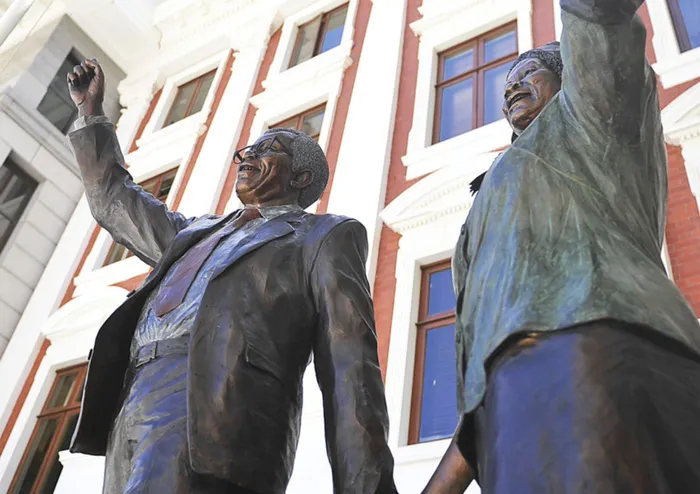
Statue of Sisulus main attraction at Parliament Statues of struggle icons Walter and Albertina Sisulu in Parliament. The writer argues that if our policies do not reach the forgotten corners of the Eastern Cape, then we are not honoring the Sisulus; we are merely performing a ritual of memory while the substance of their work slips away.
Image: File
Dr Pali Lehohla
This afternoon at the University of the Witwatersrand, as we convene to honor the lives and legacies of Ntate Walter and Mama Albertina Sisulu, we do not merely gather for a commemorative exercise. We gather to interrogate the "Numerical Truth" of our democracy. We do so by anchoring our reflections in the Lehohla Ledger—utilizing our 2,752 analytical instruments to measure the distance between the state we promised and the reality we inhabit.
The Architecture of Integrity
In the halls of Wits, an institution that stands as a pillar of intellectual rigor, we must recognize that Ntate Walter and Mama Albertina were the architects of an "Architecture of Morena Mohlomi". Ntate Walter served as the Scale—the master strategist who understood that for a movement to be sustainable, it must be institutionalized, methodical, and governed by an unbreakable internal logic. Mama Albertina served as the Engine—the tireless, nurturing force whose commitment to "Encebo-Leruo" reminded us that liberation is empty if it does not translate into the tangible economic dignity of the household and the community.
They were not abstract political actors. They were, in the most profound sense, servants of the people who understood that leadership is an act of intergenerational value creation. They built a legacy that serves today as our most vital Successor Ledger.
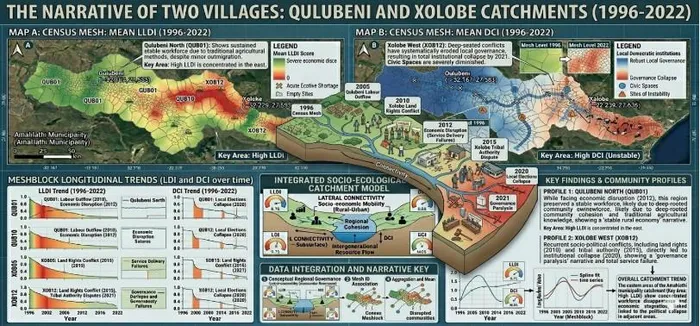
The narrative of two villages: Qulubeni and Xolobe catchments (1996-2022)
Image: Supplied
The Census Mesh of Their Origins and Conver
As we host this lecture, we must bring the "authentic essence" of their origins into the room. We look at Qutubeni and Xolobe, the birthplaces of these giants. When we perform a spatial analysis of these areas across the 1996, 2001, 2011, and 2022 Censuses, the "Numerical Truth" is sobering. We see the "Administrative Sump"—a landscape where, despite the names of our heroes being etched onto school walls, the infrastructure of the Enumeration Areas (EAs) remains trapped in a cycle of rural stagnation.
In our pursuit of Numerical Truth, we must turn the gaze of the 2,752 instruments of the Lehohla Ledger toward Qutubeni and Xolobe. To speak of Ntate Walter and Mama Albertina Sisulu without anchoring their legacy in the spatial reality of these villages is to ignore the foundational "census mesh" that authenticates our history.
Qutubeni, the cradle of Ntate Walter, and Xolobe, the birthplace of Mama Albertina, represent the profound disconnect between national iconography and local reality. When we trace the Enumeration Areas across the 1996, 2001, 2011, and 2022 Censuses, the narrative shifts from heroic struggle to a sobering account of systemic stagnation. In these spaces, the "Administrative Sump" is visible—not in rhetoric, but in the absence of basic infrastructure that should have been the dividend of the democracy they fought to secure.
The Successor Ledgers are clear: the "Encebo-Leruo" championed by Mama Albertina—the weaving of dignity and community wealth—has yet to be fully realized in the soil of Xolobe. Similarly, the "Scale" and "Engine" embodied by Ntate Walter remain absent in the agrarian recovery of Qutubeni. We see villages acting as peripheral nodes in the economy, struggling with the "Vulture Vortex" of extractive neglect, where legacy is commemorated with plaques while the citizenry endures service delivery gaps.
To truly honor the Sisulus is to demand a recalibration of our developmental metrics. If our Sovereign Statistics do not reflect the upliftment of the specific wards and EAs where our giants were born, then our democratic project remains incomplete. We must bridge this gap by applying the Architecture of Morena Mohlomi, ensuring that the legacy of the Sisulus is measured by the tangible, measurable improvement of the lives of those still living in the villages that birthed them. Our duty is to turn memory into a living, rigorous, and equitable ledger of progress.
This is the central contradiction of our current era: we celebrate the Sisulus in the capital, yet we allow the soil of their birth to suffer from a lack of "Sovereign Statistics"—the precise, localized data needed to drive investment, water, and connectivity to the very wards where they drew their first breaths.
The Challenge to the Successor Generation
To host this lecture at Wits is to accept a duty. We are tasked with rejecting the "Vulture Vortex"—that extractive economic model that treats our history as a trophy to be displayed while the foundations of our society are allowed to erode.
The Sisulus left us a blueprint. They taught us that you cannot build a nation from the top down. You build it from the ward up, from the EA up, and from the household up. Our task today is to demand that the state’s performance be measured against the development of these spaces. If our policies do not reach the forgotten corners of the Eastern Cape, then we are not honoring the Sisulus; we are merely performing a ritual of memory while the substance of their work slips away.
A Call to Authentic Service
Let this afternoon be a recalibration. Let us recognize that "Numerical Truth" is not a cold, mechanical pursuit, but a moral one. It is the quantification of our failures and our potential. As we discuss their lives, let us resolve to treat the "Successor Ledgers" of our democracy with the same reverence that Ntate Walter gave to his organizational files and Mama Albertina gave to the families she served.
We must move beyond the rhetoric of the podium and return to the "census mesh". We must ensure that the "Architecture of Morena Mohlomi"—defined by balance, justice, and intergenerational stewardship—is not just discussed, but deployed. We owe it to the Sisulus to ensure that their legacy is not just a chapter in a history book, but the living, breathing, and measurable engine of our future.
In pursuance of this objective, the Lehohla Ledger, under the guidance of the 2,752 instruments of diagnosis and implementation, will avail these this decades of conversations to boldly say in defence of the South Africa I know the home I understand.
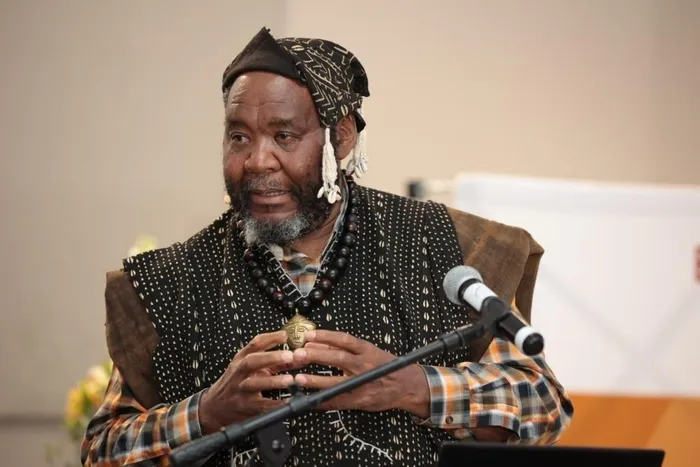
Dr Pali Lehohla is a Professor of Practice at the University of Johannesburg, a Research Associate at Oxford University, and a distinguished Alumni of the University of Ghana. He is the former Statistician-General of South Africa.
Image: Supplied
* Dr. Pali Lehohla is the former Statistician-General of South Africa, Director of the Pan African Institute for Evidence (PIE), and the founder of the Lehohla Ledger. He is a Professor of Practice at the University of Johannesburg and a Research Associate at Oxford University.
** The views expressed do not necessarily reflect the views of IOL or Independent Media.
BUSINESS REPORT