

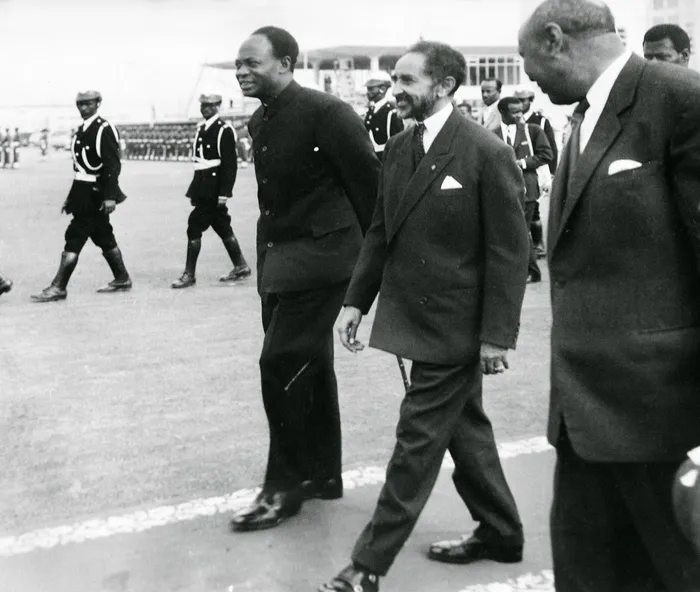
Ghana's founder and first President Kwame Nkrumah (left) and Ethiopian Emperor Haile Selassie (centre) at the formation of the Organization of African Unity (OAU) in Addis Ababa, Ethiopia on May 25, 1963. The writer argues that Africa Day invites celebration, and rightly so, yet love for Africa must be honest enough to confront the institutional weaknesses that continue to undermine its promise.
Image: AFP
By Nqobani Mzizi
Every year, Africa Day is celebrated as a reminder of where the continent has come from. Rightfully so. The day commemorates the founding of the Organisation of African Unity in 1963, the continental body that later gave way to the African Union (AU). Its historical significance lies in the pursuit of liberation, self-determination and African solidarity. That history deserves honour. Yet commemoration without reflection risks becoming ceremony.
The deeper question is whether the freedom that was pursued through political liberation is being sustained through institutions that can deliver dignity, trust and opportunity. It should also unsettle us into asking whether our institutions are strong enough to carry Africa where it must still go.
Africa is often spoken about through the language of promise. It has a young population, vast natural resources, expanding digital potential, entrepreneurial energy, cultural strength and increasing continental ambition. These strengths are real and should not be dismissed or treated as rhetorical decoration. Yet, promise does not govern itself. Without capable institutions, ethical leadership, public accountability and long-term stewardship, promise becomes frustration.
This is the governance burden of Africa’s future.
The liberation generation carried the burden of political freedom. This generation carries the burden of institutional stewardship. That burden is no less serious. Political sovereignty created the right to determine our own future. Governance determines whether that future is experienced by citizens as justice, stability and possibility.
Citizens do not experience Africa’s promise through declarations alone. They experience it through whether water flows, electricity is reliable, schools function, hospitals treat people with dignity, roads connect communities, public resources are protected and opportunities are accessible. The test of governance is lived, and it is found in the gap between what institutions promise and what people experience.
Africa Day must be more than a celebration of continental identity. It must also be a moment of institutional self-examination. The question is not whether Africa has potential. That answer is obvious. The harder question is whether African institutions, public and private, are being governed in a manner that can convert potential into reliable outcomes.
The African Union’s 2026 theme, “Assuring Sustainable Water Availability and Safe Sanitation Systems to Achieve the Goals of Agenda 2063,” gives this reflection practical grounding. Water and sanitation are often treated as service delivery or infrastructure matters. They are that, but they are also governance matters. They reveal whether institutions can plan, coordinate, procure, maintain, monitor and account. They reveal whether dignity is protected in the most basic ways.
A continent cannot speak credibly of transformation while citizens still experience water and sanitation as daily uncertainty. Safe water is not only a technical output. It is a measure of institutional reliability. Sanitation is not only a municipal function. It is a reflection of whether governance recognises the human being behind the policy target. When infrastructure collapses, maintenance is deferred, corruption weakens delivery, or when planning fails to keep pace with growing communities, governance failure becomes visible in the most intimate spaces of human life.
The AU theme is therefore not narrow. Water touches health, agriculture, education, energy, industry and social stability. The African Union has framed the 2026 theme as a call for governments to prioritise water and sanitation within national development agendas, recognising that the response must be integrated. This is precisely the language of governance: coordination, accountability and long-term systems thinking.
Yet, Africa’s governance burden does not rest with governments alone. Corporate boardrooms, public entities, universities, regulators, professional bodies, civil society organisations and regional institutions all form part of the continent’s institutional ecosystem. The quality of Africa’s future will be shaped not only in parliaments, but also in boardrooms where capital is allocated, risks are priced, communities are affected, and long-term value is either created or extracted.
African boardrooms are not separate from Africa’s future. They are among the places where that future is either protected, exploited or neglected. A board that approves an extractive strategy without regard for communities is making a governance choice. A board that treats environmental degradation as an externality is making a governance choice. A board that allows weak controls, unethical procurement or opaque stakeholder engagement is making a governance choice. These choices may appear corporate, but their consequences are social.
Good governance in Africa must therefore move beyond imported compliance language. It must ask whether organisations are contributing to sustainable value in the societies in which they operate. This does not mean boards must abandon commercial discipline. It means commercial discipline must be exercised with ethical intelligence and contextual awareness. Profit that destroys trust, weakens communities or depends on institutional fragility cannot be regarded as sustainable.
This is where stakeholder governance becomes central. Africa’s future requires institutions that understand their relationship with employees, communities, regulators, suppliers, customers and future generations. It requires boards that can balance ambition with accountability. It requires public institutions that understand that authority is not ownership. It requires leaders who know that resources held today are also held in trust for tomorrow.
The continent has no shortage of strategies, frameworks and declarations. Agenda 2063 speaks of “The Africa We Want,” a vision of an integrated, prosperous and peaceful continent. The difficulty is not the absence of continental aspiration. The difficulty is execution. Aspirations become credible only when institutions are capable of implementing them, measuring progress honestly and correcting failure without denial.
This is why public trust is so central. It is the evidence that governance is being experienced as credible. Citizens trust when institutions act consistently. Investors trust when rules are predictable. Communities trust when consultation is meaningful. Young people trust when opportunity is not permanently captured by proximity to power. Once trust collapses, even good policies are received with suspicion.
The governance burden of Africa’s future is therefore a burden of trust. It asks real questions: whether institutions can be believed; whether leaders can account; whether power can be exercised with restraint; whether public resources can be protected and whether the continent’s wealth can be converted into dignity rather than elite accumulation.
Africa Day invites celebration, and rightly so. The continent’s history carries extraordinary struggle, resilience, creativity and courage. Yet love for Africa must be honest enough to confront the institutional weaknesses that continue to undermine its promise. Celebration without accountability can become sentimentality. Criticism without commitment can become cynicism. Governance sits between the two. It honours the promise while insisting on the discipline required to fulfil it.
The future of Africa will not be secured by demographics alone. A young population can become a dividend or a source of despair, depending on whether institutions can provide education, employment, safety and opportunity. Natural resources can build shared prosperity or deepen inequality, depending on whether they are governed transparently. Digital transformation can expand inclusion or widen exclusion, depending on whether it is governed ethically. Continental trade can unlock value or reproduce old patterns, depending on whether implementation is credible.
Africa does not lack possibility. Its burden is governance.
That burden belongs to all who hold institutional responsibility. It belongs to directors who must govern beyond quarterly performance. It belongs to executives who must implement with integrity. It belongs to public officials who must remember that authority is a trust. It belongs to regulators who must protect systems without fear or favour. It belongs to citizens who must keep demanding accountability. It belongs to all institutions that shape the conditions under which African lives are lived.
Africa Day should therefore be more than a commemoration of what was won. It should be a summons to govern what was inherited. The continent’s future will not be secured by promise alone, however compelling that promise may be. It will be secured by institutions that can plan, implement, account and endure.The promise celebrated on Africa Day must become dignity experienced by Africa’s people.
That is the governance burden of a continent’s future.

Nqobani Mzizi is a Professional Accountant (SA), Cert.Dir (IoDSA) and an Academic.
Image: Supplied
* Nqobani Mzizi is a Professional Accountant (SA), Cert.Dir (IoDSA) and an Academic.
** The views expressed do not necessarily reflect the views of IOL or Independent Media.
BUSINESS REPORT