

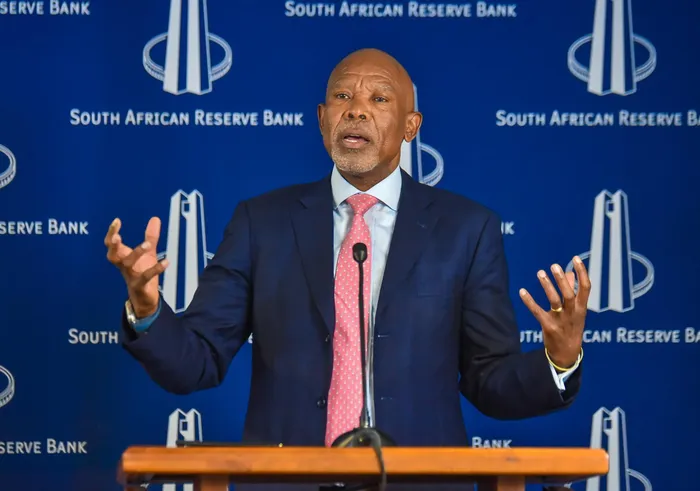
Sarb Governor Lesetja Kganyago. The writer argues that given the sharp increase in the inflation rate from 3.2% in March to 4.0% in April, sentiment is turning towards a rate increase on Thursday.
Image: SARB | Facebook
Chris Harmse
Financial markets across the globe once again last week moved weaker with a lot of uncertainty. Monthly reports from the IMF, UN, OECD and other research engines are all in agreement. Their analysis tells a worrying story. All agree that world economic growth in 2026 will be downward to 2.5% to 2.9%, against the 4.0% forecasted in February. This was before the 28 February attack of the US on Iran. They all agree that world inflation in 2026 will almost double from 2.5% to 4.2%, and that the global unemployment rate will accelerate from 4.0% to higher than 5.0%. The closure of the Strait of Hormuz has triggered a surge in oil and gas prices. Brent crude prices are projected to average $94.85 per barrel for full-year 2026. This is much higher than $82 per barrel forecasted at the end of April, with potential spikes up to $135–$150 in severe scenarios.
The above scenarios had once again a negative effect on South African financial markets last week. On the JSE, the ALSI decreased 1.15% last week, losing 3.4% over the last month and is down by 15,239 points or 11.9% down from Friday 26 February, a day before the US/Iran conflict started. The big losers last week were the JSE precious metals and mining sector that traded down by 5.4%. Industrials kept its value as the index lost only 1.6% last week, while financials traded higher the last five days by 1.80%. The FIN15 index, however, started to move negative as fears of a hike in the repo rate by the Monetary Policy Committee (MPC) this coming week.
On global markets equities, however, returned to positive territory last week. The MSCI world index increased by 1.5% last week. On Wall Street in the US, the Dow Jones bourse gained 2.3% and pushed the monthly return into positive numbers (2.7%). The S&P500 index advanced by 0.8% (5.7% over the last month) and the NASDAQ higher by 0.5% (7.8% over the last month). In the UK, the FTSE 100 also shot up by 2.7% last week.
High possibility of a repo rate hike on Thursday
Given the sharp increase in the inflation rate (CPI) of South Africa from 3.2% in March to 4.0% in April, and expectations, expressed by the MPC at its previous meeting that if oil prices remain elevated between $100 and $110 the inflation rate may test the 5.0% within months, sentiment is turning towards a rate increase on Thursday. The latest estimate is that the increase in the CPI in May will amount to 4.7%. These expectations put a high possibility of a hike of at least 0.25% this coming week.
The rand and fuel prices
The rand exchange rate showed some resilience last week and traded in a narrow but stronger band throughout the week. The currency opened last Monday on R16.71/$ but slowly started to appreciate for most of last week and closed Friday evening on R16.44/$. Against the pound, the rand gained 13 cents during last week to close on R22.11/£ and against the euro moved stronger by 22 cents last week to close on R19.08/€, its strongest level since 11 March 2026. The more stable rand and a lower brent oil price contributed to good prospects that especially the price for diesel may decrease at the beginning of June. By Thursday the diesel price was R4.81 per liter over recovered, meaning that a possible decrease in the diesel price is possible. The factor that may influence the final price to the consumer remains the decision by the Minister of Finance on the fuel tax. In March, the National Treasury cut the fuel tax on diesel and petrol by R3.00 per litre and again for petrol by R3.00 and for diesel by R3.93 per litre in April. The question is whether it will be reclaimed in June and by how much. The price of petrol was under recovered by 5 cents per litre by last Thursday.
Prospects for the coming week
This coming week all eyes will be on the decision on the repo rate by the MPC on Thursday. Statistics South Africa will release the producer price (PPI) inflation rate for April on Wednesday. It is expected that the annual rate will increase 2.7%, against the annual 2.3% in March. Apart from the developments in the Strait of Hormuz on the current oil blockade that will dominate global and domestic share, bond and exchange rate markets, the US will release its Q1 GDP economic growth figure, as well as the important personal income and spending data for April on Wednesday.

Chris Harmse is the consulting economist of Sequoia Capital Management and a senior lecturer at Stadio Higher Education.
Image: Supplied
* Chris Harmse is the consulting economist of Sequoia Capital Management and a senior lecturer at Stadio Higher Education.
** The views expressed do not necessarily reflect the views of IOL or Independent Media.
BUSINESS REPORT