

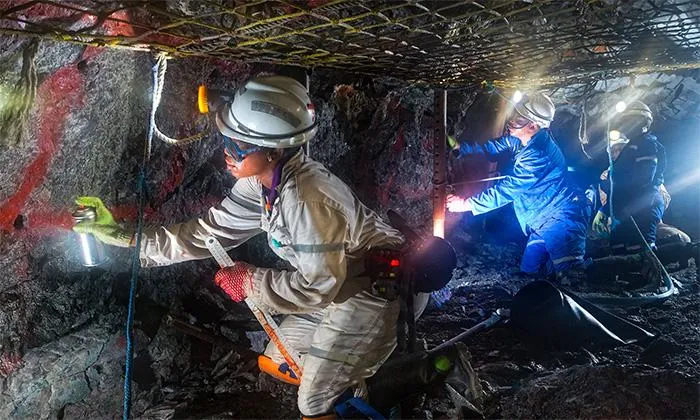
According to the annual review, the mining sector employed 470,457 people in 2025 and paid R200 billion in wages.
Image: Supplied
The Minerals Council South Africa has reiterated that the country's mining industry remains a critical pillar of the economy despite ongoing domestic and global uncertainty.
The Minerals Council’s members account for approximately 90% of South Africa’s annual mined production by value, underlining the organisation’s influential role in shaping the future direction of one of the country’s most important industries.
During its 136th Annual General Meeting (AGM) on Wednesday, the council called for urgent policy certainty, infrastructure reform and sustainable investment to secure the sector’s future growth.
The council's 2025 integrated annual review also outlined the challenges facing the sector, including regulatory uncertainty, infrastructure constraints, rising electricity costs and emerging water security risks.
Minerals Council President Paul Dunne described the current period as one of the most important moments for the country’s mining industry, as government moves to revise the Mineral and Petroleum Resources Development Act (MPRDA), first gazetted more than two decades ago.
In May 2025, the Minister of Mineral and Petroleum Resources published the Draft Mineral Resources Development Bill, 2025 (MRDA Bill) for public comment, signalling a major reform of South Africa’s mineral regulatory framework.
“We are living through one of the most important moments in recent years for the South African mining sector,” Dunne said during the AGM. “A fundamental sea change is underway as the Department of Mineral and Petroleum Resources revises the Act.”
Among other things, the bill aims to introduce artisanal and small-scale mining permits, change the definition of community and meaningful consultation, introduces the definition of interested and affected parties, and give effect to Section 24 of the Constitution (the right to a healthy environment). It also aims to speed up mining projects and ensure that more minerals are processed in South Africa instead of being sold raw to other countries.
But the industry has opposed the bill, saying that in its current form it does not encourage or sustain the growth and investment that the mining industry needs to realise its full potential to create employment, stimulate the economy and fulfil its social mandate
Dunne warned against prolonged legal disputes over mining legislation, referencing previous court battles between the Minerals Council and the Department of Mineral and Petroleum Resources (DMPR) over elements of the Mining Charter and earlier amendment bills.
“A repetition of drawn-out wrangling because of an ill-considered Amendment Bill, which does not reflect our engagements with the DMPR, must be avoided at all costs,” he said.
Both Dunne and Minerals Council CEO Mzila Mthenjane said engagements with the DMPR during 2025 had been constructive and encouraging, expressing hope that the revised Mineral Resources Development Bill would reflect ongoing discussions between government and industry stakeholders.
Mthenjane said disciplined policy reform and collaboration between government and industry could position mining as a major driver of South Africa’s economic and industrial development for decades to come.
“With disciplined policy reform, modernisation and partnerships, mining can anchor and elevate South Africa’s economic development, industrial capability, and social progress for decades to come,” Mthenjane said.
According to the annual review, the mining sector employed 470,457 people in 2025 and paid R200 billion in wages. The industry also contributed R124bn in taxes to the fiscus and added R477bn to South Africa’s gross domestic product, accounting for 6.2% of GDP.
South Africa’s mining exports remained a major source of foreign earnings, with minerals exports valued at R816bn during the year.
The Minerals Council said it continued to play an active role in addressing the country’s energy and logistics crises. During 2025, the organisation welcomed structural reforms aimed at opening energy generation, rail and port services to greater private sector participation.
Mining companies have increasingly invested in renewable energy projects to reduce reliance on the national electricity grid, lower operating costs and cut carbon emissions.
The council also intensified lobbying efforts for lower electricity tariffs, particularly for ferroalloy smelters that have become globally uncompetitive following electricity price increases of more than 900% since 2008.
While energy and logistics reforms showed progress, the council identified water security as an emerging and urgent risk for the industry. Several mining regions experienced disruptions to bulk water supply during 2025, exposing weaknesses in municipal and regional infrastructure systems.
“Water is essential to both communities and operations, and strengthening maintenance capacity, governance and investment in water infrastructure must become a national priority,” Dunne said.
For 2026, the Minerals Council said its priorities would focus on improving mine safety through predictive safety systems, strengthening transformation through skills development, securing policy certainty around the new mining legislation and restoring infrastructure reliability to support production and exports.
The organisation also plans to accelerate innovation and modernisation initiatives aimed at improving productivity and sustainability across the mining sector.
BUSINESS REPORT