

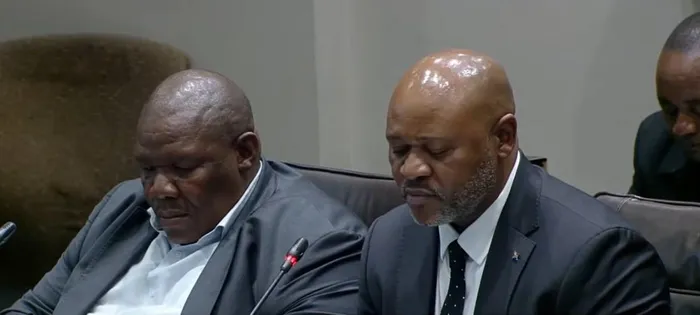
uMsunduzi Mayor Mzi Thebolla and municipal manager Felani Mndebele led a large municipal delegation to Parliament on Wednesday to appear before Scopa over the latest audit outcomes and SIU investigation.
Image: YouTube screengrab
The Msunduzi Municipality has improved its audit outcome from a qualified opinion to an unqualified audit opinion for the 2024/25 financial year, but serious governance failures, escalating irregular expenditure, and weak consequence management continue to plague the municipality.
Appearing before the Standing Committee on Public Accounts (Scopa) on Wednesday, municipal officials acknowledged that while financial controls had improved, longstanding issues involving procurement irregularities, delayed disciplinary processes, forensic investigations and political disagreements within council continue to undermine accountability.
Municipal officials told Members of Parliament that the city had received qualified audit opinions in both the 2022/23 and 2023/24 financial years before improving to an unqualified outcome in 2024/25.
Odwa Langa, senior manager in the office of budget and treasury in the municipality, attributed the improvement to stricter internal controls, audit action plans and increased monitoring by management structures.
“In line with section 131 of the MFMA, a collective audit action plan has been developed to address matters raised by the Auditor-General. The audit steering committee meets twice a week to monitor the implementation of the audit action plans,” Langa told the committee.
“To date, we are sitting at 50% of the findings that have been resolved and the 40% is still in progress of being resolved. Further strategies on improving internal controls are being employed to deal with the matters of emphasis, material regularities as well as all findings on the management report.”
Despite the improved audit opinion, the Auditor-General flagged major concerns, including unpaid creditors older than 30 days, procurement violations, fruitless and wasteful expenditure, electricity and water losses, delayed infrastructure projects and doubts over the municipality’s financial sustainability.
Scopa members focused heavily on the municipality’s inability to implement effective consequence management, particularly in cases involving fraud, procurement irregularities and financial misconduct.
Municipal officials admitted that disciplinary and forensic processes had stalled for years, with many investigations remaining unresolved.
The municipality disclosed several material irregularities, including losses from prepaid electricity sales, failures in credit control implementation and revenue losses from timber sales.
Officials confirmed that some investigations had been completed and referred either to court processes or disciplinary structures. However, they acknowledged that implementation of recommendations remained a challenge.
They said a major obstacle was political instability within the municipality’s hung council, where confidential forensic reports often fail to gain approval. Additionally, council had repeatedly failed to conclude confidential matters linked to investigations and disciplinary action since November last year.
Scopa members also raised alarm over the municipality’s growing fruitless and wasteful expenditure, which climbed to nearly R399 million in the current financial year.
Officials blamed the increase on prolonged employee suspensions, fraud investigations, cancelled tenders and interest on overdue Eskom and bulk water payments.
uMsunduzi chief financial officer, Nelisiwe Ngcobo, admitted that several employees implicated in fraud-related cases had remained on paid suspension for more than six months, forcing management to redeploy some officials to other departments to avoid further fruitless expenditure.
"There are cases, more especially in finance, where they are suspended for fraud related cases. But because of the time it has taken to conclude their cases after six months, it then becomes fruitless and wasteful expenditure," she said.
"And then we bring them back to other departments where they won't be involved in terms of cash. So we then move them to either waste or any other department so as to avoid incurring fruitless and wasteful expenditure."
Scopa chairperson Songezo Zibi questioned why disciplinary processes were taking so long despite suspensions already being based on preliminary evidence, but Ngcobo said investigators and officials handling disciplinary matters had faced intimidation and death threats from implicated individuals.
Officials said the municipality had resorted to using external panels facilitated by the South African Local Government Association (Salga) to manage disciplinary and investigative processes after internal staff members were threatened.
Scopa members criticised what they described as a culture where intimidation appeared to obstruct accountability processes.
Irregular expenditure also remained alarmingly high in uMsunduzi at more than R522m during 2024/25, with several contracts linked to procurement deviations, expired agreements, security tenders and infrastructure delays.
Municipal Manager Felani Mndebele acknowledged weaknesses in procurement oversight, including cases where contracts had to be extended repeatedly because of internal backlogs and tender evaluation delays.
Despite the governance concerns, Msunduzi defended its progress, highlighting improvements in revenue collection, infrastructure maintenance and internal financial controls.
BUSINESS REPORT