

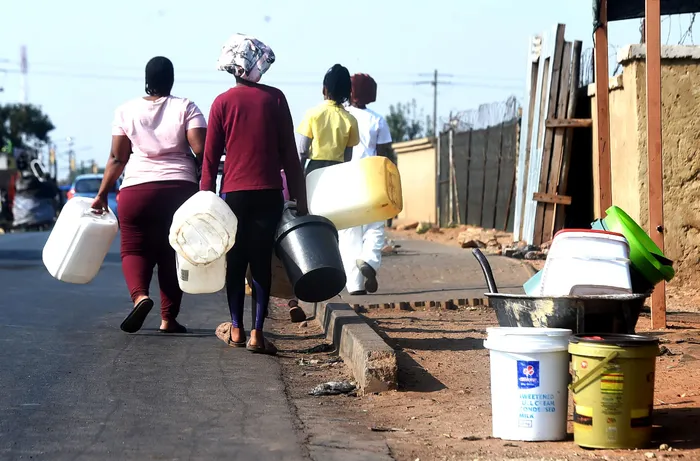
AG business unit leader Fhumulani Rabonda told MPs that water infrastructure should be treated as a priority area requiring urgent intervention.
Image: Itumeleng English / Independent Newspapers
The Auditor-General has raised serious concerns about the state of Johannesburg's water infrastructure, warning Parliament that deteriorating facilities, inadequate maintenance and weak project management are contributing to environmental damage, service delivery failures and growing public health risks.
Presenting the City of Johannesburg's 2024/25 audit outcomes to Parliament's Standing Committee on Public Accounts (Scopa) on Tuesday, AG officials highlighted extensive shortcomings at key Johannesburg Water facilities, including wastewater treatment plants and water infrastructure projects.
According to the AG, Johannesburg's water losses remain alarmingly high at 45%, translating into an estimated R2.8 billion in lost revenue. The city also owes water boards and Eskom about R3.1 billion in arrears.
AG business unit leader Fhumulani Rabonda told MPs that water infrastructure should be treated as a priority area requiring urgent intervention.
"With the water challenges that we are facing in the province, this is one of the projects that needs to be intervened," Rabonda said while referring to the Northern Wastewater Treatment Works, which is located in Diepsloot and is the largest of six wastewater treatment plants owned by the city.
"There is effective management and also effective monitoring of the implementation of the maintenance works and the clean, drinkable water that is provided to the citizens."
Earlier this year, Finance Minister Enoch Godongwana indicated that National Treasury may step in directly to address the deepening water supply crisis in the City of Johannesburg, warning that national government “cannot be a spectator” as the metro’s infrastructure deteriorates.
The AG's audit findings paint a troubling picture of the condition of Johannesburg's water assets.
During site visits to the Northern Wastewater Treatment Works and associated pump stations, auditors found "significant non-compliance due to deteriorating infrastructure, poor maintenance and failure to meet regulations".
The watchdog said this had resulted in "illegal discharges of untreated sewage and effluent, unreliable monitoring systems and ineffective environmental management, resulting in frequent spills, persistent water pollution, and increased environmental and health risks".
Photographic evidence gathered during inspections showed non-operational equipment, including belt presses and sedimentation tanks, while auditors also observed raw sewage spilling from a manhole directly into the Jukskei River.
The AG further identified weaknesses in several major Johannesburg Water projects, including the Nancefield outfall sewer, Diepsloot sewer pipeline, Woodmead reservoir and Randburg depot developments.
Auditors found that project delays were often linked to late payments to contractors arising from Johannesburg Water's cash-flow constraints.
"The project has exceeded its budget," the AG report noted in its findings on the Randburg depot project. Auditors said ongoing delays had forced Johannesburg Water to continue relying on leased premises, increasing operational costs.
The report also highlighted weak project monitoring, inadequate documentation, missing contract guarantees and poor stakeholder engagement across several infrastructure projects.
"Poor project oversight led to weak accountability, delayed issue detection and increased risk to the city," the AG said.
The concerns extend beyond infrastructure failures to governance shortcomings.
The AG reported that Johannesburg Water is linked to two active material irregularities involving substantial harm to the public. These include failures to prevent pollution of water resources at the Goudkoppies Wastewater Treatment Works and shortcomings in proactive maintenance of water infrastructure.
Overall, AG has identified 21 material irregularities across the city and its entities, with 17 linked to financial losses and two involving substantial harm to the public.
Tshwarelo Moloi, senior manager at the AG, noted that some infrastructure development and refurbishment prjects were done internally and some through the appointment of other service providers.
Moloi also warned that weaknesses in infrastructure delivery and maintenance were directly contributing to water losses.
"We did note that there is budget that has been allocated, and a particular percentage has been spent on those projects. On the wastewater treatment works, the budget that was allocated was not being fully utilised, and the project is still in progress," he said.
"However, in terms of the tariff payments, as the budget is being utilised, it is a concern that has been raised, and some of them, the cash flow constraints that are being noted in some of the entities that are given the responsibility to assist with implementing these projects."
In its overall assessment, the AG said delays in infrastructure delivery, weak project management and lack of maintenance caused high water and electricity distribution losses and had adverse effects on service delivery.
The report further noted that despite financial stabilisation efforts and support from National Treasury, Johannesburg's financial health remains under pressure due to liquidity constraints, mounting debt and poor revenue collection.
BUSINESS REPORT