


Liquidations rose in March amid trying economic conditions.
Image: ChatGPT
Business failures picked up sharply in March, with new data showing a spike in liquidations as pressure builds across parts of the economy, with the trade, catering and accommodation sector accounting for a fifth of all companies shut down.
Statistics South Africa reported that the total number of liquidations increased by 15% year-on-year in March, rising from 127 cases in March 2025.
The increase was driven by both companies and close corporations, with liquidations of close corporations rising by 14 cases and companies by five over the same period, Statistics South Africa said, drawing on data from the Companies and Intellectual Property Commission.
While the monthly jump was significant, the broader trend remains more subdued. In the first quarter of 2026, liquidations increased by just 1.1%, from 373 to 377 cases, compared with the same period last year.
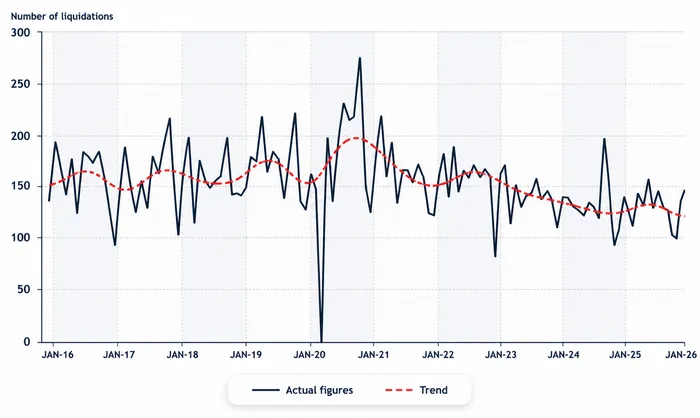
Liquidations crept up in March, mostly in the trade, catering, and accommodation sectors.
Image: Statistics South Africa
The divergence between the sharp monthly increase and the relatively flat quarterly trend suggests that business distress may be starting to accelerate.
The data shows that the bulk of liquidations continue to be voluntary rather than court-driven, pointing to companies choosing to wind up operations rather than being forced into liquidation.
In March alone, voluntary liquidations accounted for 130 of the 146 cases, compared with just 16 compulsory liquidations. This reflects a pattern where businesses are shutting down in a controlled manner, often in response to sustained financial pressure rather than sudden collapse.
The impact is uneven across sectors, but service-based industries and smaller enterprises appear particularly exposed.
Trade, catering and accommodation, as well as finance, real estate and business services, recorded some of the highest numbers of liquidations in March. Noteworthy is the fact that, when measured in current terms that include inflationary effects, total income for the tourist accommodation industry increased 7% in February 2026 compared with February 2025.
While caravan parks and camping sites continued to show declining popularity, guest houses and farms gained. However, the biggest leap came from what Statistics South Africa refers to as the “other” category – which includes BnBs.
Taking a three-month view, income was up 5.1% year-over-year.
In terms of company liquidations, close corporations, which are often smaller and more vulnerable to shifts in demand and costs, also saw a notable increase in liquidations.
Looking at the longer-term data, liquidations remain below levels seen earlier in the decade, but the recent uptick suggests conditions are tightening again.
IOL BUSINESS