

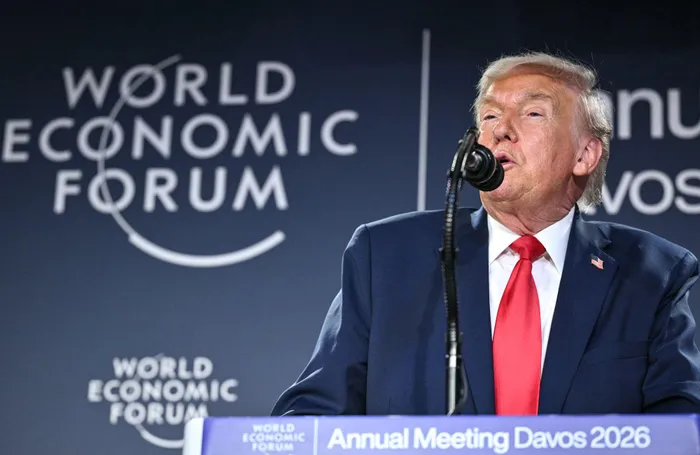
US President Donald Trump speaks during a reception with business leaders on the sidelines of the World Economic Forum (WEF) annual meeting in Davos on January 21.
Image: Mandel Ngan / AFP
In a striking condemnation of South Africa's land reform policies, US President Donald Trump has reiterated his controversial claims regarding a supposed “white genocide” against Afrikaners, accusing the South African government of perpetrating acts of injustice against this ethnic group.
Speaking during a press conference following his address at the World Economic Forum (WEF) in Davos, Trump asserted that the treatment of Afrikaners, descendants primarily of Dutch settlers, is “unbelievable” and must be contested.
“What’s happening in South Africa is terrible. It's a terrible situation,” Trump stated emphatically, directing the world's attention toward allegations of maltreatment and violence against Afrikaners that have gathered momentum over time.
He urged for these purported injustices to be “stopped,” expressing concern over the declining state of human rights in what is heralded as a democratic nation. This heightened rhetoric aligns with his administration's long-standing criticism of South Africa's reliance on race-based policies concerning land ownership that disproportionately affect white farmers.
The fabric of US-South African diplomatic relations has been particularly strained in recent months, primarily due to perceptions that the South African government is executing a systematic land grab, targeting white farmers and undermining their rights.
Trump’s mention of a recent US Human Rights Report highlighting racially motivated attacks against white farmers has amplified this rift, despite the South African government’s denouncement of such claims as “distorted and inaccurate.”
In an even more direct governmental response, Trump announced an executive order aimed specifically at assisting “Afrikaners in South Africa who are victims of unjust racial discrimination,” a move widely viewed as an overture to galvanising support among his base while escalating the tensions between the two nations.
The consequences of Trump's assertions have led to tangible repercussions, notably a shift in Washington's approach toward Pretoria.
Last year, the US House Committee on Foreign Affairs advanced a bill aimed at reassessing ties with South Africa and identifying government officials for possible sanctions. The recent diplomatic spat culminated in Trump opting out of the G20 Summit hosted by South Africa in Johannesburg this November and subsequently excluding Pretoria from the next summit slated for Miami.
Amidst these contentious remarks regarding South Africa, Trump's address at the WEF also marked a moment of self-congratulation, as he proclaimed the “fastest and most dramatic economic turnaround” in US history during his term in office.
Strengthening his narrative of America as the “economic engine of the planet,” he boasted of policy successes, including rising oil production and sweeping deregulation efforts, while simultaneously critiquing renewable energy policies in Europe.
Protests outside the WEF meeting underscored a broader discontent with Trump’s global impact, as Kurdish activists rallied, accusing him of genocide and calling for Kurdish autonomy. This juxtaposition of international concerns against Trump's America-first policies casts a shadow over his optimistic economic narrative.
IOL