

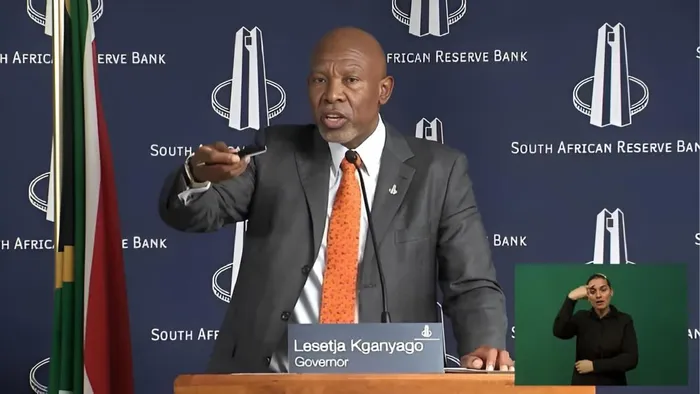
Untitled design - 1 South African Reserve Bank Governor, Lesetja Kganyago.
Image: File
South Africans will now be paying more on repaying their home loans, car finance deals, and credit cards after the Monetary Policy Committee decided in increase interest rates by 25 basis points to 10.50%.
This could add as much as R400 a month to living costs for households carrying roughly R1.55 million in debt.
Given the current geopolitical climate and the resultant spike in oil prices to as high as $120 a barrel, the decision will come as no surprise to market watchers.
South African Reserve Bank Governor, Lesetja Kganyago, in announcing the hike, said that the environment had changed since March, when the last meeting was held. He also pointed to households being "squeezed".
Markets project major central banks are expected to increase rates this year, said the Governor, also noting that international geopolitical events and climate change issues such as the floods in Cape Town would weight on growth.
Despite this, Kganyago said that South Africa's fundamentals were strong, even as inflation expectations increased to 4.4% this year, with the price of food especially to be anticipated.
Lerato Ntuli from Anchor Capital has cautioned that inflation risks remained “skewed to the upside”, warning that prolonged conflict in the Middle East could keep global oil prices elevated and continue feeding through into domestic fuel and transport costs.
The increase resulting in prime going from 10.25% to 10.50%, which can add as much as R400 a month to living expenses for indebted households, based on assumptions including a R1 million home loan, R500,000 in vehicle finance and R50,000 in credit card debt.
Earlier this week, market commentators and economists expected the central bank to hike rates, with Lara Hodes, Investec chief economist, saying SARB was likely to act pre-emptively to stop inflation risks linked to rising oil prices from becoming entrenched in the economy.
“The SARB is likely to hike rates by 25bp to 7% this week, acting pre-emptively to prevent any second-round effects from becoming embedded in inflation,” Hodes said. This is the policy rate that the bank uses and is several percentage points lower than prime.
Kristof Kruger from Prescient Securities concurred, saying markets had already largely priced in a 25-basis point increase, with investors now focused on whether the Reserve Bank indicates more tightening could follow should inflation and oil prices remain elevated.
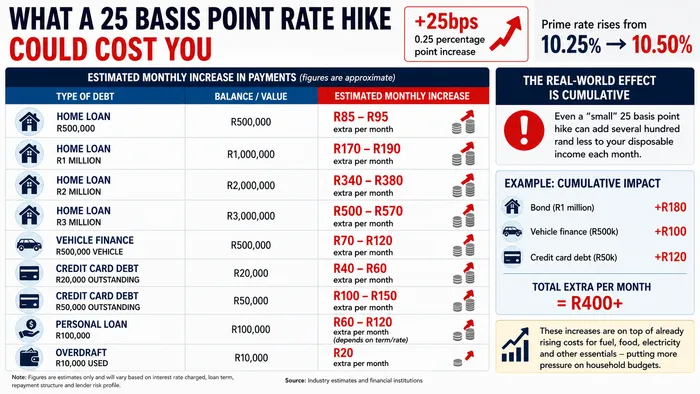
The effects of a 25bps increase on your pocket.
Image: ChatGPT
A higher-for-longer interest rate environment could help support the rand and reduce imported inflation risks linked to fuel and energy prices, said Harry Scherzer from Future Forex.
Samuel Seeff from Seeff Property Group, however, urged the Reserve Bank not to raise rates, arguing that the recent inflation spike was being driven largely by external pressures rather than excessive consumer demand.
“The higher inflation is largely imported. It is not the fault of consumers overspending in the economy,” Seeff said. He warned that another rate hike could place further pressure on households already struggling with debt costs and rising living expenses.
This comes at a time when the latest DebtBusters Debt Index for the first quarter of 2026 found that consumers earning more than R50,000 a month now require 101% of their take-home pay to service debt every month, while their debt-to-income ratio has climbed to 303% – the highest of any income group.
The report found South Africans were increasingly relying on unsecured lending to survive, with a record 96% of debt counselling applicants now holding a personal loan, while 61% had a payday or one-month loan.
The average number of credit agreements per applicant has climbed to 8.5 per person – the highest level since 2017 – suggesting growing dependence on multiple lenders.
This debt level coincides with salaries going backwards in terms of spending power, with real salaries – which reflect what consumers can actually buy with their earnings – for April falling by 1.2% month-on-month and 2.7% year-on-year to an average of R20,244, the lowest real salary level recorded in two years.
Independent economist Elize Kruger added: “With uncertainty around the global and local economic outlook expected to persist for some time, many businesses are likely to adopt a wait-and-see approach… This could negatively impact investment decisions, workforce expansion and earnings expectations for the remainder of 2026.”
IOL BUSINESS