

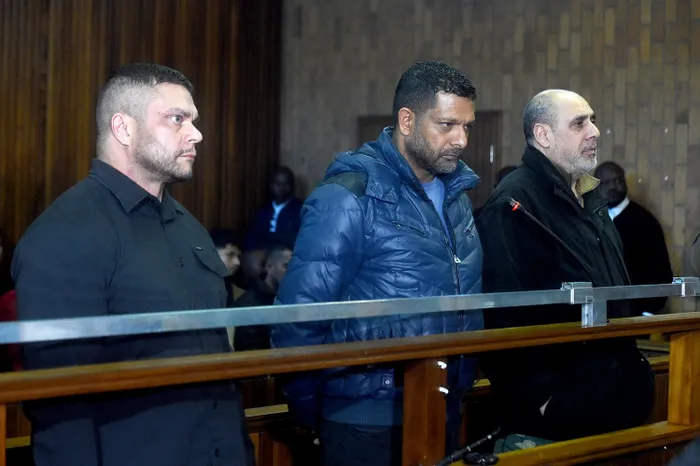
Durban businessman Tariq Downes, Crime Intelligence head Maj-Gen Feroz Khan and Gauteng Hawks head Maj-Gen Ebrahim Kadwa
Image: Itumeleng English/ Independent Newspapers
The illegal precious metals economy in South Africa could be worth as much as R60 billion a year, according to estimates reported by Reuters.
This illicit industry was thrust into the spotlight over the weekend with the arrests of Senior Crime Intelligence officer Feroz Khan and Gauteng Hawks head Ebrahim Kadwa. Both were expected to appear in the Kempton Park Magistrate’s Court on Monday in connection with alleged illegal precious metals dealings.
Welcoming the arrests, the South African Federation of Trade Unions (SAFTU) said this development confirms that the illegal precious metals trade in the country goes far beyond desperate underground miners.
“The illicit economy in South Africa cannot operate on the scale it does without sections of law enforcement, state officials, corrupt business networks, smugglers, buyers, transporters, and international syndicates working together,” SAFTU said in a statement issued on Monday.
“The illegal precious metals economy is not a small criminal side activity. Estimates have placed the illicit precious metals and illegal mining economy at tens of billions of rand annually.”
The union said the real beneficiaries are organised criminal syndicates as well as corrupt officials, formal smelters, financiers, exporters, and international buyers who profit from stolen mineral wealth while communities are terrorised.
“These arrests expose the dangerous myth that illegal mining survives merely because of undocumented migrant labour. Illegal mining is a highly organised criminal value chain stretching from thousands of abandoned and unsealed mine shafts to buyers, transporters, formal refining systems, and international illicit traders,” SAFTU added.
“The country must stop scapegoating only poor undocumented migrants while leaving untouched the recruiters, financiers, smelters, exporters, corrupt police officers, politically connected syndicates, and wealthy tycoons who make billions from the illicit economy.”
The organisation Mining Affected Communities United in Action (MACUA) has noted similar concerns about deeply entrenched networks involving sections of the state, organised crime, and politically connected actors.
“For years, the South African public has been fed a simplistic and dangerous narrative that places sole blame for illegal mining on impoverished black miners, many of whom are unemployed workers and migrants driven underground by economic exclusion, collapsing mining towns, and a regulatory framework that criminalises survival,” the organisation said.
“MACUA has repeatedly challenged this narrative and warned that the real architecture of illegal mining sits much higher up the chain.”
MACUA accused the state of consistently targeting poor men who are merely trying to put food on the table, while powerful illegal networks remain untouched.
It further stated that the absence of meaningful regulation of artisanal and small-scale mining creates a vacuum in which criminal syndicates and corrupt officials can thrive.
It is believed that South Africa has over 6,000 abandoned or ownerless mines. Illegal operations also involve the use of explosives and blasting dangerously close to homes and communities, threatening lives and even forcing families to abandon their properties.
For this reason, government is being strongly urged to seal and rehabilitate abandoned mines with urgency, and to take other measures to protect communities affected by unsafe blasting and environmental destruction.
IOL Business