

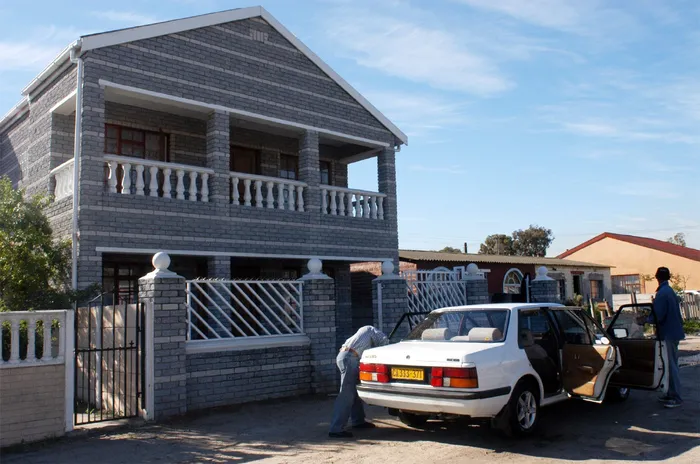
What is incredible is that homes continue to be built or improved even where there are no formal services.
Image: Gary van Wyk
The state of some of South Africa’s rural and township homes remains the same as it has been for the last 30 years.
This is a growing investment class where there is no recognition of the homeowners' wealth and no insurance available to them because their homes are not given values, says Lance Chalwin-Milton, founder of a specialised registry called E-DEED.
“That said, development will continue apace as it always does, with homeowners continuing to invest into their properties,” Chalwin-Milton says.
E-DEED is an innovative platform specifically designed to address challenges and simplify the entire process of property ownership.
Township and rural residential sector poised for an explosion
Chalwin-Milton, who boasts a wealth of experience in property and real estate, says he believes that the residential sector in these local communities is poised for an explosion, adding that with recognition of the values for their homes, the possibilities are endless.
“I believe the biggest standout of this sector is the number of homes valued at more than R1.5 million. It is absurd that none of these homes have recognition other than a roof over the owner's head.
"Why are they not considered assets by the financial institutions? Most importantly, perhaps is why are they not insured?
“Obviously, in a lot of the areas, service delivery remains a real challenge, but again, what is incredible is that these homes continue to be built or improved even where there are no formal services.
"They are built off the Grid! If E-DEED is able to create recognition of this wealth, I believe that this will go a long way to resolving this impasse.
"We are all aware that all institutions in our country are desperate to get into this market – this credible recognition will assist them enormously. This recognition will create a recognised “Insurable asset.”
According to Burger Huyser Attorneys, selling a house in South Africa requires legal compliance to ensure a smooth and legitimate property transfer. The legal firm said one of the most crucial documents in this process is the title deed, which serves as proof of ownership.
“The short answer is no, you cannot legally sell a house in South Africa without a valid title deed. The title deed is an essential document that establishes ownership and facilitates the legal transfer of property from the seller to the buyer. Without it, there is no way to prove ownership or register the transaction at the Deeds Office.”
Rural and township homes significance
He adds that the significance of these rural and township homes is -if unlocked and allowed the dignity of “first world loans” against these assets-unmeasurable.
“There are trillions of rands that could be leveraged and used in both formal and informal economies. We believe a duality of recognition needs to be created where these “Informal” properties (a misnomer in itself) run parallel to Deeded properties.”
According to E-DEED an ideal municipal service delivery would make this sector’s accelerated development easier. “However, as I said earlier, these homes continue to be developed regardless. I would say that investment in services would be a solution. Would this then open up another revenue stream for the closest municipalities and local governments?”
Mortgage penetration is low
Chalwin-Milton says mortgage penetration through the continent is extremely low. He says the only way to get this up is to recognise the “informal” housing market.
He added that it is important to understand the complexities of home ownership in these areas where Title Deeds have little to no recognition, as the land is indeed communally owned.
“It is also important to understand that the value of these homeowners’ brick and mortar is the same as any construction on a Title Deeded property.
"Once this is achieved and institutions understand the vagaries of an alternative security (in E-DEED’s case we create an non-fungible token (NFT) against the value of the risk-weighted asset (RWA) – the home) – then one will see the growth in mortgage approvals into what is an untapped market!”
Economic spin-offs
The E-DEED founder says that if this untapped wealth could be recognised and then it could potentially be leveraged to invest into the economy. “We are a country of entrepreneurs, so surely this release of wealth would cause an incremental growth in the economy,” he says.
Last year, Land Reform and Rural Development Minister Mzwanele Nyhontso committed to finalise and introduce the Equitable Access to Land Bill and the Communal Land Tenure and Administration Bill to Parliament.
These are expected to give impetus to the land reform programme by addressing long-standing legislative gaps and constitutional obligations regarding land redistribution and communal land tenure rights.
The Department of Land Reform and Rural Development in its briefing to parliament indicated that the proposed legislation will be tabled for public comment.
It is now envisaged that this will happen during the first half of this year. In the Budget Vote in July last year, the Department of Agriculture, Land Reform and Rural Development (DALRRD) was allocated R9.820 billion, with R6.168 billion earmarked for Land and Tenure Reform and Restitution, to address these issues.
This allocation included R559 million to acquire and allocate 44 000 hectares of land and a commitment to process long-outstanding labour tenant applications. These allocations signalled a recognition of the constitutional mandate to ensure equitable access to land and protect tenure security.
Despite over R52 billion being spent on land restitution, more than 5 700 land claims lodged before the original 1998 cut-off remain unresolved, with provinces such as KwaZulu-Natal, Limpopo and Mpumalanga experiencing the heaviest backlogs, said Peter Setou, chief executive of the Vumelana Advisory Fund recently.
Independent Media Property