

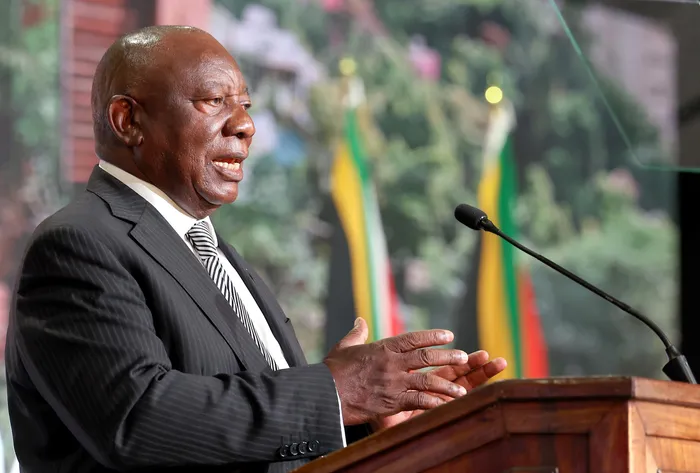
President Cyril Ramaphosa addressing the Innovative Building Technologies Summit held in Johannesburg on Tuesday.
Image: Supplied
While the South African government has provided more than 5 million housing opportunities since the dawn of democracy, more than 2.5 million families are still on the waiting list for housing throughout the country.
The inadequate supply, limited land availability, rising construction costs and delays in project delivery are all contributing to a situation of scarcity, says President Cyril Ramaphosa.
The president delivered the keynote address at the Innovative Building Technologies (IBT) Summit, held at the Nasrec Expo Centre in Johannesburg.
He says that this has a number of consequences.
“For the middle class, prices and rents are being pushed upwards. For the poor, homelessness and the proliferation of informal settlements are exacerbating already dire conditions. The delivery of basic services to unplanned settlements is stretching the capacity and the resources of the State,” says Ramaphosa.
He adds that rapid urbanisation, population growth, migration and climate change are reshaping South Africa’s human settlements on an unprecedented scale.
It is estimated that by 2050, nearly eight out of every ten South Africans will live in cities. “Many will live in informal settlements, often located on land vulnerable to floods, drought, heat stress and environmental degradation.
“In recent years, many parts of our country have borne the brunt of climate change. It is always the poorest and most vulnerable who suffer first and who suffer most.”
Ramaphosa warned that if the country continues to build in the old way – on the same land, with the same vulnerabilities, using the same methods-then the country is not solving the housing challenge.
“We must make a change. We must embrace the tide of technological progress to future-proof human settlements.
"This is a social imperative and an economic necessity. The right to adequate housing must not be the sole privilege of those with money. It is an aspiration for all that our Constitution compels us to progressively realise.
"This Summit has been convened because it is time to think differently. We have to think beyond traditional brick-and-mortar. We must embrace technological solutions that enable housing to be delivered faster, better and at scale.”
He says the government is united in its resolve to turn innovation into a coordinated national pathway for housing delivery at scale.
“Traditional construction methods, while familiar and trusted, are no longer sustainable on their own. Water scarcity, rising energy costs, climate risk and the urgency of scale demand that we modernise how we build.”
Innovative building technologies offer us a strategic opportunity, says Ramaphosa.
“When appropriately regulated, financed, socially accepted and locally embedded, innovative building technologies allow us to build faster and at scale.”
South Africa cannot continue to rely on yesterday’s construction methods to solve today and tomorrow’s problems, says Thembi Simelane, the Minister of Human Settlements, addressing the same event.
“The recent cases of prolonged rainfalls, which left a trail of destruction in Limpopo and Mpumalanga is a case in point. Notably, the built environment is both a contributor to carbon emissions and a frontline of vulnerability.”
She adds that this reality demands that the country reimagine housing not only as shelter, but as: climate-resilient infrastructure, energy-efficient assets, water-wise systems, and engines of green economic growth.
Simelane says Innovative Building Technologies offers a pathway to do exactly that. In the South African context, Innovative Building Technologies refer to building systems developed outside conventional brick-and-mortar methods, and certified through Agrément South Africa in terms of the National Building Regulations and Building Standards Act.
These include, among others:
She says these are not experimental curiosities. “They are viable construction solutions capable of delivering:
Simelane says the mainstreaming of IBTs is firmly grounded in government policy. She adds that the 2024 White Paper on Human Settlements, approved by Cabinet, commits the state to: invest in innovative and flexible building typologies, promote sustainable and resilient materials, strengthen partnerships with the private sector, academia, and civil society, and enable rapid responses through alternative building technologies.
In support of this policy direction, the Department of Human Settlements says it will, guided by this Summit, finalise Performance-Based National Norms and Standards for Innovative Building Technologies.
It says these standards:
“Our approach is clear: IBTs must complement and strengthen, not undermine, South Africa’s construction sector, says Simelane.
She said they must:
“Our objective is simple, but transformative," she says, "that within the next decade, Innovative Building Technologies become a normal, trusted, and scalable part of South Africa’s human settlements delivery system. Not a parallel system. Not a niche market. But a mainstream option.”
Simelane says this will enable them to build faster, build better, build greener and build at scale
“This Summit is not about choosing technology over people. It is about choosing people through better technology. It is about restoring dignity.
"It is about building settlements that are safe, sustainable, and inclusive. It is about ensuring that the child born today grows up in a home that is: structurally sound, energy efficient, climate resilient and embedded in a functional neighbourhood.”