

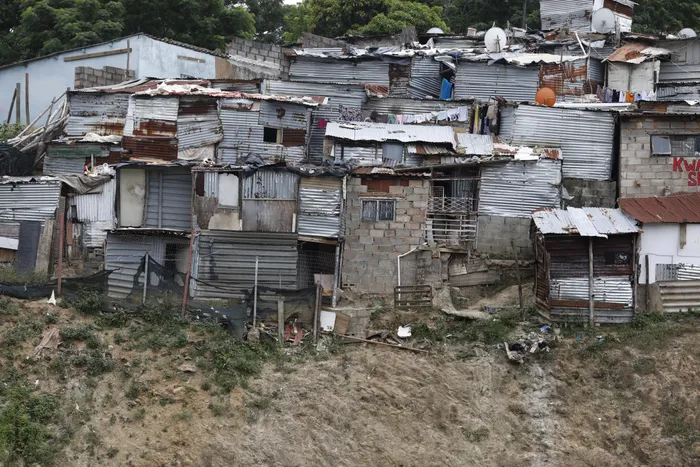
The growth of informal settlements is primarily to rapid rural-to-urban migration, limited availability of suitable land due to steep topography and environmental constraints,severe financial limitations, and ongoing infrastructure vandalism and illegal connections.
Image: DOCTOR NGCOBO Independent Newspapers
The housing backlog in South African cities cannot be resolved in the short to medium term under the current funding and delivery models.
This is confirmed by the eThekwini Municipality, and as outlined in the 2025/26 Integrated Development Plan (IDP), which noted that informal settlements constitute the largest component of the City’s housing backlog, accounting for approximately 66% of the total demand, says EThekwini Municipality’s spokesperson Gugu Sisilana.
“According to the eThekwini Municipality and as outlined in the 2025/26 Integrated Development Plan (IDP), the proliferation of informal settlements is regarded as a serious and escalating concern that lies at the centre of the city’s service delivery and development challenges,” she said in response to this publication’s media enquiry.
Factors causing informal settlements
The city says that it attributes the growth of informal settlements primarily to rapid rural-to-urban migration, limited availability of suitable land due to steep topography and environmental constraints, severe financial limitations, and ongoing infrastructure vandalism and illegal connections.
It said these factors collectively increase the cost and complexity of providing formal housing and basic services.
Sisilana says the city acknowledges that traditional housing delivery alone is no longer sufficient to address the scale of the challenge. She says that, as stated in the IDP, the municipality has therefore adopted an incremental upgrading approach, prioritising the provision of basic services such as water, sanitation, and electricity to reduce immediate health and safety risks while longer-term housing solutions are pursued.
“Where informal settlements are located in high-risk areas such as floodplains or unstable slopes, relocation remains necessary, although progress is constrained by the scarcity of safe, well-located land.”
eThekwini Municipality says the rapid proliferation of informal settlements significantly impacts its ability to deliver services and advance development.
It adds that it places pressure on already strained infrastructure, contributes to high levels of non-revenue water and electricity, and diverts financial resources toward emergency interventions rather than long-term developmental projects.
“The IDP highlights that these pressures limit the Municipality’s capacity to invest in catalytic economic growth and spatial transformation initiatives.”
The growth of informal settlements is caused by several factors and forces, including:
“The informal occupation of land is a problem for municipalities because it is unplanned, disrupts existing plans and decision-making, and forces municipalities to provide basic services in places that may not be suitable for human settlement.
"So yes, it is a problem, but municipalities have a constitutional obligation to respond with basic services. They also need to understand that it is happening because of powerful forces that are not easily stopped.
"They also need to make plans to prevent informal settlements from growing by providing serviced land in suitable places to accommodate growing urban populations.”
He added that the growth of informal settlements in the major cities is faster than the supply of new formal housing; hence, the housing backlog is getting bigger rather than contracting.
“The government’s housing budget has also been squeezed in recent years, so municipalities and provinces are building fewer RDP/BNG houses. There is an informal settlements upgrading programme, but it has not been very effective for various reasons. So housing remains a massive challenge in SA cities and towns.”
Request for support
To effectively manage this challenge, Sisilana says the Municipality requires strong support from the national and provincial government, including adequate and flexible funding, policy reforms to enable incremental development, and assistance with land acquisition.
“In addition, partnerships with the private sector, civil society, and communities are essential to implement innovative solutions and ensure sustainable outcomes.
“The eThekwini Municipality remains committed, as guided by its 2025/26 IDP, to addressing informal settlements in a humane, sustainable, and coordinated manner, while balancing the needs of vulnerable communities with the long-term development objectives of the City.”
Informal settlements spiralled during the Covid-19 outbreak
The City of Cape Town is one of the biggest metros in South Africa, with a population of about 4.7 million people.
Over the past decade, the city has experienced high levels of inward migration due to rapid urbanisation, says Mayoral Committee Member for Human Settlements in Cape Town, Councillor Carl Pophaim.
“Currently over 243 812 households are living in informal settlements in Cape Town,” Pophaim says.
According to the MMC, Cape Town experienced an unprecedented large-scale unlawful occupation of land (privately owned land and municipal and other state agencies’ land) over the Covid-19 national lockdown period, which led to the establishment of 186 new informal settlements, bringing the total number of informal settlements to 657 informal settlements.
“More than 60% of the newly established informal settlements are considered high risk – situated under power lines, in wetlands, retention ponds and biodiversity protected areas.”
In informal areas, the city says it assists residents with water and sanitation services, solid waste and electricity services where it is possible to do so, and where the settlement is not on privately-owned land.
“On City-owned land, close to 98% of informal settlements are supplied with electricity (note some settlements are on privately-owned land, while others are in areas where Eskom must supply electricity; while others are on land that is not suitable, such as in ponds, water retention and catchment areas, among others).”
Over the next three years, the CoCT’s Human Settlements Directorate says it plans to spend a total of more than R8.4bn for upgrading informal settlements, upgrading and maintaining Council flats, serviced plots provision and subsidy housing.
Hundreds of unrecognised informal settlements
Up north, the City of Tshwane says it has 210 recognised informal settlements, where there are no services that are provided in terms of clean running water or sanitation services.
“The Department has since completed a new count of informal settlements, as part of the development of the Informal Settlements Management Policy, which is due for consideration by the Council for public participation. The number of informal settlements has increased to 502," says MMC for Human Settlements, Aaron Maluleka.
“As indicated above, the number of informal settlements has since increased, and this is due to uncontrolled and uncurbed land invasions. The rampant invasions took place mostly during the period when the city did not have a service provider for the prevention of land invasion.
"Further exponential increase in the number of informal settlements was also during the financial years of 2019/20 and 2020/21, when the country was operating under lockdown restrictions, which were put in place to mitigate the spread of the Covid-19 virus, where evacuations and evacuations of persons were not permitted.
"It must be noted that with the current legal framework and the history of our country, it is difficult to evict the people after the invasion, hence we have all these informal settlements even after progressive intervention by the government, either in terms of providing the low-cost houses, service stands, community residential units and affordable rental housing stock.”
Urban management and developmental challenges
The City of Tshwane says land invasion translates into many other urban management and developmental challenges. After invading the land, the illegal occupiers require services which they, in most cases, acquire illegally at the expense of the city and the law-abiding citizens.
“The invasion further makes our planning and development mandate extremely difficult and also impacts negatively on our environment, especially on environmentally sensitive areas. As soon as land is invaded, the occupiers are counted as part of the housing backlog.
"It is common knowledge that the consequence of this is many protests, motions, petitions and memorandums which must be addressed or responded to. It is important to note that the approved budget of the city can only attend to issues as identified through the Integrated Development Plan (IDP).
"The invasion of land mostly occurs after the approval of plans and the budget. It is often difficult to provide rudimentary services or even formalise all the settlements due to a limited budget, the capacity of our infrastructure and the scarcity of land.
"The prevention of land invasion is the only mechanism available to the government to plan, develop, control and regulate human settlements development.”
The Constitution asserts responsibility
Maluleka says the Constitution gives responsibility for the provision of basic services to the local authority to provide water and sanitation services to communities within its jurisdiction.
“The city does not have the capacity to provide rudimentary water services directly to all identified informal settlements, therefore external service providers are required to assist with the provision of water to communities.
"The city also does not have an existing water supply near all informal settlements to enable provision of water through, for example, communal taps.
"It is on this basis that the city spends more than R375 million annually to provide rudimentary water service through mobile water tankers to 170 informal settlements and rudimentary sanitation through chemical toilets to 110 informal settlements.”
Call for public discussion
Turok says SA needs a more serious public discussion about the way forward, and the government needs to be more honest about the challenge and its own limitations, instead of promising everyone a free house, as in the past.
“If all the key stakeholders put their heads together in a serious way, I think we could come up with a credible plan to deal with the situation. There is no silver bullet – we need a multifaceted response, including working with informal solutions to incrementally upgrade and improve them.”