

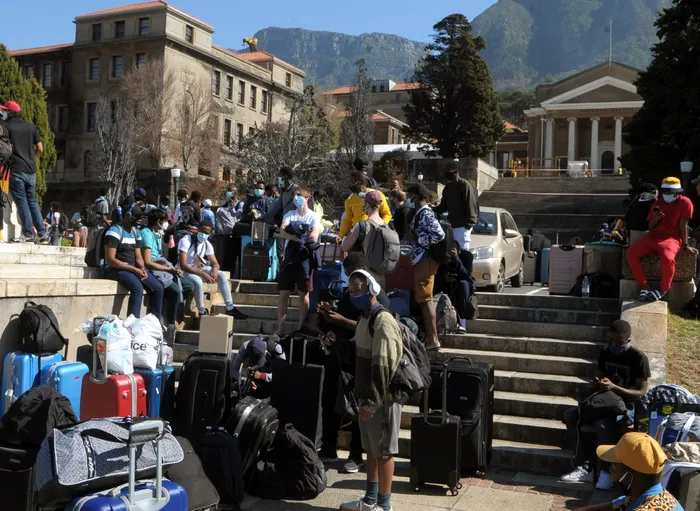
Most accommodation options, including university residences, exceed the National Student Financial Aid Scheme (NSFAS) accommodation cap.
Image: Tracey Adams
The University of Witwatersrand's (Wits) on-campus residences remain attractive due to the wraparound support services they offer, supported by cost-recovery measures.
However, the National Student Financial Aid Scheme's (NSFAS) accommodation cap has influenced access to these residences, as it is often lower than the student accommodation rental rates, thereby affecting who can secure university residence accommodation, says Basil Mugwena, the director for Campus Housing and Residence Life at Wits.
Responding to Independent Media Property’s enquiry, Wits says it received over 50 000 applications for spaces in residences, these are applications many of which would have been withdrawn by prospective students if they were not made an academic offer from the University.
“Whilst the University can only accommodate about 6 000 students, there are numerous options for students in accredited private residence service providers in and around Braamfontein, which can accommodate about 26 000 students, which has tremendously decreased the demand for accommodation in the area,” Wits says.
Affordability remains one of the primary challenges in securing student accommodation in Stellenbosch, says Stellenbosch University spokesperson Martin Viljoen. He says most accommodation options, including university residences, exceed the NSFAS accommodation cap.
“Annual costs vary depending on residence option. Residences on the main campus vary between R61 000 and R80 000. On the Tygerberg campus, this ranges from R49 000 to around R85 000. Student houses and flats are around R60 000 to R85 000 a year. Residence accommodation fees exclude meals (R36 400 for three daily standard meals),” Viljoen says.
In October last year, South African Student Accommodation Providers Association (SASAPA) CEO Inga Ncomanzi said the high cost of property and rent in the Western Cape directly drives up student accommodation rates, making affordability a persistent challenge.
“The NSFAS allowance caps, while an attempt at regulation, have not adequately accounted for the market realities of this region, creating financial strain on both providers and students,” Ncomanzi said then.
SU says the development of student housing is therefore a costly undertaking and is influenced by various financial and operational factors. Stellenbosch University says it has recently completed two new residences, adding 400 beds to the overall accommodation capacity.
According to Viljoen, the applications to residences are relative to the number of conditional and final offers SU makes. He says approximately 80% of applicants who receive an offer will also apply for residence placement.
“In this regard, Stellenbosch University offers approximately 8 300 beds in student housing on both the Stellenbosch and Tygerberg campuses. In addition, the University also offers 4 000 private accredited beds.
SU says it followed a proactive approach to student accommodation, saying all applicants and returning students are informed of their accommodation status during the preceding academic or application year.
It says all residences were at full capacity in preparation for the commencement of the academic year on Monday, February 9.
“Students are directed to secure accommodation prior to their arrival on campus, and the private accommodation website is made available in advance to support this process. It is therefore important that students finalise their accommodation arrangements as early as possible.
"Students are also encouraged to apply for top-up bursaries and to consider student loans to ensure their financial readiness.”
Viljoen says the national demand for student accommodation is well-documented; in some cases, there may be a shortage of suitable and safe accommodation close to campus. For others, he says it may be that affordability is an issue, especially for students affected by the NSFAS cap on housing allowances.
Three years ago, it was reported that the national student housing supply-demand gap already exceeded 500 000. The World Bank’s International Finance Corporation forecast then that by 2025, the student accommodation shortage would rise to more than 780 000 beds.
“The challenge around accommodation in Stellenbosch, however, is not one of availability, but rather affordability. Both residences and most accredited private accommodations exceed the NSFAS accommodation cap. It is therefore of the utmost importance that students secure funding before arriving on or returning to campus.”
SU encouraged students to apply for top-up bursaries and to consider student loans. It says it also communicates widely to all applicants and students that accommodation is not included in the academic offer and that applicants should plan to secure accommodation before arriving on campus.
“Applicants as well as returning students are already informed in the previous academic year of the outcome of their residence applications,” Viljoen says.