

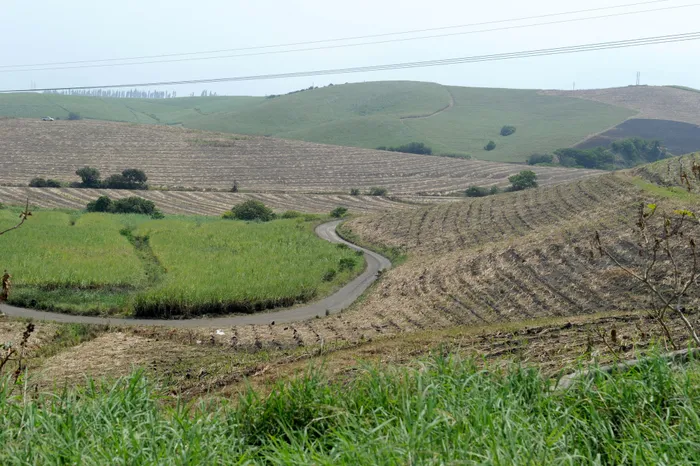
In his State of the Nation Address in 2021, President Cyril Ramaphosa said during the course of the next financial year, they will establish a land and agrarian reform agency to fast-track land reform.
Image: Independent Newspapers Archives
As President Cyril Ramaphosa prepares to deliver the State of the Nation Address (Sona) on Thursday evening, questions have arisen on why the Department of Land Reform did not implement the Land Reform Agency, which the president announced about five Sona's ago.
“Who is stalling the process? Was it (former minister of the Department of Agriculture, Land Reform and Rural Development Thoko) Didiza or now (Department of Land Reform and Rural Development Minister Mzwanele) Nyontso, or are the bureaucrats that are ignoring the president's instruction,” asks Professor Johan Kirsten, the director of the Bureau for Economic Research (BER).
Delivering the State of the Nation Address in February 2021, Ramaphosa said: “During the course of the next financial year, we will establish a land and agrarian reform agency to fast-track land reform.”
In 2020, he said SA became the world’s second-largest exporter of citrus, with strong export growth in wine, maize, nuts, deciduous fruit and sugar cane. He noted that the favourable weather conditions in 2020 and the beginning of 2021 meant that agriculture was likely to grow in the near term.
This provided an opportunity for further public-private partnerships in agriculture to promote transformation and ensure sustainable growth.
The president said the success was an opportunity to accelerate land redistribution through a variety of instruments, such as land restitution and expropriation of land to boost agricultural output.
“To date, the government has redistributed over five million hectares (ha) of land, totalling around 5 500 farms, to more than 300 000 beneficiaries. This is in addition to the land restitution process, which has benefited over two million land claimants and resulted in the transfer of around 2,7 million ha.
“We are also pursuing programmes to assist smallholder and emerging farmers with market access, to develop skills across the entire agricultural value chain and increase the number of commercial black farmers,” Ramaphosa said at the time.
Why is the state still holding onto the 2.5 million ha of land they acquired through PLAS, asks Kirsten.
“This is an ideal opportunity to empower black farmers. Why is the land not transferred to them with title deeds? Why is there no consequence management?”
Despite over R52 billion being spent on land restitution, more than 5 700 land claims lodged before the original 1998 cut-off remain unresolved, with provinces such as KwaZulu-Natal, Limpopo and Mpumalanga experiencing the heaviest backlogs, said Peter Setou, the chief executive of the Vumelana Advisory Fund, last month.
He said agricultural economists have identified that among the three elements of the land reform programmes identified in Section 25 of the Commission, redistribution of land experiences a higher rate than restitution of land and tenure of land.
“Reports show that 2.545 million hectares of land are held by the Proactive Land Acquisition Strategy programmes. These must be transferred to qualifying black South Africans with title deeds. This process will facilitate and enhance access to finance for the new land owners and further promote an enabling environment for partnerships with the private sector.”
According to an article in "The Conversation" titled "How a land reform agency could break South Africa's land redistribution deadlock," agricultural economist Wandile Sihlobo and Kirsten proposed that establishing a Land Reform and Agricultural Development Agency could significantly accelerate land reform.
They argued this could happen if the current impediments ("arteries") to the process were removed.
Kirsten and Sihlobo wrote that in 1994, when South Africa became a democracy, white farmers owned 77.580 million hectares of farmland out of the total surface area of 122 million hectares. They said the new government set a target of redistributing 30% of the 77 million hectares within the first five years in government.
“This target has been consistently moved over the years, and now the aim is to reach 30% by 2030, in line with the National Development Plan’s agriculture and land reform objectives.
“Our estimates, which include restitution, redistribution, private transactions and state procurement, suggest that 13.2 million hectares (or 17%) have already been transferred from white landowners to the state.
"An additional 3.08 million hectares have been transferred to black owners and 10.135 million hectares through private and state-supported transactions, including land restitution.
“Adding 2.339 million hectares of land that was identified for restitution but for which communities elected to receive financial compensation as the means for restitution brings the total area of land rights that were restored since 1994 to 15.56 million hectares. This is equivalent to 20% of formerly white-owned land,” said Kirsten and Sihlobo in 2021.
In another report titled Land Reform and Development, selected South African case studies by Natalie van Reenen described its importance in South Africa for several broad reasons.
It says land has productive value, and those from whom access has been unfairly removed are unable to enjoy the economic and income-generating potential that such land can offer.
“Land reform has been shown to reduce poverty, support sustained growth, and increase efficiency by reducing inequality, increasing productivity, and stimulating economic growth (Gersbach and Siemers 2010).
"Furthermore, in South Africa, land and access to land are emotive, representing dignity, heritage, belonging, and the restoration of past injustice. Land reform is an important element in addressing these social inequalities and rectifying historic patterns of land ownership.”
This report has been prepared under the guidance of Nomvuyo Guma, formerly Chief Director: Microeconomic Policy in the Economic Policy Division of the National Treasury, and with editorial assistance by Andrew R. Donaldson, Southern Africa Labour and Development Research Unit and University of Cape Town.
Land reform is identified as an important part of South Africa’s development challenge in the Treasury’s "Economic Transformation, Inclusive Growth and Competitiveness" paper (National Treasury 2019).
It adds that progress has been made in addressing backlogs in title deeds as part of Operation Vulindlela’s first phase.
“For the period ahead, further regulatory and institutional changes are proposed to strengthen the contribution of land reform to rural livelihoods and agrarian development, while also accelerating access to affordable, secure urban housing.”
Independent Media Property