

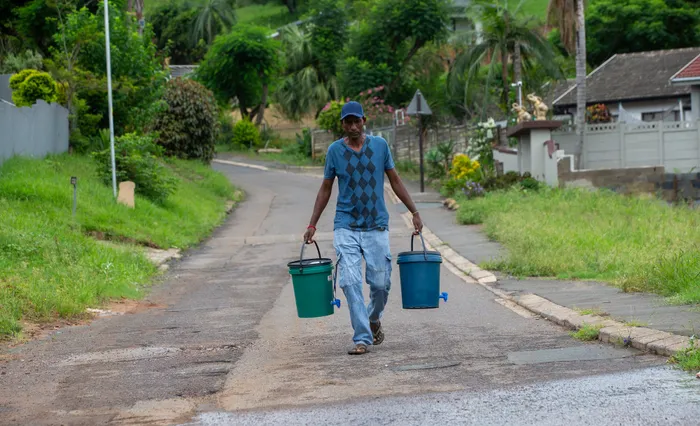
The municipal intervention announced by Finance Minister Enoch Godongwana in his Budget 2026 will addresses the single biggest driver of South Africa's current property migration patterns.
Image: Leon Lestrade
In a pivotal moment for South Africa’s property sector, Finance Minister Enoch Godongwana's Budget Speech on Wednesday underscored a decisive shift towards accelerating infrastructure investment and implementing structural reforms, all aimed at revitalising local government systems through Operation Vulindlela.
The minister's message resonated with stakeholders, highlighting the direct implications for operating costs, asset performance, and long-term investment decisions within the sector.
"This is aimed at strengthening financial sustainability, accountability and transparency. Spatial and housing reforms focus on restructuring our cities to ensure that people have access to affordable housing located close to centres of economic activity.
"This is a systematic effort to remove the structural blockages that have held back growth for many years," Godongwana said.
According to Justin Davidson, a portfolio manager at Anchor, the 2026 Budget reinforces the operating environment. This strengthening is achieved by enhancing fiscal discipline, decreasing policy uncertainty, and signalling a continuation of reform efforts.
He says lower borrowing costs, a more stable inflation outlook and growing public infrastructure investment will help support capital planning and valuations over time.
“Importantly for property owners and developers, the renewed focus on municipal reform, energy security and logistics performance addresses some of the constraints facing the sector. While the environment remains challenging, this signalling helps to underpin expectations and support selective investment and development activity.”
One of the headlines for the property sector was a radical intervention in local government, says Yael Geffen, CEO of Lew Geffen Sotheby's International Realty.
She says Godongwana announced a major reform for metro trading services, allocating R27.7 billion over the medium term to a performance-linked grant for electricity, water, and sanitation.
“It’s a stark warning to badly-run councils because the Minister pointed to Johannesburg as a case study of failure, noting that while the city collects R11.9 billion in water revenue, only R1.3 billion is reinvested into Joburg Water, creating a massive R64 billion maintenance backlog.”
Under the new system, revenue collected for services must be reinvested into those same services, and failure to meet reform targets will result in direct budget cuts.
Geffen emphasises that this move addresses the single biggest driver of South Africa's current property migration patterns.
“Let’s be blunt: one of the biggest reasons for the flood of semigration to the Western Cape is simple-the municipalities there work. The lights stay on, and the taps run,” she says.
“If this reform succeeds in fixing infrastructure and accountability in places like Johannesburg and eThekwini, it will have a massively positive knock-on effect on the national property market.
“People don't want to flee; they want to live where their assets are secure, and their quality of life is high. If we can make municipal services work across the country, we won't just retain residents; we'll revitalise entire local economies.”
Last week, the Institute of Municipal Engineering of Southern Africa (IMESA) emphasised that technical capacity within municipalities plays a central role in addressing challenges in municipalities and echoes the widespread calls for the appointment of more engineers.
The institute said that it is heartened by President Cyril Ramaphosa’s acknowledgement in this year’s State of the Nation Address that patronage, not technical capacity and merit, is what is weakening local government administrations in many places.
“It is important to understand the actual ratio of technical to support staff necessary for a municipality to operate professionally and efficiently,” says IMESA president Geoff Tooley, noting that this is legislated, but most municipalities are not compliant.
“The Municipal Staff Regulations (MSRs) in South Africa, issued by the Minister of Cooperative Governance and Traditional Affairs (COGTA) under the authority of the Local Government: Municipal Systems Act, 2000, were formally introduced in 2021 to professionalise local government and standardise human resource practices across municipalities,” he explained.
“COGTA, through these regulations, calls for a ratio of three technical service delivery staff members (like engineers, planners and artisans) for every one support staff member (such as human resources, finance and supply chain management).
“I do not believe that there is a single municipality in the country that meets this requirement,” Tooley stated, adding that some of the better-run municipalities sit at a one-to-one ratio at present.
“When service delivery does not meet the required standard, all municipal employees are often painted with the same brush. The competency of the technical staff is brought into question when there is, in fact, good work that is being done by a limited number of efficient staff under very trying conditions. This has a demoralising impact on the technical staff.
“It is critical that municipalities work to rectify the imbalance and meet the requirements of COGTA and the Municipal Staff Regulations. That is how we can start to turn the tide in service delivery,” Tooley stressed.
According to Davidson, attention now turns to implementation. He says progress in stabilising and reforming municipalities, accelerating infrastructure investment and maintaining momentum on energy and transport reforms will be key determinants of sector performance.
For the property sector, he says the focus now shifts to asset quality, balance sheet strength and selective growth. “If reform momentum continues, conditions should gradually improve for sustainable investment, development and long-term value creation.”
Independent Media Property