

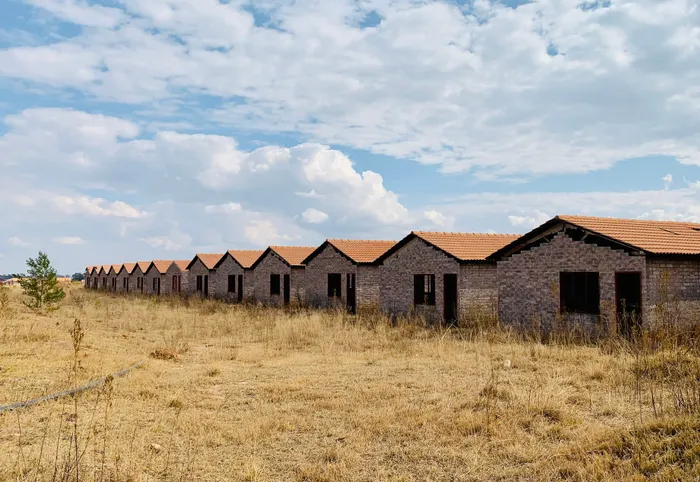
It is important to accelerate projects from planning to implementation through innovative financing and development solutions that deliver affordable housing
Image: file
South Africa's housing backlog of more than 2.6 million units with over 4 000 informal settlements, places urgent pressure on municipalities to unlock development-ready land, strengthen partnerships, and streamline approval processes.
“Municipalities face a complex mix of regulatory bottlenecks, limited well-located land, unlawful land occupation and significant infrastructure backlogs,” says Sithole Mbanga, the CEO at the South African Local Government Association(SALGA).
“The government cannot address these challenges alone. Sustainable solutions demand a coordinated,all-of-society response anchored in strong, transparent and accountable public–private partnerships,” he added.
Housing backlog continues to grow amid rapid urbanisation & informal settlements.
“The reality is that South Africa’s housing backlog, now estimated at 2.6 million units, continues to grow amid rapid urbanisation and the expansion of informal settlements. This underscores the need for urgent, coordinated and systems-based solutions,” says Lindiwe Kwele, the CEO at the Gauteng Partnership Fund (GPF).
In this context, Kwele says the GPF serves as a strategic partner to municipalities, accelerating projects from planning to implementation through innovative financing and development solutions that deliver affordable housing and strengthen the socioeconomic fabric of Gauteng communities.
Stimulate solutions to the housing challenge
As such, the Local Government Property Development Summit co-hosted by the South African Local Government Association (SALGA) and the Gauteng Partnership Fund (GPF), from Thursday, March 26 to Friday, March 27, at Focus Rooms in Sandton, Johannesburg will seek to stimulate solutions to the housing challenge.
Recently, the City of Tshwane said a whopping R32.5 billion would be required to upgrade or relocate all existing informal settlements in the municipality.
This figure far exceeded the City’s current budget and available resources, said Ald. Aaron Maluleka, the MMC for Human Settlements at the City of Tshwane.
Catalyst for scaling up affordable housing delivery
It is anticipated that the Summit will act as a catalyst for scaling up affordable housing delivery, crowding in private and developmental investment, and reshaping South African cities and towns into centres of dignity, inclusion and shared economic opportunity.
The Summit brings together municipalities, developers, financiers, planners, national policymakers and international partners under one roof to fast-track property development and accelerate the delivery of affordable housing.
The Summit will be structured around four strategic focus areas:
1. Policy and Regulatory Reform:
A high-level national dialogue will focus on modernising Spatial
Planning and Land Use Management Act, streamlining and accelerating land-use management
and development approvals, and repositioning municipalities as proactive enablers - rather than
inadvertent obstacles - to sustainable development.
2. Strengthening Development Partnerships:
Local and international case studies - including
Ongos Valley, Conradie Park and Jewel City - will be showcased to illustrate scalable, replicable
models for affordable and social housing delivery, and to demonstrate the power of coordinated
public–private and community partnerships.
3. Financing the Future of Human Settlements:
Banks, development finance institutions (DFIs),
metropolitan municipalities and private developers will explore innovative financing instruments
and blended finance models to unlock land, diversify municipal revenue streams and scale
affordable rental and gap housing. This conversation is critical as municipalities face tightening
fiscal space and are compelled to grow their own revenues through development-led economic
expansion.
4. Technology and Climate-Resilient Housing Innovation:
With the future of human settlements increasingly smart, green and resilient, the Summit will spotlight innovations emanating from the Innovative Building Technologies Summit, as well as climate-resilient design, modular and off site construction systems, and other technologies capable of accelerating delivery at scale while reducing environmental risk.
Delivering a speech at an engagement session with the Mayors of Metropolitan municipalities in South Africa held last week, Velenkosini Hlabisa, the Minister for Cooperative Governance and Traditional Affairs(CoGTA) said that given that metropolitan municipalities house 62% of the nation’s population and generate over two-thirds of the GDP, it is imperative to recognise their critical role in South Africa’s economic stability and social well-being as we work to improve governance and service delivery.
He said metropolitan municipalities across South Africa are facing systemic governance, fiscal and institutional pressures that severely hinder their ability to serve their communities effectively.
He said political instability in some of our metros impact negatively on the ability of our metropolitan municipalities to effectively govern and provide sustainable and efficient service delivery.
The Minister said the poor decision-making and a lack of accountability, compounded by declining revenue and low municipal collection rates, left many areas financially strained. “Additionally, organisational inefficiencies and ageing infrastructure create significant barriers to delivering essential services, while rapid urbanisation heightens demand for these services, resulting in community dissatisfaction and protests.”
Metros play a crucial role in improving the quality of life for communities
Hlabisa said to address these challenges required a concerted effort to improve intergovernmental relations and foster strategic partnerships that enable better resource allocation and sustainable planning for the future.
“The metros play a crucial role in improving the quality of life for communities by promoting inclusive local economic development and providing vital services, including housing, electricity, water, sanitation, and waste removal.”
Independent Media Property