

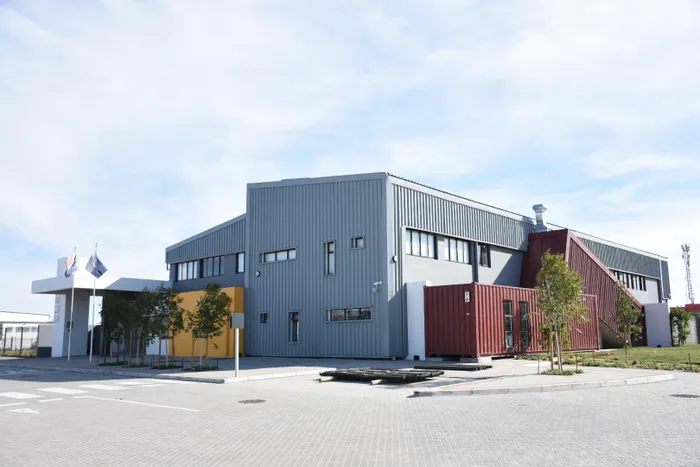
The real value of modular construction: not as a shortcut, but as a more responsive way of building.
Image: Supplied
With pressure mounting to deliver schools, healthcare facilities, student accommodation and other essential infrastructure faster, modular construction is increasingly entering the conversation.
However, despite its growing relevance, it is still too often misunderstood.
For many, the term still brings to mind buildings that feel temporary, generic or architecturally compromised. According to Landseer Collen, the founder and director at BPAS Architects, that perception says more about how modular systems are applied than about the method itself.
“Modular construction is a process, not a style,” he says. “When it is considered properly from the outset, it can offer speed and efficiency without compromising architectural quality or creativity.”
At its core, he says modular construction allows building components-or entire sections-to be manufactured off-site in controlled conditions and assembled on location. This enables site preparation and construction to happen in parallel, helping to reduce programme time, improve coordination and limit disruption on active sites.
For Collen, the real opportunity lies in how early modular thinking is introduced into the design process. “Working modularly requires a different kind of design discipline,” he says. “You’re not designing for on-site improvisation. You’re designing for precision, sequencing and integration. If done well, that can strengthen the outcome rather than dilute it.”
Modular construction myths
One of the most persistent misconceptions around modular construction is that it limits creativity. In practice, Collen argues, the opposite can be true.
“Modular buildings only feel repetitive when the design is repetitive,” he says. “Today’s systems can accommodate a wide range of materials, finishes and spatial responses. The creativity lies in how the system is used.”
Another common assumption is that modular buildings are rigid or short-lived. Yet in many cases, modularity can improve long-term adaptability, particularly in sectors where operational needs change quickly.
“That’s especially relevant in education, healthcare and housing,” Collen adds. “Buildings often need to evolve over time. Modular systems can make that easier without requiring you to start over.”
A practical example
BPAS Architects says it applied this thinking at Curro Durbanville High School in Cape Town, where the firm was tasked with adding temporary classrooms to an existing campus under tight timing constraints.
It says the project needed to be delivered quickly, while minimising disruption to teaching and end-of-year examinations.
Using modular thinking and prefabricated interlocking panel systems, the team says it was able to fast-track delivery while maintaining cohesion with the existing campus environment. Rather than appearing as makeshift additions, the classrooms were designed to read as considered extensions of the school.
“Temporary doesn’t have to mean inferior,” says Collen. “In an educational environment, the quality of the built space matters. Even provisional structures should support dignity, focus and a sense of belonging.”
The panel system also allowed for faster assembly, consistent quality control and future reconfiguration as needs changed.
Real value of modular construction
For Collen, that is the real value of modular construction: not as a shortcut, but as a more responsive way of building. “When modular thinking is applied well, it doesn’t simplify architecture,” he says. “It makes it more adaptable, more resilient and better aligned to how people actually use buildings.”
Speaking at the South African Investment Conference
(SAIC) on Tuesday, Thembi Simelane, the Minister for Human Settlements says to move forward, the current phase of the investment drive must be characterised by delivery, not declarations.
She says their credibility as an economic partner will increasingly be defined by the ability to translate pledges into projects, and projects into tangible development outcomes.
“Economic diplomacy, therefore, must ultimately be measured by its impact on the ground, both within South Africa and across the African continent.
Implications for government and development sectors
This places a clear responsibility on government and key development sectors, says Simelane, including infrastructure, housing, and human settlements, to play an enabling role by:
•Positioning catalytic projects within regional value chains
•Supporting industrialisation and innovation, including through initiatives such as Innovative Building Technologies (IBTs)
•Ensuring that investment contributes to the development of sustainable,inclusive and resilient African cities and communities.