

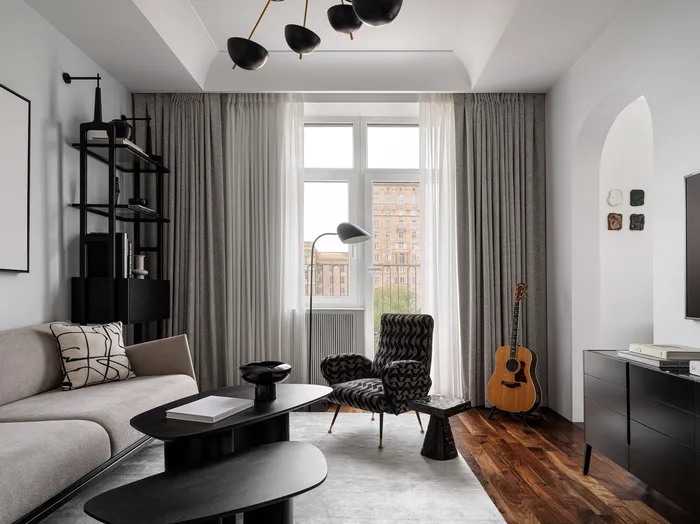
A young couple’s apartment reimagines Stalinist architecture with graphic detail, clever budgeting and timeless style When design aligns with how people want to live, value follows.
Image: Sergey Krasyuk
Design is often the difference between a property that trades at market value and one that exceeds it.
However, this is not talking about aesthetics, Ross Levin the licensee/owner at Seeff Atlantic Seaboard and City Bowl, believes.
He says he is talking about how a space is designed to function. “We spend a lot of time in property talking about price per square metre. Architecture rarely gets the same attention, but it should.”
In Cape Town, the owner says the most consistent outperformers tend to share a few architectural fundamentals:
•Orientation and light.
Homes that are positioned correctly for natural light, particularly north-facing, feel warmer in winter, brighter year-round and ultimately more liveable. It sounds simple, but it has a direct impact on demand.
•Indoor-outdoor integration.
This isn't a trend locally, it's an expectation. Properties that properly connect internal living spaces to terraces, gardens or views consistently outperform those that don't. Not because they look better, but because they align with how people actually live in this city.
•Proportion and flow.
You can feel when a space works. Ceiling height, room scale, and how one area leads into the next all affect how a buyer experiences a home, We see it often in older apartments that have been well renovated versus newer stock where space has been compressed for yield,
•Materiality.
There's a reason why stone, timber, and textured finishes continue to hold value in the Western Cape. They age well, respond to the climate and create a sense of permanence that glass-heavy, purely aesthetic designs sometimes lack.
This is not theory, says Levin. “We've sold properties at levels above expectation where the underlying design justified it. And we've seen well-priced homes underperform because the architecture didn't support the lifestyle buyers were looking for.”
He says Cape Town has always had a strong architectural identity, from Cape Vernacular homes designed around climate, to more contemporary builds that prioritise light, volume, and view corridors.
“When design aligns with how people want to live, value follows. And when it doesn't, no amount of pricing strategy can fully compensate for it.
That's the part of the market that doesn't show up in the data, but consistently shows up in the outcome,” Levin says.
Meanwhile, Liya Peter, the Real Estate Broker at Seeff George, says the first quarter of 2026 has officially solidified George as the undisputed "Economic Capital" of the Garden Route, with the property market showing a level of resilience that outpaces almost every other secondary city in South Africa.
He says with the prime lending rate stabilising at a more approachable 10.25% the first quarter saw a significant surge in buyer confidence, resulting in over 511 registered transactions in the opening months alone,
“We've seen the average sale price in George climb to a record R2.62 million, a sharp jump from 2025's figures, fueled by a high-velocity "flight to quality."”
The broker says the narrative of the quarter has been dominated by Semigration 2.0, where the 20-to-45-year-old demographic is no longer just "visiting" but fully relocating their lives, driving a massive 15-20% valuation premium for homes equipped with off-grid solar and water systems.
He says estates like Oubaai and Kingswood have remained the primary engines of this growth, proving that in 2026, buyers are not just looking for a roof over their heads-they are investing in a "15-minute lifestyle" where security, infrastructure, and mountain trails are non-negotiable,
Ultimately, Peter says what the country is witnessing is not just a temporary "boom"-it is a fundamental shift in where and how South Africans choose to live. He says the verdict is clear: the Garden Route market is exceptionallv strona underpinned by a well-managed municipality and a lifestyle offering that is unmatched nationally.
“While other regions may face volatility, George is maintaining a steady, sustainable growth rate that provides both immediate lifestyle rewards and long-term capital security. Whether you are a first-time buyer entering the market or an established investor expanding a portfolio, the data confirms that the Garden Route isn't just holding its own; it's setting the pace for the rest of the country. George is no longer just a destination on a map-it's the benchmark for high-value, high-quality living in 2026.”
•Average Sale Price: R2.62 Million (up 11.5%)
•Sales Volume: 511+ Transactions
•Market Sentiment: Strong & Growing
•Growth Outlook: Steady & Sustainable