Mandela and Mugabe – a tale of two countries
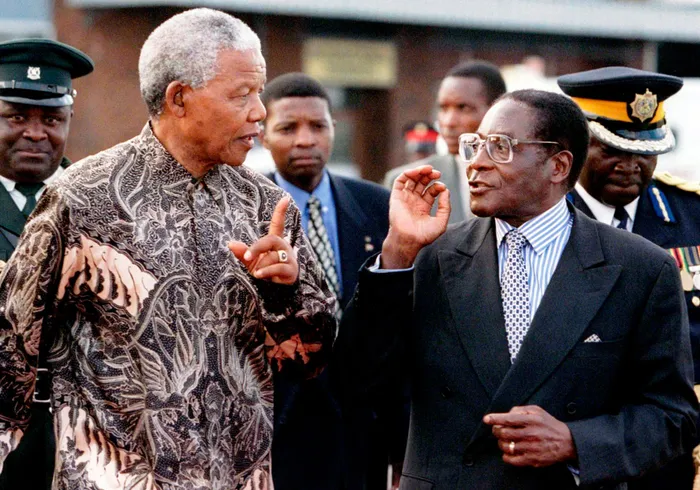
Former president Nelson Mandela and Zimbabwean President Robert Mugabe of Zimbabwe. Picture: Reuters Former president Nelson Mandela and Zimbabwean President Robert Mugabe of Zimbabwe. Picture: Reuters
An altercation has erupted between Zimbabwean President Robert Mugabe and ANC secretary-general Gwede Mantashe, as reported (“Mugabe blasts Gwede”, The Star, September 8).
In this feud Mantashe said (Creamer Media, September 7) he had lodged a complaint with his Zanu-PF counterpart to stop Mugabe from making unfortunate and unwarranted attacks on Nelson Mandela.
In so doing he accused Mugabe of destroying Zimbabwe’s economy.
Mugabe was quoted last week saying Mandela had cherished his personal freedom over the economic freedom of his people, which was why today in South Africa “everything is in the whites’ hands”.
This, according to Mugabe, was Mandela’s biggest mistake. Furthermore, Mugabe stated also that in recently talking to a minister in President Jacob Zuma’s cabinet he asked him how they handled the land issue after independence and why they left the whites with everything. The minister is reported to have answered this question by saying “ask your friend Mandela”.
At a state funeral last week Mugabe expressed similar sentiments by declaring the following about whites in South Africa “they are in control of land, industries and companies and are the employers of the blacks”.
“These blacks have failed to liberate themselves from white supremacy because of what Mandela did.”
In 1993 a political settlement was reached at the multi-party negotiations that followed the Congress for a Democratic SA (Codesa), resulting in the first democratic election on April 27, 1994 and a new political and constitutional dispensation in terms of the 1996 constitution. A non-racial liberal democracy replaced the previous discredited and oppressive apartheid system.
This system of liberal democracy is under attack not only from Mugabe, but from certain local political quarters. So for instance, according to Mzwanele (Jimmy) Manyi, the country must abandon its constitution and embrace a majoritarian parliamentary system in order to address the socio-economic challenges besetting our country.
These comments were made by Manyi at a meeting of the Progressive Professionals Forum, following its national executive committee meeting held in KwaZulu-Natal, at the beginning of the year (The Mercury, January 25). Manyi does not explain what exactly a majoritarian parliamentary democracy entails.
It can be presumed he means a system in which parliament is sovereign and as a result the majority party, which would be the ANC, would use its majority to govern and legislate without the constraints of a rigid constitution and an enforceable Bill of Rights.
There are other persons under the banner of critical race studies and radical political change that are belittling the Mandela settlement and calling for a radical political and economic change, and a rejection of the constitution and its values.
They reject racial reconciliation and are obsessed with “black pain and white guilt” and as a result demonise white persons today for the oppression of apartheid and colonialism.
Examples of such are the EFF and its leader Julius Malema, with its policy of land grabs, by virtue of encouraging the unlawful seizure of vacant and unoccupied land and by inflammatory and reckless statements, like “we are not going to kill whites just yet” as well as fascist behaviour in the pandemonium they cause in the House of Assembly.
South Africa has a constitutional democracy, involving a supreme rigid constitution, incorporating an enforceable Bill of Rights. It was the product of extensive and penetrating negotiation from 1990 to 1996, which involved a two-stage process, culminating in the final constitution of 1996.
The latter was drafted by the Constitutional Assembly, an elected body, representative of the entire nation, elective democratically on April 27, 1994, which gives it moral and political legitimacy.
The final constitution was part of a political settlement negotiated by the founding fathers of the nation, such as, inter alia, Mandela, Walter Sisulu, FW de Klerk, Joe Slovo, Colin Eglin and iNkosi Mangosuthu Buthelezi.
The inordinate problems and challenges that South Africa faces are not the fault of an exceptional constitution, rather the fault of the present ANC government, which finds itself mired in controversy, corruption and mal-administration.
What is required of the government is inspired political leadership to address the vast socio-economic problems, such as poverty, unemployment and inequality of our land ownership and other resources.
In Zimbabwe the policies of Mugabe have indeed destroyed the economy of that country. In this regard Mantashe is correct.
In effect Zimbabwe is a dictatorship in which Mugabe endeavours to resolve any problems by violence and not by peaceful means, as he did with his brutal land reform programme, which destroyed a thriving agricultural economy and immeasurably impoverished the country as a whole. He and his political henchmen live in a very lavish and luxurious manner, while the majority of his people wallow in great poverty.
A comparison of the two states is indeed a “tale of two countries”.
South Africa is a liberal democracy, grappling to resolve problematic socio-economic issues and economic inequality, within the framework of an operating democracy.
Zimbabwe was a country that had at the time of independence in 1980 inordinate prospects for development, but sadly to say is today a failed state, subject to the whims of a brutal dictator, Mugabe.
Its wonderful people, the vast majority of whom are long suffering, yearn for meaningful change and real freedom. Although in the 23 years of our democracy, much has been accomplished, very much more is required to reduce poverty, unemployment and effect economic equality in relation to African people.
The country is a land of infinite potential that provides a place in the sun for all. Inspired and competent political leadership could bring about prosperity and social justice for all the people of this country.
George Devenish is Emeritus Professor at UKZN and one of the scholars who assisted in drafting the Interim Constitution in 1993.