

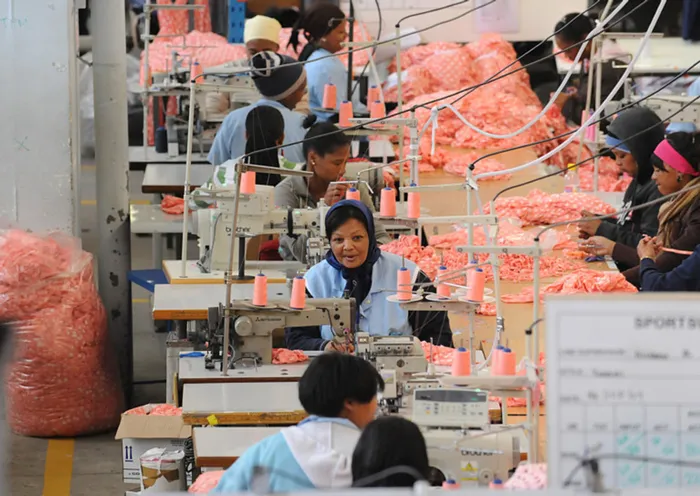
090914. Cape Town. The Southern African Clothing & Textile Workers' Union (SACTWU) confirms that the clothing industry wage strike will start tomorrow morning, 15 September 2009. The union has received an overwhelming mandate to embark on strike action in pursuit of its members' wage demands. Of the 46 600 clothing members of the union who voted in a secret ballot over the last three weeks, 92% have voted in favour of strike action. Clothing employers are currently offering a weekly wage increase of between R19 and R32 per week.Clothing workers are the lowest paid employees in the whole of the South Africa Manufacturing sector. Picture Henk Kruger 090914. Cape Town. The Southern African Clothing & Textile Workers' Union (SACTWU) confirms that the clothing industry wage strike will start tomorrow morning, 15 September 2009. The union has received an overwhelming mandate to embark on strike action in pursuit of its members' wage demands. Of the 46 600 clothing members of the union who voted in a secret ballot over the last three weeks, 92% have voted in favour of strike action. Clothing employers are currently offering a weekly wage increase of between R19 and R32 per week.Clothing workers are the lowest paid employees in the whole of the South Africa Manufacturing sector. Picture Henk Kruger
The Western Cape’s beleaguered textile and clothing industry has been given a lifeline by the government’s new procurement policy and the promise of thousands of jobs over the next two years.
The industry shed 100 000 jobs in the past decade as cheaper imports from Asia, notably China, squeezed manufacturers, leading to losses of orders and subsequent job losses.
On Thursday Southern African Clothing and Textile Workers Union (Sactwu) spokesman Etienne Vlok said the new plan would see thousands of people employed.
Johan Baard, the executive director of the Apparel Manufacturers of SA, which represents factory owners, said that as well as a range of other government interventions, the plan would certainly create more jobs.
For the first time in years, the sector was for the first time in years “cautiously optimistic”.
Currently the sector was supplying only between 5 and 10 percent of the government’s clothing and textile needs. This translated into 10 000 jobs.
While the state has not said how much of their procurement would have to be local, Vlok said he anticipated that it would be enough to create many more jobs.
Economic Development and Finance MEC Alan Winde said the new plan would make a huge difference to the industry, but cautioned that manufacturers needed to become more competitive and he hoped that they would not only depend on the state’s plan, but would also seek out new markets.
Under the new plan, all spheres of the government, including state-owned enterprises, will have to procure a range of goods and services – from power pylons, canned vegetables to clothing, textiles footwear and leather products, from local suppliers.
Supply chain officials have already attended workshops hosted by the National Treasury to make them aware of the new regulations and to ensure that they adhere to it.
Some of the goods that local companies will be able to supply includes uniforms for nurses, the police and defence force; linen; safety boots; and overalls.
Vlok said signs of the clothing and textile industry stabilising was borne out of recent figures which showed that 50 percent less jobs were lost this year compared to last year.
He and Baard put this down to a range of initiatives the national government had implemented to help shore up the industry and to save jobs.
Some of these initiatives included:
* Increased efforts to combat customs fraud.
* The Industrial Development Corporation (IDC) offering loans at lower than prime to help manufacturers fulfil their order obligations.
* A new accord which lowers the wages for new entries into the industry, and most recently the weaker rand had proven to be good for exporters.
Baard says already they will employ 1 000 young people over the next two to four months.
“This is crucial and significant for local manufacturers, which has seen significant job losses over the years,” Baard said.
Making the joint announcement, ministers Ebrahim Patel (Economic Development) and Rob Davies (Trade and Industry) said the Preferential Procurement Policy Framework Act promulgated by Finance Minister Pravin Gordhan in June had come into effect on Wednesday.
In a joint press statement, the ministers said: “The first designations mark an important milestone in government efforts to arrest and reverse industrial decline with and in support of the private sector.” - Cape Argus
lynnette.johns@inl.co.za