

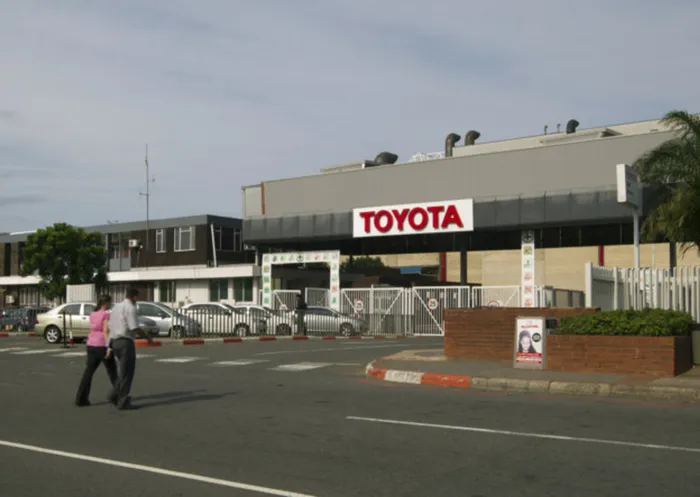
People walk near Toyota Motor Corp's Durban car factory. People walk near Toyota Motor Corp's Durban car factory.
The two consecutive strikes which have crippled the automotive industry for the past eight weeks have come to an end, but workers at Durban’s Toyota plant will be feeling the pinch for months to come.
The first strike, at Toyota itself, ended on September 9, after running for three weeks from August 19.
However, Toyota was one of seven vehicle manufacturers affected by the National Union of Metalworkers of SA (Numsa) strike in the automotive components sector, which only ended yesterday.
The factories could not function without the components, and a short while after restarting, had to close again.
An employee at the country’s largest vehicle manufacturing plant in Prospecton, who spoke to the Daily News on condition of anonymity, said he had not been paid since the strike in the auto manufacturing sector began.
The 36-year-old father has been struggling to make ends meet.
The strike had been on a no work, no pay basis, so when the union accepted the employers’ increase offer of 11.5 percent for this year, 10 percent for next year and 2015, the Toyota employee was anxious to get back on the job and start earning money again.
However, soon after returning to work, workers were told to go back home as the components industry supplying them had also gone on strike.
“When we were striking they had no-one to supply components to, so they probably shut down or worked short time, meaning less money in their pockets. They, too, have the right to strike for better pay, but this is really affecting us.”
Because of the no work, no pay principle, another shutdown at Toyota meant he would not be paid while component manufacturers downed tools.
Cut
“I had to cut into the savings for my children’s education to feed them,” he said.
Another Toyota employee said it would have been better if the strikes had taken place simultaneously.
He said he was sure the same outcome could have been reached.
“It’s a shame that in South Africa in 2013, we still have to take such drastic action to get what we deserve. Why can’t the employer just come with a good offer in the first place? Then we would not have to go on strike.
“The increment is good for us in the long run, but right now I will have a sour festive season because I will still be patching the holes in my pocket from not getting paid during these two months. I don’t even want to think about (the) back to school (expenses) in January.”
Only employees who assemble Quantum minibuses and other vehicles with imported components, and who make up a small portion of Toyota’s 8 500 employees, were able to continue working.
Toyota spokesman, Leo Kok, said to date a total of 14 889 vehicles were lost a day owing to the stoppages.
“We won’t be able to recoup losses, but may be able to refill orders,” said Kok.
He said that Toyota’s senior managers had visited the company’s headquarters in Japan last week to discuss the matter.
“We are working on a catch-up plan.
“The impact of strike will be evident is sales figures, our focus is on the customers in over 60 countries waiting for cars,” Kok said.
He said that although strikes were not abnormal or unique to South Africa, what was detrimental was the length of strikes.
“Prolonged strikes place us under a lot of pressure. It affects the stability of supply, which is a critical component for manufacturers. This damaged our brand significantly,” he said. It also affected staff and their livelihoods, he said.