

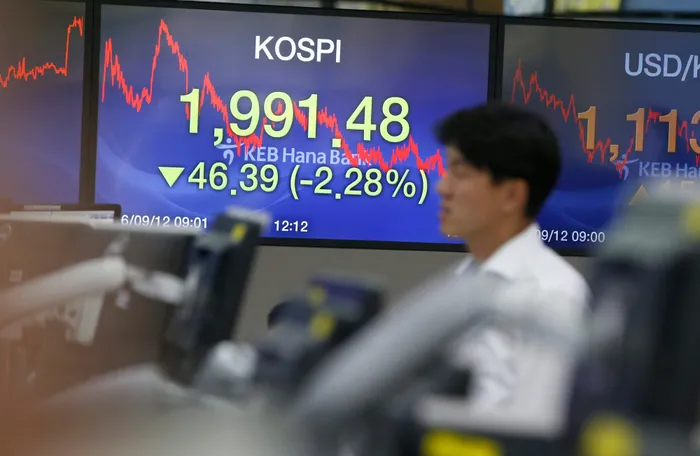
A gauge of emerging market currencies declined on Monday as the dollar surged to a 24-year-high on fears of a global recession, while Sri Lankan bonds dropped to record lows after the country’s president and prime minister offered to resign following violent protests EPA/JEON HEON-KYUN
A gauge of emerging market currencies declined on Monday as the dollar surged to a 24-year-high on fears of a global recession, while Sri Lankan bonds dropped to record lows after the country’s president and prime minister offered to resign following violent protests.
Prolonged instability on the island country may delay progress on negotiations with the International Monetary Fund for a bailout package, Sri Lanka’s central bank governor said.
Sovereign dollar bonds issued by Sri Lanka slipped between 1.5 cents and 2.3 cents to hit record lows on Monday. MSCI’s index of emerging market (EM) currencies slipped 0.2 percent as the greenback surged to its strongest levels since late 1998.
“The environment will remain challenging for emerging markets – selling pressure on currencies will not ease and you are likely to see more warning signals that economies are heading for a recession or stagflation,” said Piotr Matys, senior forex analyst at In Touch Capital Markets in London.
Stronger-than-expected US labour market data last week bolstered expectations that the Federal Reserve will deliver another 75-basis-point rate hike later this month, a move that could worsen the outlook for battered emerging market assets.
Turkey’s lira slipped 0.4 percent after ratings agency Fitch downgraded the its debt rating to “B” from “B+” on Friday, citing rising inflation and economic concerns.
Mexico’s peso also suffered, skidding 0.4 percent, after Moody’s on Friday cut the Latin American country’s credit rating by one notch on weak investment prospects.
Weakness in shares of China’s tech giants and a resurgence in domestic Covid-19 cases pressured regional stocks, with the CSI300 and Hang Seng indices losing between 1.7 percent and 2.7 percent. Emerging market stocks were down 1.4 percent.
Eastern and Central European currencies also extended declines, with the Hungarian forint weakening to 408.31 to the euro, despite recent interest rate hikes. Worries about an an energy supply crunch heightened as Nord Stream I – the biggest single pipeline carrying Russian gas to Germany – started annual maintenance yesterday.
REUTERS