

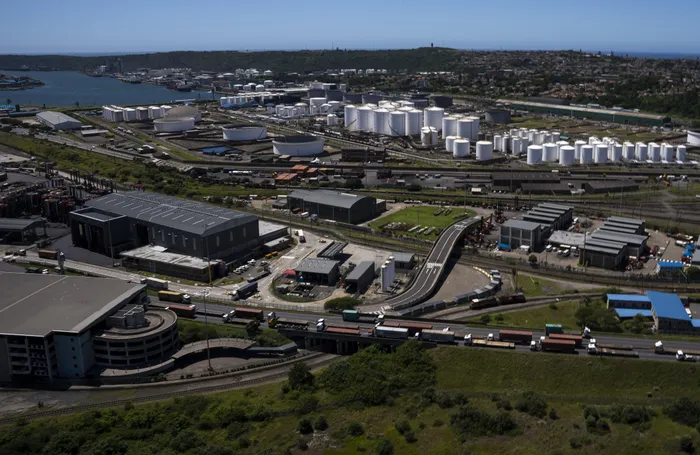
Aerial view of Bayhead Road at the Port of Durban. The move follows extensive engagement between government entities, oil majors, and black industrialists after concerns were raised about the impact of a Section 79 directive, which proposes the renewal of 25-year leases at Transnet’s Island View Precinct (IVP) in the Port of Durban versus the Section 56 determination that allows for an open tender process.
Image: Transnet National Ports Authority
Oil major companies operating in South Africa will be compelled to give transformation partners greater access to key fuel infrastructure through a new Third-Party Access Framework being developed by Transnet National Ports Authority (TNPA).
The framework will set clear rules for how third-parties can access strategic fuel facilities, how capacity is allocated, and the processes governing monitoring, dispute resolution, compliance, and enforcement.
The move follows extensive engagement between government entities, oil majors, and black industrialists after concerns were raised about the impact of a Section 79 directive, which proposes the renewal of 25-year leases at Transnet’s Island View Precinct (IVP) in the Port of Durban versus the Section 56 determination that allows for an open tender process.
The directive from the Minister of Transport has elicited concerns from several industry stakeholders.
Black traders with technical capacity and balance sheet strength to enter the market have warned that automatic lease renewals could entrench the dominance of foreign-owned oil companies and restrict access to critical storage infrastructure.
They argue that this would undermine efforts to diversify ownership and management in the petroleum sector.
Announcing the changes in Parliament, Transport Minister Barbara Creecy said an independent third-party aggregator will be established to manage access, rejecting earlier suggestions that the Central Energy Fund (CEF), which holds a 15% stake in IVP, should play that role.
"First of all, we had indicated that it will be necessary to proceed with ownership empowerment with regard to the oil majors. Most of these companies at the moment are at Level 4, and the intention is that during the period of the lease they would need to move to at least Level 1 or Level 2," Creecy said.
"So what we're saying is that in terms of the leases, all designated terminal operators must disclose and publish uncommitted capacity and provide access to third-parties in compliance with the Petroleum Pipelines Act and reserve specific capacity for new market entrance."
Creecy said all designated terminal operators will be required to disclose and publish uncommitted capacity, reserve capacity for new entrants, and grant access to third parties in compliance with the Petroleum Pipelines Act.
Under the new mechanism, operators must submit capacity allocation models to both the National Energy Regulator of South Africa (Nersa) and TNPA. These must include criteria for allocating uncommitted capacity, tariff schedules, technical requirements, priority rules, and a strict "use-it-or-lose-it" policy.
"And the mechanism includes criteria for allocating reserve uncommitted capacity, tariff schedule, technical requirements, priority rules, a use it or lose it policy, non-discrimination and transparency assurances," she said.
"Now what we would want to ensure, because we want to make sure that there is no hoarding of excess capacity, we would want to establish a use it or lose it rule."
She said the TNPA can claim underutilised capacity from a particular third party user or operator and then allocate it to others who have vessels ready to berth.
To prevent discrimination, she said, allocation decisions must be transparent, fair, and explicitly supportive of new market entrants.
She said for third party access procedures, there needs to be publication of available capacity and TNPA will maintain a terminal capacity registry and publish monthly bulletins on an online portal.
TNPA will maintain a terminal capacity registry and publish monthly bulletins through an online portal. Interested third parties will need to submit formal applications including corporate details, licensing documents, proof of financial capacity, and technical information.
Applications will be evaluated through a transparent queuing system on a first-come, first-served basis where demand exceeds supply.
Approvals will require sign-off by both TNPA and Nersa before execution, followed by ongoing monitoring and reporting requirements.
Oil majors sought to reassure Parliament that they remain committed to domestic investment and sector transformation.
Bidvest Tank Terminals (BTT) committed R1.4 billion as part of negotiations for its new Terminal Operator Agreement. It said its members are committed to investing in infrastructure and promoting transformation and will provide further details of the individual contributions as part of their separate presentations
"As a broad indication, our members who are beneficiaries under the s79 direction have R60bn in planned investment linked to IVP operations which will enhance operations and improve security of supply of products," BTT said.
Vopak told Parliament it has invested more than R6bn over the past decade in expanding storage capacity to support supply security and accommodate new entrants. It is also developing its Jet Project, currently in front-end engineering design, with anticipated capital expenditure of roughly R1bn.
"This project is subject to the concluding of the new TNPA lease. The 25-year lease extension provides the certainty needed for future major investments in infrastructure modernisation, safety, and efficiency as well as for recoupment of historical investments made by Vopak," the group said.
BUSINESS REPORT